Surprised by Rhino

rhinoSeveral weeks ago, my family watched Bolt on DVD. While titled after the movie’s main character, it seemed the movie was created to showcase Rhino the hamster. If my family’s outbursts of laughter are any measurement, Rhino virtually stole every scene.

***** Spoiler Alert begins! *****

But one scene caught me totally off guard. At the movie’s climax, Penny, Bolt’s owner, is trapped in a movie studio that is engulfed in flames. Bolt the dog, Mittens the cat and Rhino the hamster rush toward an entrance to the movie studio. Mittens asks, “What should we do?” Bolt responds, “Just make sure I get in there.” Surprisingly, Rhino speeds through the door in his hamster ball and uses his plastic ball to bear the weight of the building’s collapsing metal frame while Bolt shoots past to find Penny. As his plastic ball begins to splinter under the weight, Rhino cries out, “It’s a good day to die!” And in the following seconds of that scene, you realize that he was actually willing to die so that Bolt could go on to save Penny.

***** Spoiler Alert ends (maybe) *****

As the movie’s action continued, my eyes welled with tears and my mind lingered on that scene. Okay, okay, I know it was a cartoon. But there was something poignantly relevant in that moment that needs to be unpacked. Throughout the movie, Rhino gives himself wholeheartedly to the adventure. And at the most crucial moment, when the other side character wonders how to respond, Rhino instinctively and naturally acts. At the instant when everything counts, he automatically does what’s needed. He responds with what the ancient fathers called “virtue.” His courage and self-sacrifice had become second-nature, so embedded in his flesh and bones that he throws himself into certain death on behalf of his friends without even hesitating to think about it. His body and mind operate as a single self-sacrificing unit, “It’s a good day to die!”

Rhino’s character reminds me of something St Paul says in Colossians. He says that he and his compatriots are praying for the Christians in Colossae so that they may lead lives worthy of the Lord, fully pleasing to him, bearing fruit in every good work and growing in the knowledge of God. Lives worthy of the Lord, in which goodness and knowledge of God are second nature and embedded in flesh and bone so as to be ready to act instinctively in the moment.

So, what does a life worthy of the Lord look like? If the self-help titles available at the local bookstore are any indication, such a life would be success in all areas of living. But is Jesus’ life, ministry, death, resurrection and glorification all about my success in relationships, money and business? I don’t think so. In fact, and this might sound sacrilegious, I don’t think Jesus cares a whole lot about my success. There are much more important things, such as my salvation.

So, if Scripture and the Church’s teaching are the final assessment of a life worthy of the Lord, then such a life should personify sacrifice — instinctive readiness to give myself for the good of others. A life worthy of the Lord is a cruciform life, a life in which every thought, feeling, and action is shaped by Christ’s cross.

In the movie, Rhino yearns to have Bolt’s signature lightning bolt branded upon his fur. Perhaps I need to yearn more for Christ’s cross branded upon my heart.
Word-Chef

I enjoy writing. Yet, this hasn’t always been the case. I hated writing as a kid. Up through high school, I was a “math geek” and would take equations over essays any time.

My attitude toward writing began evolving sometime in college, after I had changed my major from Information and Computer Science to Pre-Ministry. By the time I graduated from college, I was enjoying the craft more.

Although I’ve enjoyed writing for a couple of decades now, my appreciation for the craft has continued to transform. Upon graduating from college and entering the full-time pastorate, I was filled with youthful zeal and arrogance. I believed writing would be my key to success and notoriety. I dreamed of writing the next book that would unlock spiritual mysteries and capture the hearts of American Christians.

As I matured in my ministry a little, writing became more utilitarian. Words were the tools for teaching, inspiring and leading. I studied great communicators and their techniques in order to become more successful in my own attempts to impart ecclesiastical vision and theological instruction.

Several years ago, writing shifted into a more reflective craft. I was enamored with the idea of wordsmithing. There was something romantic in the vision of a master wordsmith, a skilled artisan of prose who could sense the grain and texture of words and intuitively assemble them into a masterpiece.

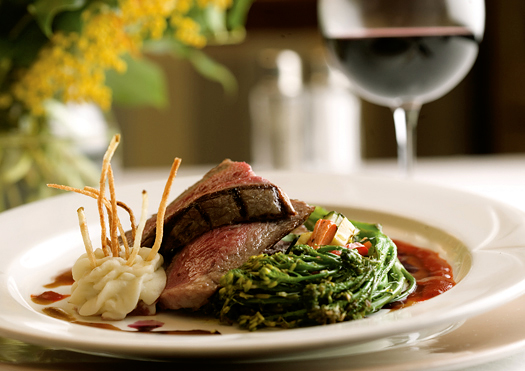
Fine DiningThe other day I was thinking about writing and I thought about a new image for a writer — a word-chef. For me, this concept captures the mastery and innovation of a wordsmith, but adds a relational dimension. Like a smith, a chef must also be skilled in his or her craft. She must master tastes, textures and temperatures and know how to combine and present them in artistic and palatable ways. This generates layers of complexity since her creation must play upon all of the senses. Yet, ultimately, a chef’s craft is for another person. As much as she loves creating in her medium, her final product is to be consumed and enjoyed by another. Another will admire the blending of colors, inhale the enticing aromas, detect the subtle textures, and have their palate caressed by the flavors.

That’s the direction I want to progress in my writing. I want to put voice to the inherent beauty around me in such a way that it impacts all of the senses. I dream of working with savory words that will roll around in another’s mouth and evoke images that allow them to experience the tang or sweetness of the moment.

This desire bore itself deeply into my thoughts the other day as I was finishing a walk around my neighborhood. In the warm light of a setting sun, I saw a young man and woman saying goodbye to each other. They held each other, kissed and parted. As the young man rode off on his bike and the girl walked down the street, I noticed a slight smile light upon her face.

It was a touching moment that no one else would witness and I wanted to frame it with words, to write a few sentences that would express the ardor and pathos of young love. And all I could do in that moment was fumble with my inability as the words remained just beyond my reach.

Moments like this occur frequently. And as providence allows me to observe them, I’m hoping beyond measure that I will learn to recount those moments with words like a verbal chef, fashioning a sumptuous meal filled with aroma and flavor that unleashes the magic of imagination.

Another Surprise!

Back in 2007, Paul Potts stunned the world with his incredible operatic voice on Britain’s Got Talent. The surprise wasn’t his voice, but such a beautiful voice unexpectedly springing from the kind of person everyone assumed Paul was from just his looks.

Well, it’s happened again. This video of Susan Boyle on Britain’s Got Talent, has circulated around the internet and TV, but it’s worth watching repeatedly. It’s a great metaphor of God’s kingdom and an appropriate reminder that authentic beauty can be found in the most unassuming places. I love sneak-attacks by beauty.

If you missed the link above, click HERE to view the YouTube video.

What Day Is It Again?

Because of my long background as a Protestant, I have to admit that there are a lot things about Orthodoxy that I’ve categorized as “strange.” Don’t misunderstand me. It’s all beautiful and filled with incredible meaning and mystery. In fact, I’m sure it’s “strange” to me only because of my context. The more acclimated I become to life in the Orthodox Church, the more natural everything seems. For example, I can no longer imagine a Christian life or worship without icons, incense, chanting, liturgy and a priest, just to name a few aspects.

But I think the one thing that will take much more time to become natural is being out of sync with the rest of my culture in celebrating Easter. The Orthodox Church uses a different calendar in regards to Easter than pretty much the rest of Western Christianity. So rarely does Orthodox Pascha (Easter) fall on the same Sunday as Western Easter. Some years, like this year, the two Easters are a week apart (Orthodox Easter is April 19th while everyone else celebrates Easter on April 12th). Some years, like last year, the two Easters are almost a month apart. Frankly, it’s really weird.

Both my family and Debbie’s family are evangelical Christians. Many of our friends are evangelical Christians. And so, as we approach this weekend, there have been many well-wishes of a “Happy Easter.” I see signs and banners everywhere for Easter services this weekend. My kids have been on Spring break this week. I even get a 1/2 day holiday at work for Good Friday. We’ll probably get together with our families this Sunday, and maybe even have an Easter egg hunt for the kids.

I’m glad Easter is celebrated in our culture. And I’m so thrilled that many people in our lives truly know and celebrate Christ’s resurrection. But it’s so strange delaying our actual celebration while the “rest of the world” prepares for this holiday. As I just mentioned, we’ll join in some of our families’ celebration, but not fully. For what’s Easter’s joy without first journeying through Holy Week?

While Holy Week is climaxing this weekend for those around us, it’s just starting for my family and parish tomorrow with Lazarus Saturday and then moving into Palm Sunday this coming Sunday. Now that I think about it, it’s going to be odd this Sunday morning when our parish processes outside with palm branches the same day all the surrounding churches will be celebrating Easter. And on that same day, my family will move from Palm Sunday and the anticipation of Christ’s death directly into the joy of Easter with our families and then back into the somberness of Holy Week with our parish through the rest of the week.

This weekend is a microcosm of our family’s life as new Orthodox Christians. We always feel just slightly out of sync with the rest of our Christian family members and friends. I’m not complaining, mind you. Debbie and I value the people God has placed in our lives and we have chosen to live closely with them. So that often means coping with quizzical looks when we try to explain why we pray differently, worship differently, eat differently, celebrate strange feasts days, go to confession, use odd words (like Pascha), and say and do a host of other things that are part of our Orthodox life.

Yet I wouldn’t have it any other way. I love Orthodoxy. I love being an Orthodox Christian. Journeying through Lent this year as part of the Orthodox Church has reminded me how much I need the fullness of Christ’s life that is in Holy Orthodoxy. As I’ve alluded in my last several posts, I sense something has “clicked” inside of me. In fact, it’s probably more accurate to say that something that was hindering me “broke” a couple of weeks ago. As I continue settling into Orthodoxy, I’m sensing increasing clarity and stability in my relationship with God, his people and myself. The fears that have whispered to me these last several years are becoming silent, replaced with a growing confidence to move boldly back into life.

Learning to Run Again

One of my favorite photographers is Zeb Andrews. I love looking at his work. What he does with a camera and his imagination is inspiring. He’s written a wonderful post on his website speaking about what makes photography worthwhile. And while his post is photography-specific, I believe the ideas behind it apply to many areas of life. Here’s some of what he has to say:

“Your photography is not limited by your camera, nor your lens.  It is not limited by shutter speeds, aperture, film, focus, flash, white balance, color, black and white, grain, noise, etc.  It is not limited by your budget nor your education.  It is not, and I repeat, not, limited by light.  It is certainly not limited by where you live or where you go.  Your photography is limited simply and quite importantly, only by your own imagination and vision.  All those factors I mentioned (and more) can certainly affect your photography, but ultimately you make of it what you will.  Photography begins and ends with the photographer, the best light in the world, or most advanced metering system will not change that…

“What matters most happens before the picture is even taken, not after.  The worth of your photography is in what gets you up at 4 am in the morning to brave freezing conditions in hopes of a sunrise.  It is what makes you follow your children around all day long patiently snapping frame after frame.  It is what causes you to drive for miles, or walk them, in search of that moment, be it in the middle of a sprawling urban landscape or a natural one.  It is significantly in what keeps you picking up that camera as the fractions of seconds become days, the days months, the months pool into years, and beyond.  It is in this desire to see, to experience, to feel, to celebrate, to remember, to be a part of, to be amazed or amused, that you will find what makes your photography worthwhile.  Everything that comes after the snap of the shutter is merely added drama, and it is never as important as you think it is.”

This isn’t the first time something in photography has opened a window into other areas of my life. As I ponder Zeb’s words, I realize that it’s too easy to slip into laziness. Sure I could give it another name and make up excuses, but bottom-line it’s simple laziness. My slothfulness is one of the areas of my life that I’ve become painfully and shamefully aware of during this Lent.

Years ago, I had a fire within me. I had a passion similar to what Zeb describes. I possessed what I believed to be a calling in my life and I pursued that calling with everything within me. I felt like I was a long-distance runner. With almost two decades of practice, I had found my stride as I stretched ever-forward toward my goal.

And then I stumbled. Or was I tripped? Does it even matter any more? All I know is that I hurt. All I could feel was pain and confusion. When before I had run, now I could only walk and limp. I was no longer confident that everything I had been pursuing was worthwhile anymore. And I chose to become lazy, to stop running and to cast off much of the discipline and structure that had helped me to run.

Recently, I’ve come to realize that if I don’t change, I will become the very thing I’ve always dreaded — nominal. I hear St Paul speaking familiar words:

“Do you not know that in a race all the runners run, but only one gets the prize? Run in such a way as to get the prize.  Everyone who competes in the games goes into strict training. They do it to get a crown that will not last; but we do it to get a crown that will last forever. Therefore I do not run like a man running aimlessly; I do not fight like a man beating the air. No, I beat my body and make it my slave so that after I have preached to others, I myself will not be disqualified for the prize.” — 1Cor 9:24-27

Now mere days away from Holy Week and the hope of Christ’s transfiguring Pascha before me, I hear the cry (ala Forrest Gump), “Run, Jason, run.” I know the destination is much different than before as are the necessary disiplines and training. And I know I will face much soreness as I use atrophied muscles. But I choose to run again.

Repentance

“It is easy indeed to confess that I have not fasted on prescribed days, or missed my prayers, or become angry. It is quite a different thing, however, to realize suddenly that I have defiled and lost my spiritual beauty, that I am far away from my real home, my real life, and that something precious and pure and beautiful has been hopelessly broken in the very texture of my existence.”

Alexander Schmemann, Great Lent

This is the heart of repentance. This is where God’s grace really performs its work during times like Great Lent. Not only do our attitudes, words and actions bob to the surface of my life, but I actually come to grips with the fact that the very waters of my life are turbid and rancid. As Fr Schmemann puts it, I’ve lost my spiritual beauty and something precious, pure and beautiful has been hopelessly broken in the very texture of my existence. I live with this keen awareness during Great Lent. And yet, even this is God’s abundant grace. For it compels my heart to cry out, “Lord, have mercy on me a sinner” and to strain toward the renewed life and creation of Pascha.

Developing Proper Habits

“Our culture prefers effortless spontaneity with occasional divine intervention in emergencies.”

So states NT Wright in a recent lecture on Christian virtue called, “Learning the Language of Life.” That one sentence describes most of my early Christian formation, so I feel like I’ve been playing “catch-up” the last decade as a Christian.

One of the reasons why I love Lent is that it exposes my bad habits that interfere with my development into Christ’s likeness — my laziness, gluttony, pride, lust, depression, anger, and greed. And those are just the ones I’m aware of. Sheesh. Most of the time, these things remain hidden in the murky shadows of my heart. But during times like Lent, and especially during Lent, I become aware of this foulness within me.

But to use a sports metaphor, the pain of having these areas exposed is like the soreness I feel when I increase my exercise regimen. The tearing down of my physical muscles is required for the rebuilding of newer, stronger muscles.

It’s similar in the spiritual life. As Wright also states in his lecture, “Everything we do is habit-forming.” Unfortunately, I’ve developed a lot of bad habits. They need to be torn down in order for new ones to be developed. And every year, Lent plays an important role in this ongoing process.

But you may ask, “What about grace?” And the simple answer is that the entire process is grace. By grace, God saw the world’s plight and acted. By grace, God forgives. By grace, God summons us to him. By grace, God immerses us into his Church. By grace, God fills us with his Spirit. By grace, God calls us to participate with him in ours and the world’s continuing renewal.

God’s grace and my effort go hand-in-hand. Not equally, mind you. God’s grace far surpasses any effort I exert. But my exertion and concentration are necessary. It’s how my will, mind, body and emotions actually get face-time with God’s grace. And one day, the proper habits that require so much effort now, will become second nature. They will require less exertion and less concentration as they become deeply embodied within who I am. As that happens, I will be increasingly prepared to live in God’s renewed world, not just in the future, but even here in the present.

The Human Vocation

I’ve been rereading parts of Bishop Kallistos Ware’s The Orthodox Way, specifically the chapter entitled “God as Creator.”

There are some ideas and quotes in this chapter that keep pinging around in my head. Ware states that God has formed two levels of created things: the “noetic” or “spiritual” level and the “material” or “bodily” level. He then states, “Man, and man alone, exists on both levels at once.” This is fascinating to me. In all of God’s vast creation, humanity alone is created to exist and interact on both levels of creation.

Ware then states that by being designed to participate on both levels of creation, humanity is a microcosm of the entirety of creation. And as such, humanity is also the mediator of creation:

“It is his [humanity’s] God-given task to reconcile and harmonize the noetic and the material realms, to bring them to unity, to spiritualize the material, and to render manifest all the latent capacities of the created order… As microcosm, then, man is the one in whom the world is summed up; as mediator, he is the one through whom the world is offered back to God.”

I love what this implies. At the ontological level, humanity is created uniquely to live and play simultaneously on both dimensions of creation. At the operational level, humanity’s vocation is, in Ware’s words, “to manifest the spiritual in and through the material.”

I am designed to manifest the spiritual in and through all of the details and activities of my material life. Talk about “fear and trembling!” How I talk, relate, work, think, eat, drive, pray, write, listen, play, rest, and much more are to be ways in which I manifest the spiritual in and through the material. That means I must learn to live every part of my life beyond the material or bodily level of my existence — beyond passions, reason, and even will.

But wait there’s more! Not only are humans designed to be miniature creations, the places where the two dimensions of creation — heaven and earth — come together and are offered back to God, but we are also made in God’s image. Ware states, “Man is the finite expression of God’s infinite self-expression.” My life is to reflect the life and character of God.

In other words, we are not only the image and expression of creation to God, we are also the image and expression of God to creation.

There is so much that can and should be said beyond the scope of this simple post. However, my intention was to refocus my own vision back onto what human life and vocation are all about.

I’m ashamed to admit that I’m easily distracted. I too easily let busyness, worries, fears, desires and other “bright and shiny things” distract me. So I’m hoping that during this Great Lent, my Lord takes me a couple of small steps closer to realizing my vocation in his kingdom. My life is to be both the image of creation and the the image of God. My life is to be the place where heaven and earth are stitched back together. My vocation is to participate in Christ’s ultimate vocation of bringing together and reconciling all things in heaven and earth (Eph 1:10 & Col 1:19-20). And my life is to be his life, the very life of Christ surging and spilling out of me like rivers of living water (Gal 2:20 & John 7:38).

New Photoblog

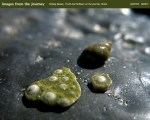
images-from-the-journey

I love looking at good photography. Images can communicate in ways that words cannot. A few years ago I bought a Canon PowerShot A620 with the intention of developing basic skills in digital photography. I admit that I’m not great, but I’ve had a lot of fun taking pictures. Recently, I was gifted with a Nikon D40x. The move from a point-and-shoot to a DSLR is very exciting for me and has injected me with a lot of enthusiasm to take my basic skills to the next level.

So… in anticipation of the photos I’ll be taking, I’ve started a simple photoblog. I’ve already posted  a couple of images that I took over the last couple of years on my PowerShot. I’ll probably be posting several more of these older shots during this time that I learn to use my Nikon as well as learn to use Pixelmator and Capture NX2.

Fr Stephen & “Kalomiros on the Orthodox Life”

Fr Stephen has posted a wonderful excerpt from Dr. Kalomiros’ book, Nostalgia for Paradise. These thoughts on the Orthodox life are so balanced and come to me at such an appropriate time. Just a couple of nights ago, Debbie and I were talking about my self-imposed spiritual disciplines as a Protestant. And just the other day, Fr Patrick was reminding me of our family’s need to spend time learning a new rhythm of being Orthodox.

Now I read Dr. Kalomiro’s words and quite frankly, I just want to cry. I want to cry out of repentance for the pride and hardness created by imposing practices upon myself that were beyond the measure of grace given to me. I want to cry out of joy for the beautiful vision of what a true human life in Christ looks like. And I want to cry out of thankfulness for now being a member of a Church that can actually nurture me with wisdom into the life in Christ for which I have longed. 

There is so much in this short excerpt that grips me. If I were to cut and paste good quotes, I would need to simply paste the entire excerpt. But this one paragraph is the clincher for me. I dream of living this kind of life:

“It is a modest soul that is out of its waters in the limelight of men but blooms in solitude and quiet. It is a heart free to its very roots, impervious to every kind of pressure, far from every kind of stench, untouched by any kind of chains. It distinguishes truth from falsehood with a certain mystic sense. Its every breath offers gratitude for all of God’s works that surround it and for every joy and every affliction, for every possession, and for every privation as well. Crouching humbly on the Cornerstone which is Christ, it drinks unceasingly of the eternal water of Paradise and utters the Name of Him who was and is ever merciful. Such a soul is like a shady tree by the running waters of the Church, with deep roots and a high crown where kindred souls find comfort and refuge in its dense branches.”

Fr Stephen & “It Is But a Small Thing”

Fr Stephen posts a great reminder of how the small thoughts, attitudes and actions in our daily lives are so important. When I was a younger man, my goal was to do great things for God. I dreamt of leaving a magnificent legacy that would far outlive my earthly life. My sight was always straining toward the horizon, waiting for that moment when I would do something big for God.

Now I’m a bit older and hopefully a bit wiser. And with some age, my goals have changed. I strive to be a good husband, a good father, a good friend and hopefully a good man. And this is lived out not by great momentous deeds, but by the many small, insignificant moments in my life. An encouraging smile. An attentive ear. A compassionate hand. And as my gaze shifts from the horizon to the present moment, I can better see what Fr Stephen describes in his closing thought:

“This is the day of salvation. It may come in a thousand discreet moments, every one of which is alive with the fire of God.”

May I learn more and more to be warmed and ignited by the fire within these moments.

Fr Gregory’s Reflection on the Walmart Tragedy

I’m sure everyone who has heard about death of the Walmart employee on Friday morning is sickened by what happened. I had originally decided not to blog about it because, while I had some thoughts forming, I felt I had nothing substantial to offer but my own sadness and revulsion at what happened.

This morning, Fr Gregory posted a thoughtful reflection on that event that I believe is worth reading. We simply can’t shake our heads at this tragedy as if we’re innocent and then go on with our consumerist lives as usual. Sure, we can tell ourselves that we would never have participated in such an atrocity. But we all participate in the same spirit of the age that caused Friday’s event. That’s why Fr Gregory’s call to both contemplation and action must be heard, especially during the Nativity season. For it is this very darkness and death that resides in all of us that Christ came to conquer.

Met. Kallistos Ware & “The Cosmic Christ”

Fr Stephen posts a meditation offered by Met. Kallistos Ware. You can read the entire post HERE. The quote below contains the final thoughts of that meditation:

“Do we reflect sufficiently, I wonder, upon the environmental implications of our Lord’s Incarnation, upon the way in which Jesus is ecologically inclusive, embedded in the soil like us, containing within His humanity what has been termed ‘the whole evolving earth story’?

“Do we allow properly for the fact that our Savior came to redeem, not only the human race, but the fullness of creation? Do we keep constantly in mind that we are not saved from but with the world?

“Such, then, is our Orthodox vision of creation; such is our vocation as priests of the created order; such is our Christian reponse to the ecological crisis. Such is the deeper meaning implicit in the words that we say daily at the beginning of Vespers: ‘Bless the Lord, O my soul’.”

I love the thought of Jesus being “ecologically inclusive, embedded in the soil like us.” I am so thrilled that Orthodoxy has such a vibrant understanding of Creation. The Church’s understanding of Christ’s Incarnation provides the ultimate framework for a sound theology of and ministry toward Creation.

In fact, since 1989, much of the Orthodox Church observes September 1, the first day of the Church’s liturgical year, as the Feast of Creation. In a paper called, “Orthodox Liturgy and the Care for Creation,” Bishop Irineu offers the following thought:

“The vocation of humanity, as shown in liturgical theology, is not to dominate and exploit nature, but to transfigure and hallow it. In a variety of ways – through the cultivation of the earth, through craftsmanship, through the writing of books and the painting of icons – humanity gives material things a voice and renders the creation articulate in praise of God.”

Christ’s Incarnation fulfills humanity’s divine mandate in Genesis to be the stewards and caretakers of Creation. He is the ultimate steward of Creation, rescuing both his eternal family of co-stewards and Creation itself from the clutches of brokenness, sin and death. Jesus tramples down death and offers his life, which enables us to embrace our true vocation as Creation’s cultivators and craftsmen that gives it a voice of praise to God.

Visit to Oak Glen

This past weekend, Debbie attended a Women’s Retreat in Santa Barbara. David called me up and asked if I wanted to take the kids out to Oak Glen with him. We agreed and am I’m glad we did! The weather was beautiful and we had a fun time. Click HERE to view pictures in my MobileMe Gallery.

And if you want to see the kids making Apple Cider, click HERE.

Saying “Good-bye” and “Hello”

Since tomorrow is a holiday (Veteran’s Day), I decided to take today as a vacation day and thus extend my weekend. This afternoon both closed a chapter in my life and revisited another.

logo-1About five years ago, upon leaving full-time pastoral ministry, a few of us in our newly-founded faith-community decided to start a wedding video business called inFocus Video Productions. This endeavor was to provide supplemental income for us as well as to provide a way to incarnate Christ’s presence through our lives and skills. Earlier this year, we decided to close our business. We filmed our last wedding in late October and officially closed our virtual doors early this month. Today, I cleaned and packed all of my video equipment to sell on Ebay. While being a wedding videographer was physically demanding and took me away from my family on many Saturdays, I enjoyed the last five years. I got to work closely with two of my best friends, hone my creative skills, and quietly serve and pray for the various couples on their wedding day. Now, as I type this, there is a vacant spot in a small corner of my bedroom where I stored my video equipment. I’m glad we decided to close our business, but today I’m also a bit sad that it’s over.

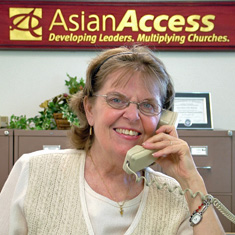
hale-spAfter packing my video equipment into my car, I drove to the Asian Access offices where I worked for three years after leaving professional ministry. Today, the office staff celebrated 25 years of wonderful service of the office receptionist, Ellen Hale. Ellen is an incredible person and is literally the voice of Asian Access as she answers the office phones. She has impacted hundreds, if not thousands, of people by incarnating Jesus’ life through her joy, her gentle disposition and her faithful prayer. I am so glad I was able to celebrate this great milestone with her. I was moved as I watched a video of Asian Access missionaries personally thank Ellen for her impact in their lives and ministry. This past year, I have missed my Asian Access friends. This afternoon was a nice time visiting with them as well as meeting Dana, who replaced me as the Staff Accountant, Joe, Silk and Margaret.

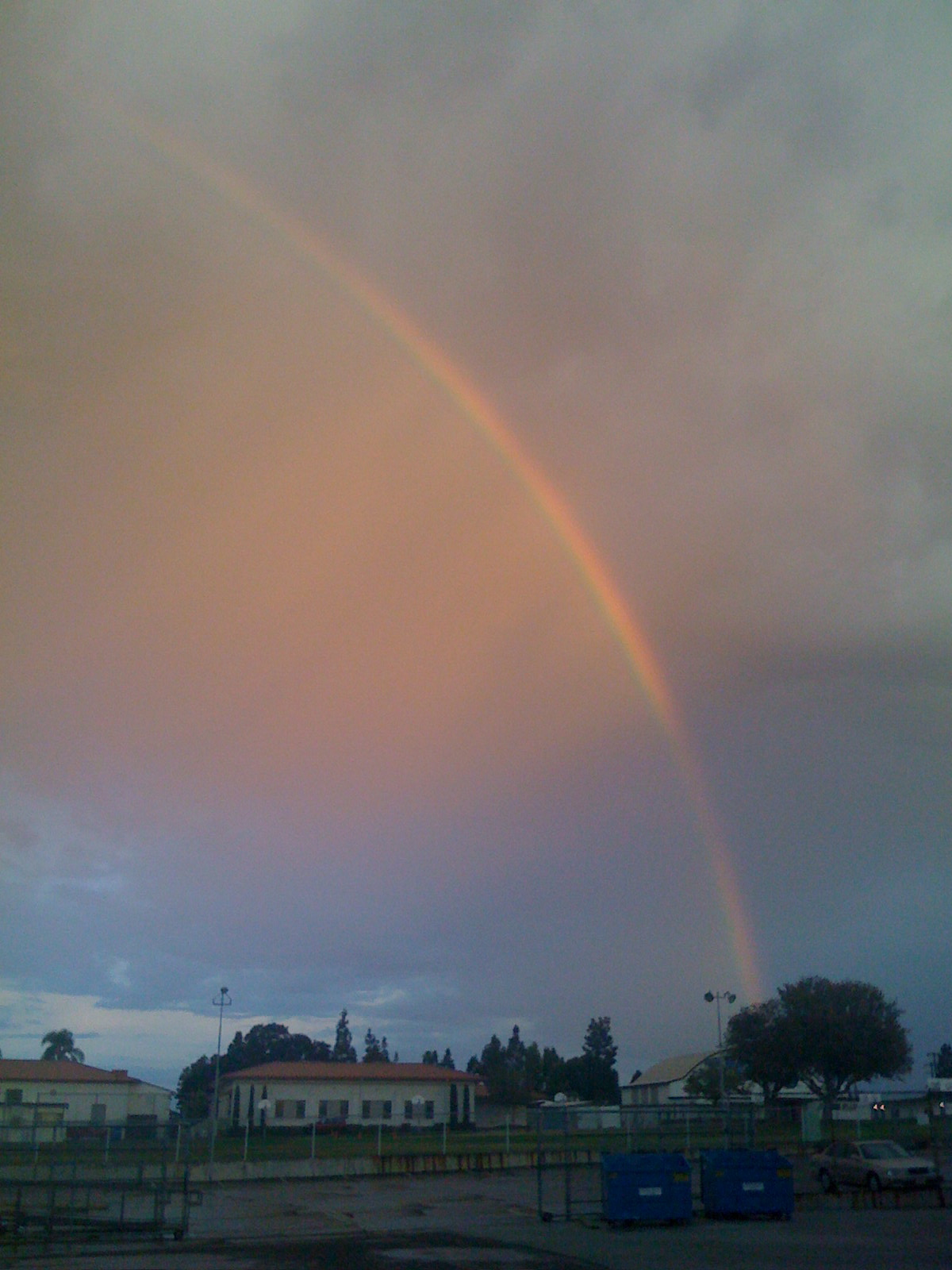
Rainbow at Work

My co-worker told me to come outside when she arrived at the office. This is what I saw:

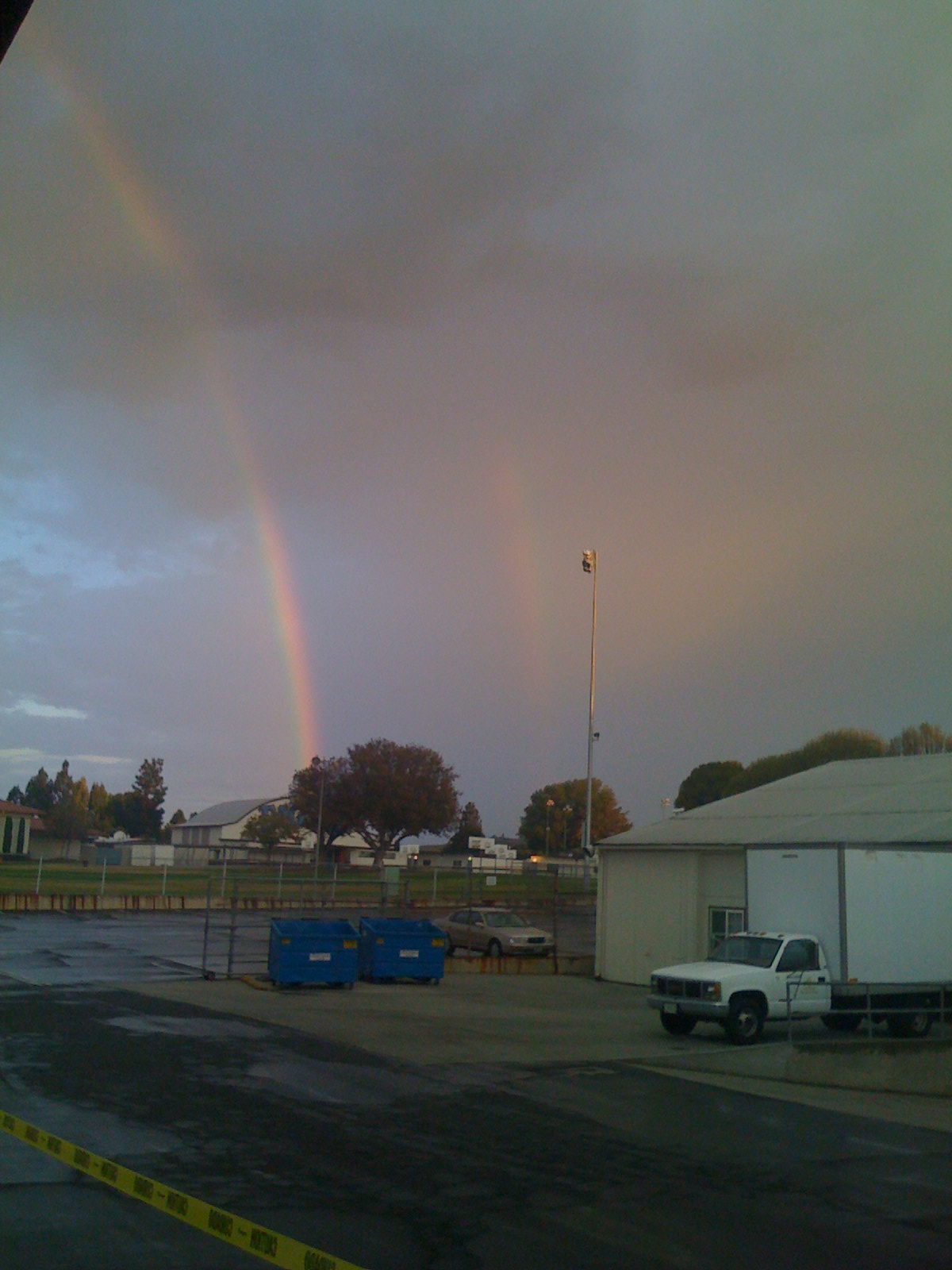
A few minutes later, it turned into a double rainbow.

Perhaps today will be a pot-of-gold kind of day!

Aaahhh… Summer!

Debbie’s already posted a couple of times about how summer is progressing for our family. (You can read them HERE and HERE.) I am so glad that she gets a few weeks off this summer. She’s worked so hard non-stop for the last few years. I know she has missed spending leisurely time with our kids. And I know they have missed it with her as well.

I am also enjoying the slower pace. I feel that as I age, my body quickly acclimates to a more relaxing schedule than when I was younger. Yesterday was a good example. I got home from work about 4:30 pm. Debbie and the kids were swimming at their cousins’ home, so I exercised and went for a nice walk. Later, I took Debbie out for Garden Burgers at one of the family-owned restaurants in Glendora. We’ve gotten to know the owner’s wife, who is Greek Orthodox. So while waiting for our burgers, we had a nice conversation with her about fasting (we’re currently in the Apostle’s Fast) and how to help our kids learn the spiritual importance about fasting. During dinner, Debbie and I had a nice relaxing conversation. After we arrived home from dinner, I went out to water the grass in front of our apartment complex. For some reason, the sprinklers haven’t been turning on, so the grass and bushes are like crispy bacon without the cool bacon aroma. So I spent a nice time in the cool evening, watering the lawn and listening to John Grisham’s Playing for Pizza. Then later, Debbie, Michael and I watched a good cowboy movie called Crossfire Trail, which is based off of a Louis L’amour novel.

No stress. No rush. No scurrying to finish homework or scrambling to get to a meeting.

And as I thought about the slower rhythm of summer, it reminded me that we’re also experiencing a slower rhythm at Church. The Paschal season ended on Pentecost a couple of weeks ago. And as wonderful as Lent, Holy Week and Pascha were, I am enjoying the slower rhythm of the Church. It’s as if the Church is making room for all of us to take the victory and beauty of Pascha and to live it out in the world personally — in our normal rhythms of prayer, fasting, family, friends, work, and play. For me, this is what being a Christ-follower is all about — learning to grow into and embody Jesus’ fullness in real life, to become by grace what Christ is by nature. That’s salvation. That’s mission. That’s life. It really is that simple because Jesus is my salvation, my mission and my life. And being in a Church where this is just normal life for everyone is absolutely awesome!

So, I feel like I’m walking through life more thoughtful and contemplative right now. And while there are things I’d like to write about, even feel compelled to write about at times, to do so without restraint would risk engaging in a flurry that is alien to what is best for this moment and season.

 Subscribe through Feedburner