Icon of St. Nectarios

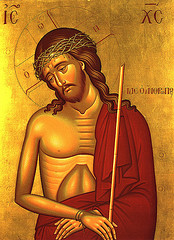
Debbie took three of our kids to Matins this morning at St. Peter’s. When they returned home, my oldest son gifted me with a small icon of St. Nectarios that he bought for me. St. Nectarios was a very humble and pious man who, among other things, loved God’s Word, prayer, and graciously endured false slander. He is such a beautiful example of a Christ-filled life, one that I hope I may emulate.

I’m hoping to address the issue of saints and icons in a future post, but I want to say now that one of the ways I feel the Orthodox Church offers the fullness of the Gospel is through the commemoration of the saints. God is alive and truly wonderful through his saints.

Below is a synopsis of his life from AbbaMoses.com:

“Saint Nectarius was born in Selyvria of Thrace on October 11, 1846. After putting himself through school in Constantinople with much hard labour, he became a monk on Chios in 1876, receiving the monastic name of Lazarus; because of his virtue, a year later he was ordained deacon, receiving the new name of Nectarius. Under the patronage of Patriarch Sophronius of Alexandria, Nectarius went to Athens to study in 1882; completing his theological studies in 1885, he went to Alexandria, where Patriarch Sophronius ordained him priest on March 23, 1886 in the Cathedral of Saint Sabbas, and in August of the same year, in the Church of Saint Nicholas in Cairo, made him Archimandrite. Archimandrite Nectarius showed much zeal both for preaching the word of God, and for the beauty of God’s house. He greatly beautified the Church of Saint Nicholas in Cairo, and years later, when Nectarius was in Athens, Saint Nicholas appeared to him in a dream, embracing him and telling him he was going to exalt him very high.

“On January 15, 1889, in the same Church of Saint Nicholas, Nectarius was consecrated Metropolitan of Pentapolis in eastern Libya, which was under the jurisdiction of Alexandria. Although Nectarius’ swift ascent through the degrees of ecclesiastical office did not affect his modesty and childlike innocence, it aroused the envy of lesser men, who convinced the elderly Sophronius that Nectarius had it in his heart to become Patriarch. Since the people loved Nectarius, the Patriarch was troubled by the slanders. On May 3, 1890, Sophronius relieved Metropolitan Nectarius of his duties; in July of the same year, he commanded Nectarius to leave Egypt.

“Without seeking to avenge or even to defend himself, the innocent Metropolitan left for Athens, where he found that accusations of immorality had arrived before him. Because his good name had been soiled, he was unable to find a position worthy of a bishop, and in February of 1891 accepted the position of provincial preacher in Euboia; then, in 1894, he was appointed dean of the Rizarios Ecclesiastical School in Athens. Through his eloquent sermons, his unwearying labours to educate fitting men for the priesthood, his generous almsdeeds despite his own poverty, and the holiness, meekness, and fatherly love that were manifest in him, he became a shining light and a spiritual guide to many. At the request of certain pious women, in 1904 he began the building of his convent of the Holy Trinity on the island of Aegina while yet dean of the Rizarios School; finding later that his presence there was needed, he took up his residence on Aegina in 1908, where he spent the last years of his life, devoting himself to the direction of his convent and to very intense prayer; he was sometimes seen lifted above the ground while rapt in prayer. He became the protector of all Aegina, through his prayers delivering the island from drought, healing the sick, and casting out demons. Here also he endured wicked slanders with singular patience, forgiving his false accusers and not seeking to avenge himself. Although he had already worked wonders in life, an innumerable multitude of miracles have been wrought after his repose in 1920 through his holy relics, which for many years remained incorrupt. There is hardly a malady that has not been cured through his prayers; but Saint Nectarius is especially renowned for his healings of cancer for sufferers in all parts of the world.”


 Subscribe through Feedburner

Journeying Home (1) — From Evangelical to Emerging Church

As I mentioned in an earlier post, I’ve always been searching, even when I didn’t have words to express what I was looking for. Meeting Jesus and becoming his apprentice answered the deepest parts of my questing heart. And following God’s calling into professional ministry for over fourteen years provided wonderful opportunities to fulfill that search.

Yet through it all, I have always felt God calling me to journey deeper and to explore his kingdom. So here I am, standing on the threshold of the Eastern Orthodox Church. Ironically, all of my adult education and professional experience have brought me to this place — a place where all of my adult education and professional experience are virtually obsolete and irrelevant. And while that prospect has its own issues to deal with, I have a substantial peace about the next steps. Simply put, I believe God has journeyed with me and shaped me so that I could be right here.

When I first committed to following Jesus, I told him I would go wherever he led me. And if that means following him into a place where everything I’ve learned and worked for must be laid aside, then it is a very simple price to pay in order to journey with him further into his life and likeness.

So how did I get here? 

As an associate pastor in a small Vineyard church, I had fully embraced the business model of running a church. Inspired by men like John Maxwell, Rick Warren and Bill Hybels, I strained to create an efficient and effective Christian organization. I spent most of my waking hours trying to design and implement systems for assimilating, training, mobilizing, and reaching people, especially leaders. And on a personal level, I was doing everything I counseled others to do in order to grow as Christians — Sunday worship attendance, small group attendance, tithing, evangelism, daily quiet time, teaching Sunday school, reading the Bible in a year, serving in ministries, praying for people, practicing spiritual gifts and more. 

And yet, something was terribly wrong. I was always stressed, frustrated, and angry. I was consuming caffeine non-stop and taking Tylenol like candy for my constant headaches. The worst thing was how I had learned to create a happy “ministry” exterior to cover up this internal mess. I could be smiling and joking with someone that I was fuming over and he would never know it.

And then I crashed. I had a burnout crisis that is still very vivid in my memory after all of these years. The despair and self-loathing I felt at that moment still haunts me.

I crawled away from that moment completely broken. I could do only one thing — cling to Jesus. I spent most mornings in a local coffee shop just resting in Jesus’ presence. I listened to worship music, prayed, read Scripture and journaled. But these were no longer activities I did to grow as a Christian. They became communion with Jesus. I quickly became aware that I had spent years amassing Bible knowledge, developing organizational skills, and engaging in Christian activities with very little, if any, inward transformation into Christ’s likeness.

I learned painfully that the system one uses is designed to produce the results one experiences. In other words, my broken inner life was the direct result of how I lived my life as a Christian and a pastor. It was because of how I lived my life, not despite it, that I was in such a mess. My theology and my practices were broken. And simply trying to “do better” or “try harder” would ultimately create the same results.

So my focus changed to following Jesus into his likeness and allowing his ministry to be the natural outflow of his character and life within me. I would still do my job as a pastor, but everything began changing. My theology began changing as I realized that virtually every aspect — christology, bibliology, soteriology, eschatology, missiology, cosmology — was distorted and therefore contributed to my ill health. This in turn changed my teaching and preaching. And it changed how I worked as a pastor. I could still do my job, but how I did it and why I did it had changed. Over time I began to sense health.

And over time I began to sense something else.

I was becoming a square peg trying to fit into a round hole. I was no longer fitting in the church I helped build and pastor. The lasting changes I was experiencing on a personal level and trying to realize on a corporate level would require a hugely different church paradigm in order to see them reproduced within the congregation’s life. In the end, I probably created more disruption than was necessary.

Through a series of circumstances, God orchestrated my departure for the sake of my health as well as the church’s. Mark, who was also on staff with me at the Vineyard, left as well. We, and a few families close to us, received the leadership’s blessing to go and try to develop something new, a missional community.

To be continued…

 Subscribe through Feedburner

David Feliciano and “Orthodoxy Is For Everyone”

My friend, David, who has been very instrumental in my family’s progress into Orthodoxy, has a post worth reading called, “Orthodoxy Is For Everyone.”

I was with him during the time he initially began exploring Orthodoxy and I had the privilege of attending his and Nicole’s Chrismation service. At the time, I believed I was following God’s calling as an evangelical pastor, so I wasn’t really offended by David’s conversion. I believed that he had his calling and I had mine. Sure he may have believed that he was entering into the fullest expression of the Church and Faith. But I had the surety of my calling. What I didn’t realize then, but do realize now, is that I needed to take a few more turns in my own journey with Jesus to prepare me to enter Orthodoxy. Somehow, Jesus used my obedience to my sense of calling to prepare for where I am today.

And while I haven’t been received into the Orthodox Church yet, I want to echo David’s words:

“My own experiences and beliefs about this living and ancient faith/tradition is that it IS for everybody. It is only foreign in the sense that it is radically Christian and holy, and I believe that it truly is the fullness of the gospel (i.e., the fullness of Jesus’ message and tradition).”

Oh, and Thank You, David, for embodying this radical Christianity and helping us to enter this wonderful Faith.

 Subscribe through Feedburner

Another Thought About Interpretation…

After my last post on Fr Stephen’s post, “An Orthodox Hermeneutic,” I had another thought regarding my pride and biblical interpretation. When I examine Orthodox interpretation of Scripture, not only must I hold my personal biblical interpretations in light of 2000 years of Living Tradition, but I must also hold it in light of Orthodoxy’s 2000-year ability to maintain the true Gospel.

As an evangelical Protestant and then in the last several years of association with the Emerging Church, we talked non-stop about recovering and redefining the Gospel. For various reasons offered by really smart people, it is clear that the Gospel in western Christianity has become overly-simplified, distorted or completely replaced with something else.

This isn’t true of Orthodoxy. I’ve noticed it in my reading of Orthodox theology and have now experienced it firsthand, especially during Lent and Holy Week. And these services, with their liturgy and prayers, are centuries old. They have been faithfully and unwaveringly helping Jesus’ followers enter and live in the Gospel for hundreds and hundreds of years. As much as I enjoy my theological musing and study, I cannot make that claim about my biblical interpretations. So when my doctrines rub up against Orthodox doctrines, I must learn to comply humbly.

 Subscribe through Feedburner

Fr Stephen Freeman & “An Orthodox Hermeneutic”

Christ is risen!

Fr Stephen has written a post worth reading called, “An Orthodox Hermeneutic.” In my short and limited experience with Orthodoxy, I have to admit that a lot of what he says makes sense. Personally, I no longer adhere to Sola Scriptura since it strips Scriptures out of the very context that created them and gives them meaning — the Church and its Living Tradition. In addition both modern biblical scholarship and the teaching from the pulpit are examples of what happens when Sola Scriptura runs its course — every person has an interpretation of Scripture.

Yet, at a deep level, I also struggle with some of what Fr Stephen says. I have my own pet biblical interpretations and some of them are not embraced by the Orthodox Church. In those moments, I have to ask myself, “Can I honestly hold up the interpretative conclusions that I have reached from my limited study before 2000 years of the Church’s Living Tradition and believe that I’m right and they’re wrong?” You see, it boils down to pride rather that correct interpretation. Here’s a bit from Fr Stephen’s post:

“Thus it is that the Church itself is the proper hermeneutic of Scripture – having been written by Christ, ministered by the apostles, not with ink, “but with the Spirit of the living God; not in tables of stone, but in fleshy tables of the heart.” Thus, to a certain extent, to say that the Scriptures are the Church’s book is a tautology. Either the Church is that epistle, written in the fleshy tables of the heart, or it is not the Church at all. It is partly for this reason that Orthodoxy sees the interpretation of Scripture as something that does not take place apart from the Church nor without the Church, but in the midst of the Church, which is herself the very interpretation, constantly echoing the Word of God in her services, sacraments, and all of her very life.

“It is, of course, the case that there are things to be found within the Church that are not “of” the Church, but are things to be purged, to be removed, to be met with repentance. Indeed the life of the Orthodox Church is only rightly lived as a life of constant repentance. “A broken and contrite heart, O God, Thou wilt not despise” (Psalm 50 (51):17.”


Subscribe through Feedburner

Bright Week

As a newbie to Eastern Orthodoxy, I’m trying to learn stuff as fast as I can. Well, this week is Bright Week. For Orthodox, Bright Week begins a time of celebration that lasts until Pentecost. And during this period, because of the reality of Jesus’ resurrection, Orthodox do things a little different. Below is a list of things that are done during Bright Week. I first heard this list on the Orthodixie pocast. Mark was able to find these items through the This Side of Glory blog.

  • During Bright Week, our prayers in church and at home are sung and not read as we sing all week the feast of the risen Christ: Christ is risen!
  • During Bright Week, we do not read from the psalter at home or in church for the prophecies have been fulfilled: Christ is risen!
  • During the entire Paschal season there is no prostrating or kneeling permitted in church or at home for we stand with the resurrected Christ: Christ is risen! [Ha! I did remember that one. Hooray!]
  • During the Paschal season we begin all of our prayers at home and in church by singing the troparion of Pascha: “Christ is risen from the dead, trampling down death by death, and upon those in the tombs bestowing life!”
  • During the Paschal season and extending to Pentecost, we do not pray “O Heavenly King, the Comforter, the Spirit of Truth…” for the Comforter comes on Pentecost. Christ is risen

Christ is Risen! Truly he is risen!

 Subscribe through Feedburner

So, What About Your Kids?

As I’ve mentioned before, our entire family is exploring Eastern Orthodoxy together through 2008. So you may be interested in how my children are processing their experiences.

First, St. Peters has several families with children. Our kids began making friends fairly quickly. As much as their spiritual development is a priority for Debbie and me, we knew it had to happen in the context of good friendships. I believe most, if not all, of the kids have grown up Orthodox in that church since it converted en masse from being a Four Square church to Orthodoxy about twelve years ago. So we’ve been thrilled that our kids have been embraced by the youth. It was a blast watching our kids playing and hanging out together with new friends at the Pascha Party at the park on Sunday.

Also, if you’re not familiar with Orthodoxy, all of the children join the adults for all of the services. That’s because Orthodox children, even young babies, are part of the parish and receive the Eucharist every Sunday. If there is a Sunday school program at an Orthodox Church, it is supplementary and usually held after Divine Liturgy on Sunday morning. In fact, all of the children participate in the full life of the Church. (It was very moving to watch over 20 children bowing before and venerating the cross simultaneously during many of the Holy Week services.)

Debbie and I were concerned about how our kids would fit in as we joined St. Peters. While our kids have made friends fairly easily at past Protestant churches, they had attended their own “age-appropriate” programs during the adult worship service. So, how would our kids deal with the lengthy Orthodox services? How would they process things that were different from the Protestant experiences like venerating the icons, chanting, crossing themselves, kissing the priest’s hand and other differences? Would these differences hinder them from making friends with the Orthodox children?

Well, after four months at St. Peters, it seems like we had nothing to be concerned about. As I mentioned above, our kids began making friends very quickly. And each, in his or her own time, has taken to Orthodox practice and theology (at their level of understanding) like a duck to water. Practices and points of theology that have been serious issues of internal wrestling for Debbie and me were virtually nothing for the kids.

For example, our older kids immediately understood the logic and theology behind venerating the icons. They understand that Jesus conquered death and so those who have passed on are still alive and desire to intercede for the salvation of God’s people on earth. My kids love the story of the saints. And it thrills me that they find the lives of those who have lived for Christ hundreds of years ago as interesting and relevant to their own salvation and relationship with Christ.

Also, all four of my kids loved Holy Week and Pascha. We took them out of school on Friday so that they could experience everything during their first Pascha. It seemed like we virtually lived at the Church for three days, a lot of that time spent standing in services. And all four of them kept telling us how great the experience was.

After we got some sleep following the Pascha service, I asked my kids to write down a few things that they like and dislike about Orthodoxy. Here’s what they said:

Christopher (8 yrs old) said he likes the Orthodox Church because, “They share stuff. They are very nice. They tell the truth. They are very holy. We give respect (he’s speaking of the various acts of veneration to the icons, cross, Gospel and priest). And it’s fun to hang out with them.” The only thing he didn’t like was the fact that it’s hard to understand the chanting.

Danielle (10 yrs old) said she likes the Orthodox Church “Because the people are nice and the priest is sometimes funny in his sermon. I also like the chanting and incense.” Her only dislike, “The only bad thing is sometimes the service goes too late.”

Catherine (13 yrs old) said she like the Orthodox Church for these reasons, “I love how they study the saints and not just read them out of the Bible. I also love how they reenact Palm Sunday and the hanging and taking down of Christ [from the cross]. And I like how they all fast the same thing.” Her only dislike was “I don’t like how long we have to stand. But if we keep going there [to St Peters], it will become easier.”

Michael (16 yrs old) said “I like the Orthodox Church because the people are all nice. I enjoy Fr. Patrick and how he is able to be funny while preaching. I also enjoy the fact that there is more respect. Today, most Christian churches have loud ‘rock bands’ playing worship songs while at the Orthodox Church, they do chanting that is calmer and more respectful.”

Michael is very much like me. He observes and processes things quietly and internally. On Sunday after all the Pascha events, he said, “Dad, this weekend was amazing.” That simple statement spoke volumes.

All four of my kids are eager to become Orthodox. However, Debbie and I want to wait at least another couple of months before we seriously consider the idea of our family becoming catechumens. This probably will be one of the most important decisions of our family’s life, so we don’t want to make an emotional decision. It will be the first time that our family will choose a church home together and not joining one because it was dad’s next pastoral job.

 Subscribe through Feedburner

A Pascha Surprise

We arrived home last night after the Agape Service and Pascha Party to discover a nice surprise. Catherine had captured a few caterpillars a couple of weeks ago. Two of them had emerged from the cocoons over the Pascha weekend, so we released them back into the wild. It was a nice symbolic way to end our Pascha experience.

 Subscribe through Feedburner

Post-Pascha Reflections

I awoke this morning and sat on the couch for a few moments, attempting to recollect my thoughts and feelings of the past week. Do you know that exhausted, almost numb feeling you have the day after a momentous event like a wedding, or birth, or funeral? You know, those events when your life is virtually consumed for days, if not weeks; where every waking moment and your entire schedule is completely altered in preparation for that event. And then you wake up the morning after the event and realize in the midst of your quiet fatigue that your life, as you knew it, has been changed forever.

That’s how I feel right now.

In over twenty years as a Christian, I have never been so completely immersed in Jesus’ journey to the cross and empty tomb. And I have tried. In the past, I’ve fasted for Lent. I’ve attended Palm Sunday, Good Friday and Easter Services. I’ve used resources to help me understand the culture and theology around these historical events as well as reflect upon and pray through this pivotal moment in creation’s history. And many times I’ve had some wonderful and personally meaningful Easters. 

But nothing I have done over two decades can even compare to what our family experienced this week. In fact, until this week, I would never have known that such an experience was possible. Sitting here on this side of my first Pascha, I feel like we actually journeyed with Jesus from Bethany where he raised Lazarus from the dead. I feel like we walked through the gates of Jerusalem with him to the cries of “Hosanna.” I feel like we stumbled back out of the city walls to the horror of the cross and then to the despair of the sealed tomb. I feel like we were with the first women as they discovered the terrifying and miraculous truth that he had risen. Even as I write this, tears are welling up again. What has previously been words on a page or scenes in a movie has become very real.

I’m not sure if I can fully express it in words, but my entire being feels like the events of Jesus’ crucifixion, burial and resurrection actually happened this week and I was a part of it. I was there at the cross hearing the nails being pounded. I was there at his sealed tomb grieving the loss of my friend. I was there in Hades witnessing the ultimate vanquishing of death. I was there at the empty tomb awestruck at the impossible reality that he was alive. And all of this resonating with the truth that Jesus has conquered death by death.

And I was there not by some Hollywood-like realistic re-creation of historical events or by somehow reading and thinking my way into what those events may have been like. I was there through the power of the Holy Spirit as God’s Church, invoking its two thousand years of Living Tradition, created a fully immersive environment of worship, prayer, Scripture, liturgy, symbol, theology, wisdom and community that made all of this Real to me and made me Real for it. I experienced powerfully how the Church’s Living Tradition is truly the life of Christ.

And now I sit. My heart is full. My mind is reeling. My body is exhausted. My eyes burn from both fatigue and tears. And my spirit is joyful at the prospect of living in and with a community whose very identity and life resounds with the cry, “Christ is risen! Truly He is risen!”

 Subscribe through Feedburner

Holy Pascha

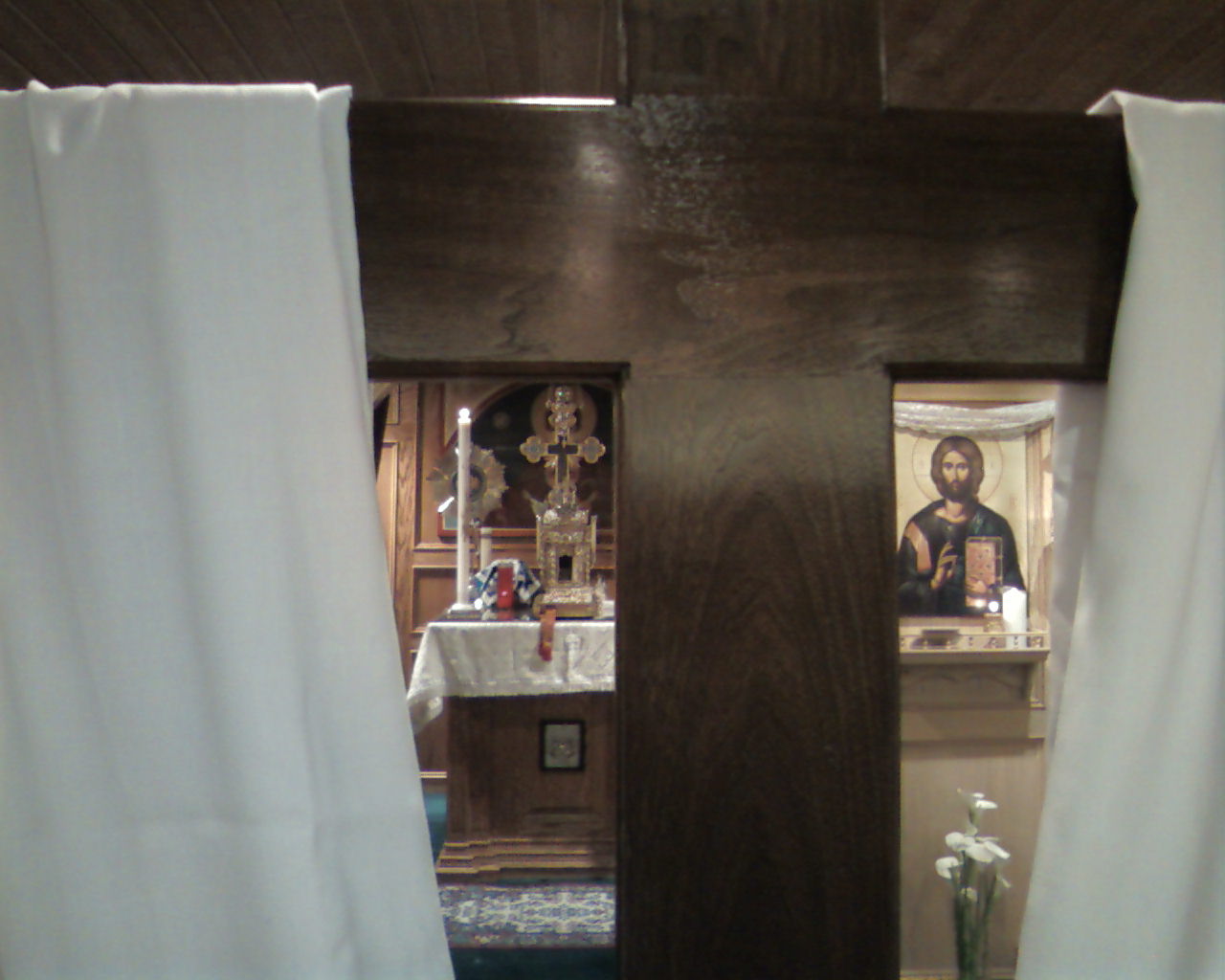
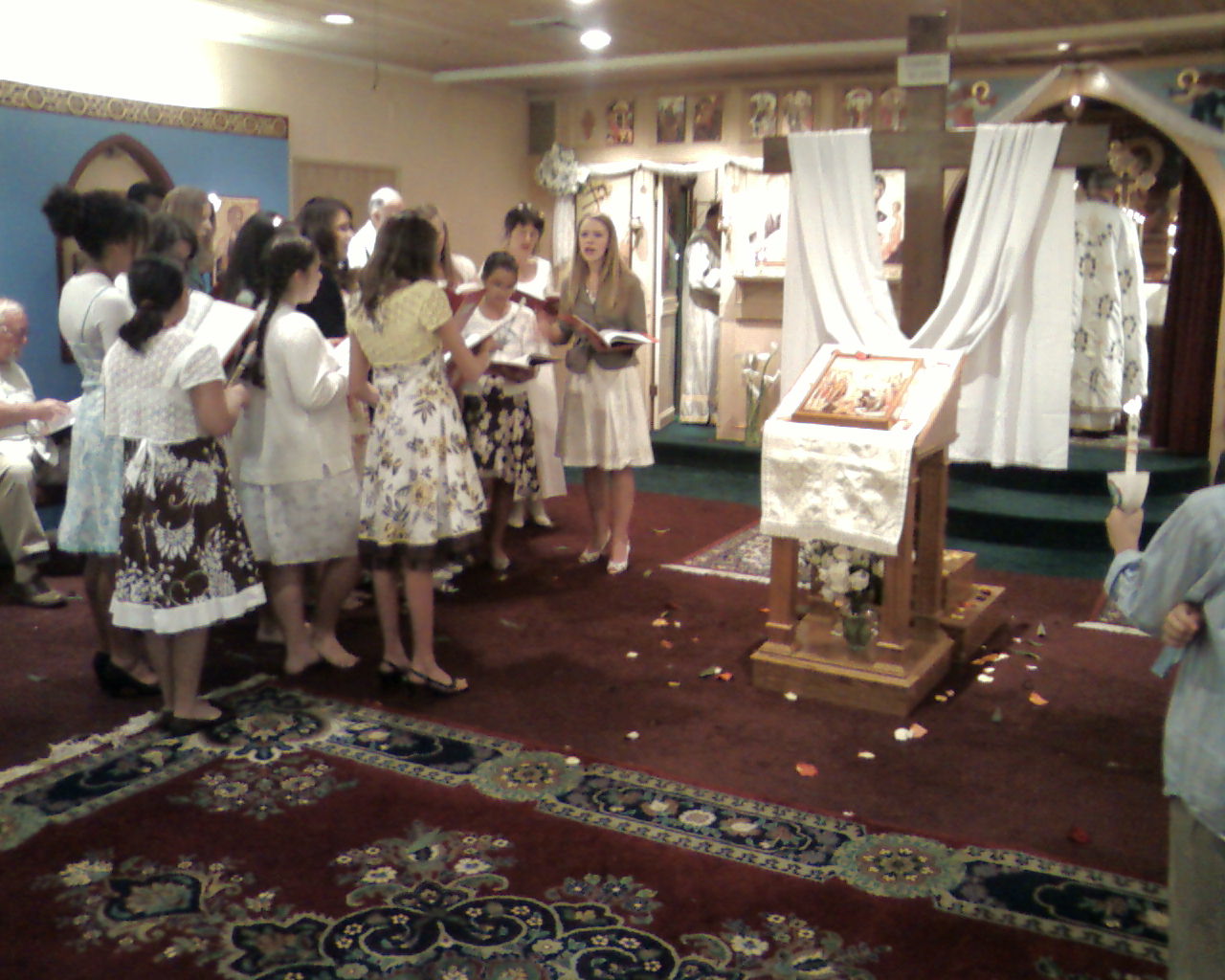
It’s about 4 am. We got home from our first Pascha service about 3:30 am. It was absolutely stunning! The candles, the songs, the priest banging on the church door with the cross, the choir, the flowers. Amazing!

We sang this great song over and over throughout the service as we held our candles above our heads:

“Christ is risen from the dead, trampling down death by death,

And upon those in the tomb, bestowing life!”

Now we’re exhausted and will try to sleep for several hours and re-energize before the Agape Service at 2 pm and the Pascha party at 4 pm.

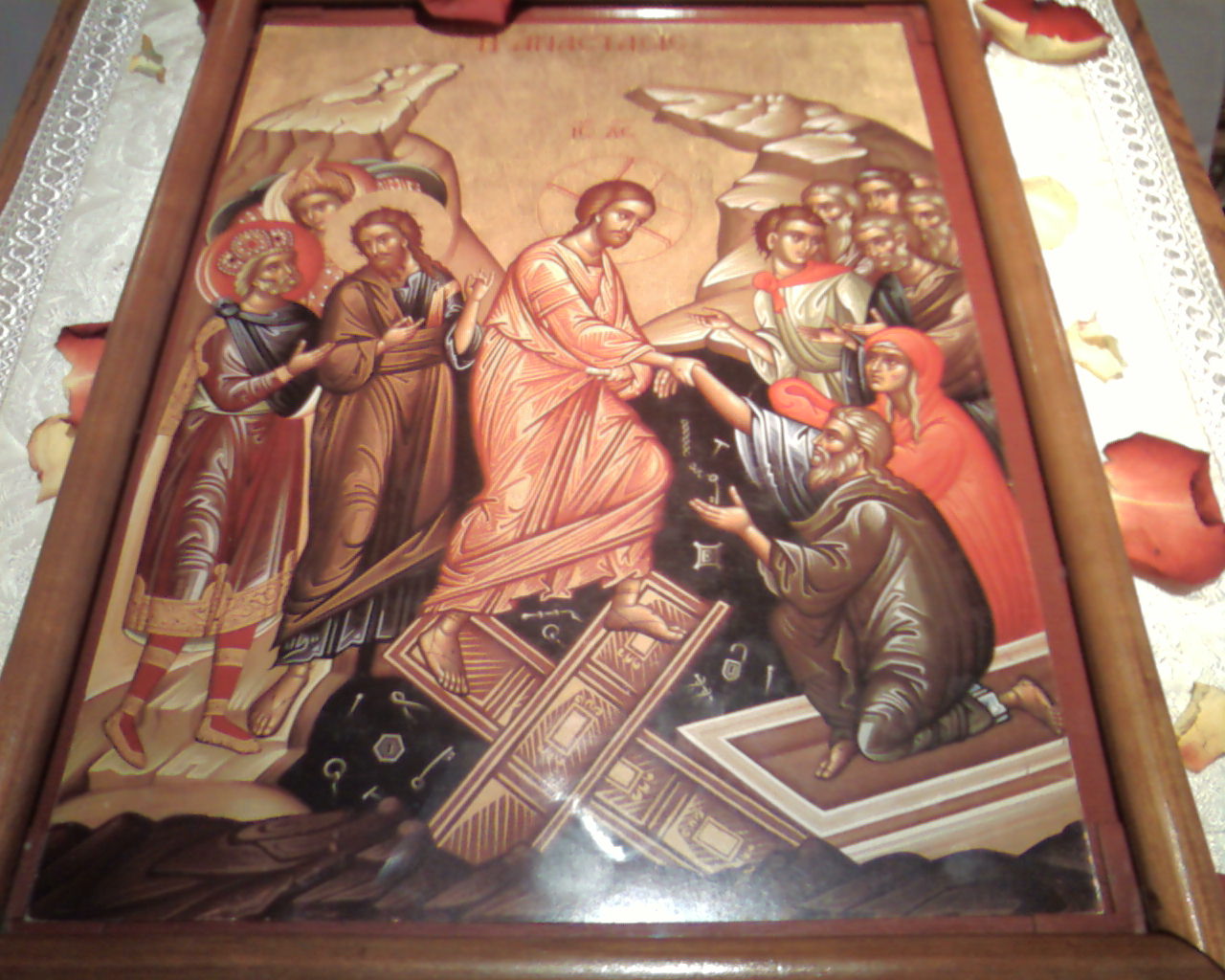
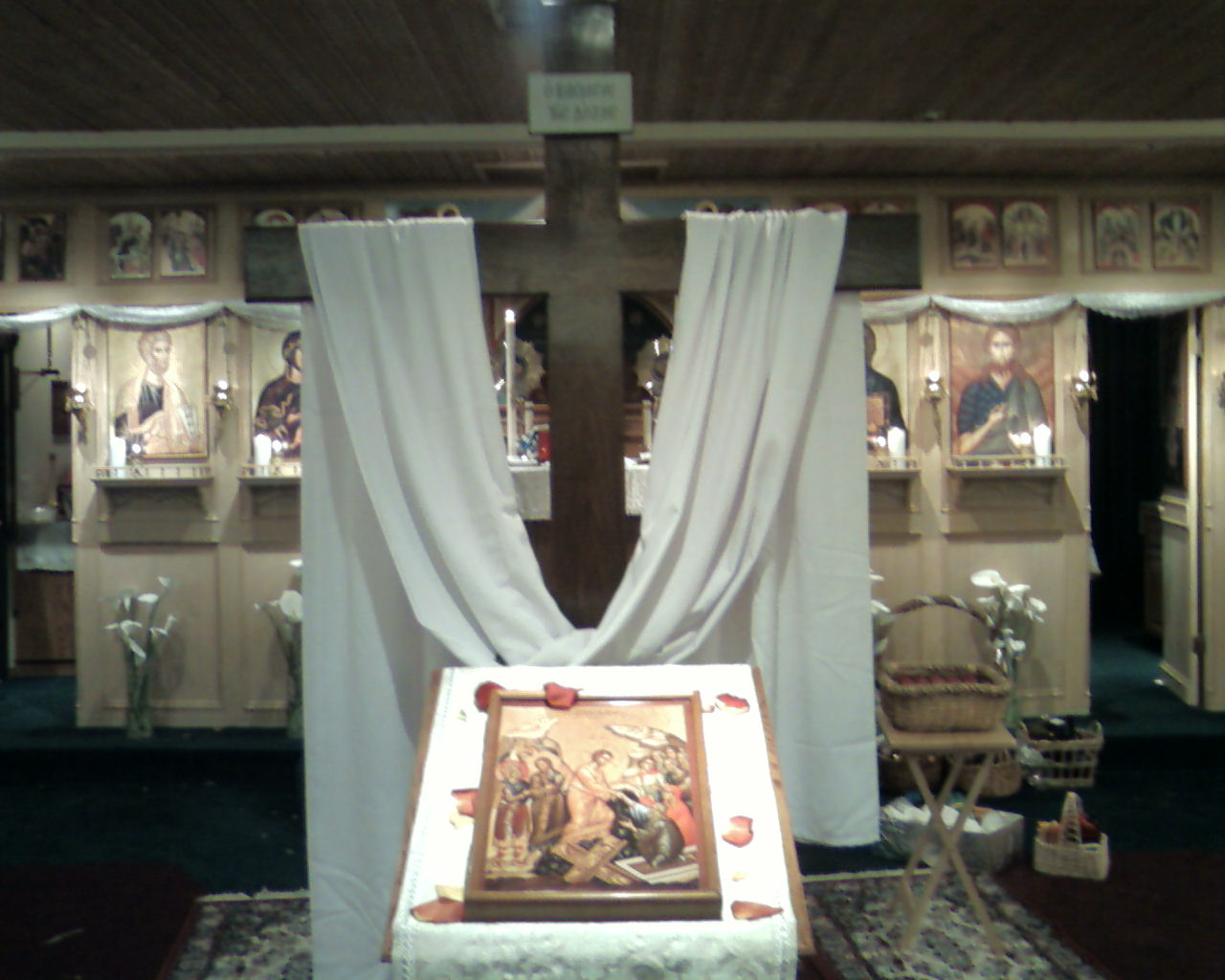
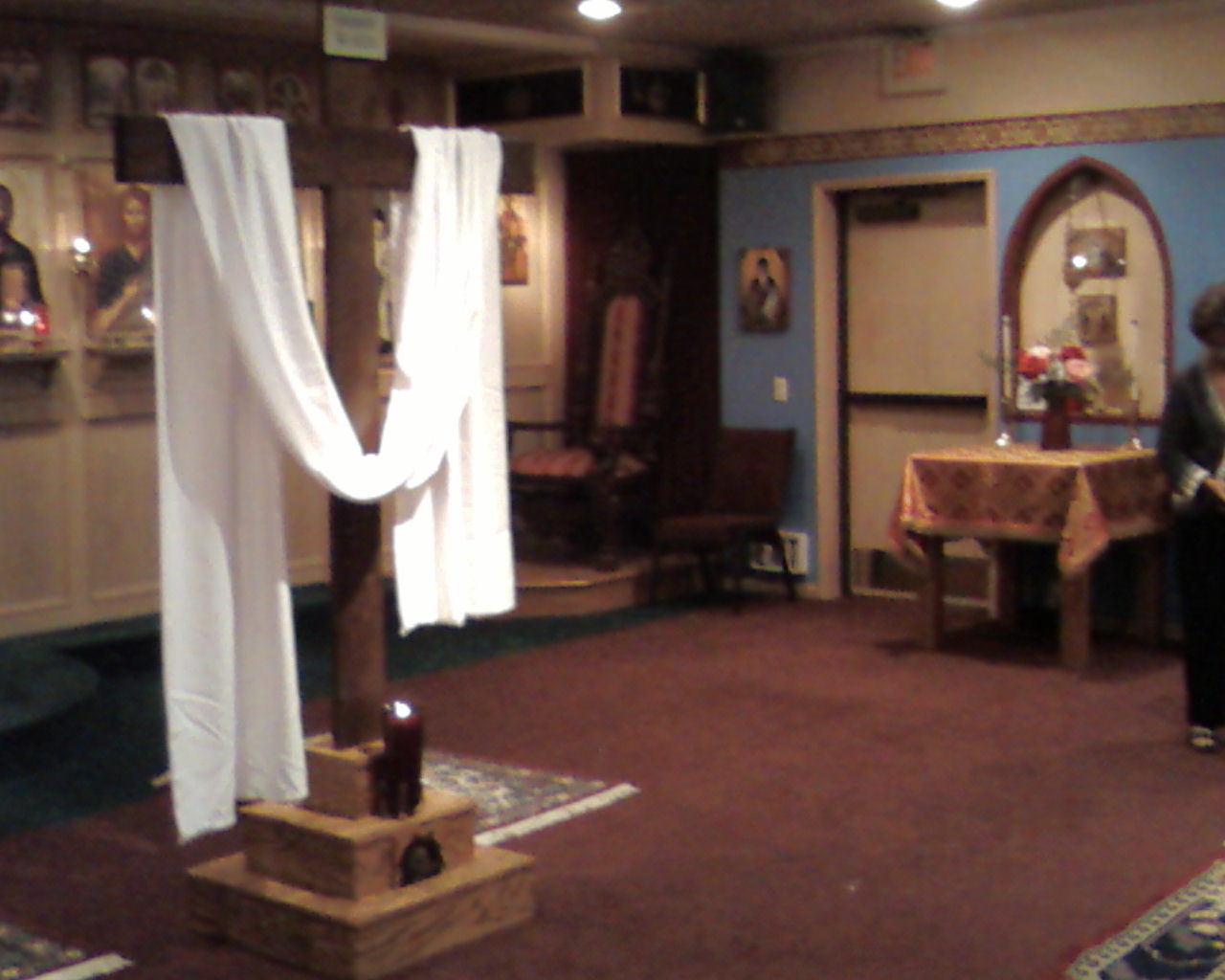
Below are a few pictures I snapped with my cell phone during the Pascha service.


And now I’m off to bed.

 Subscribe through Feedburner

Great & Holy Saturday

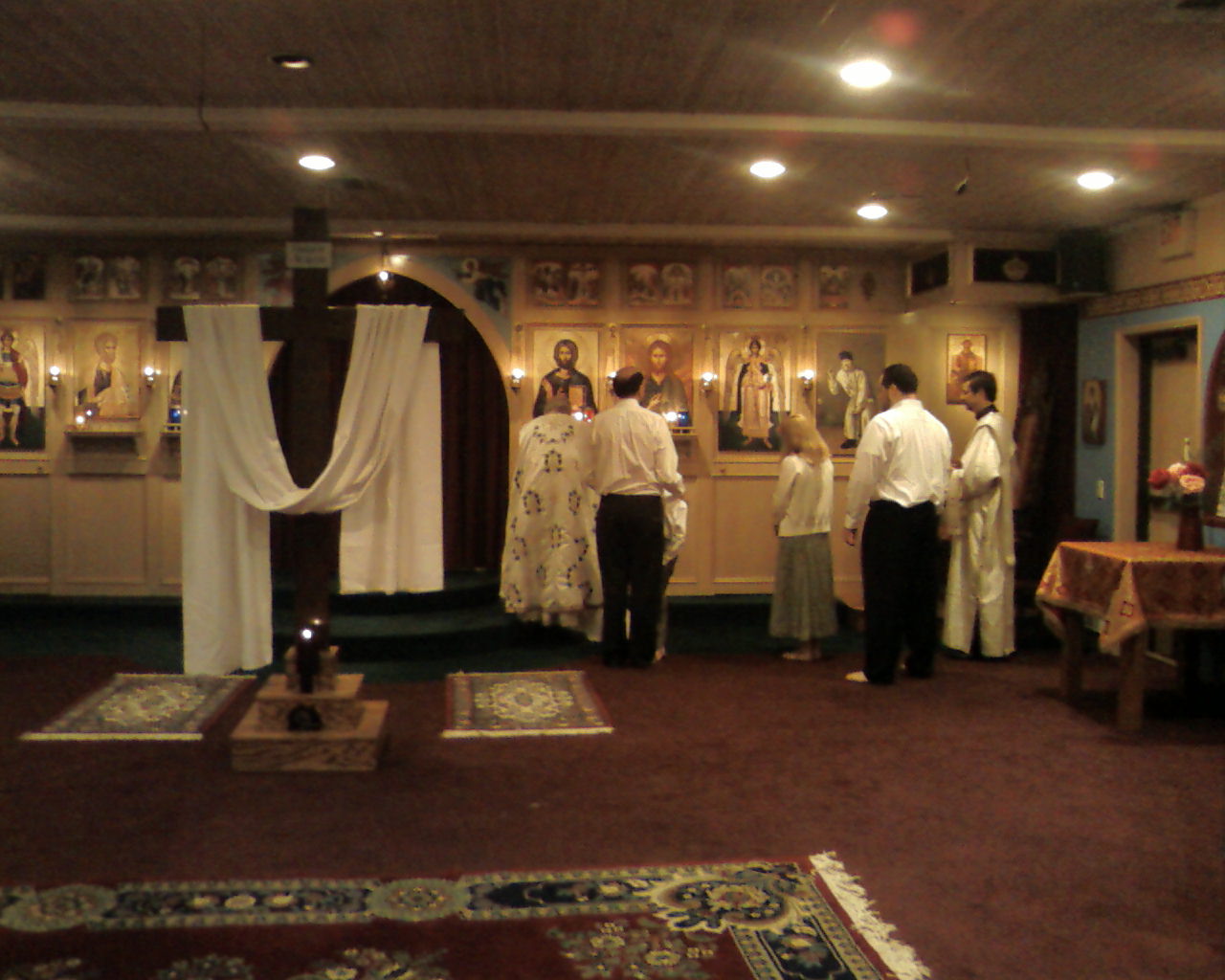
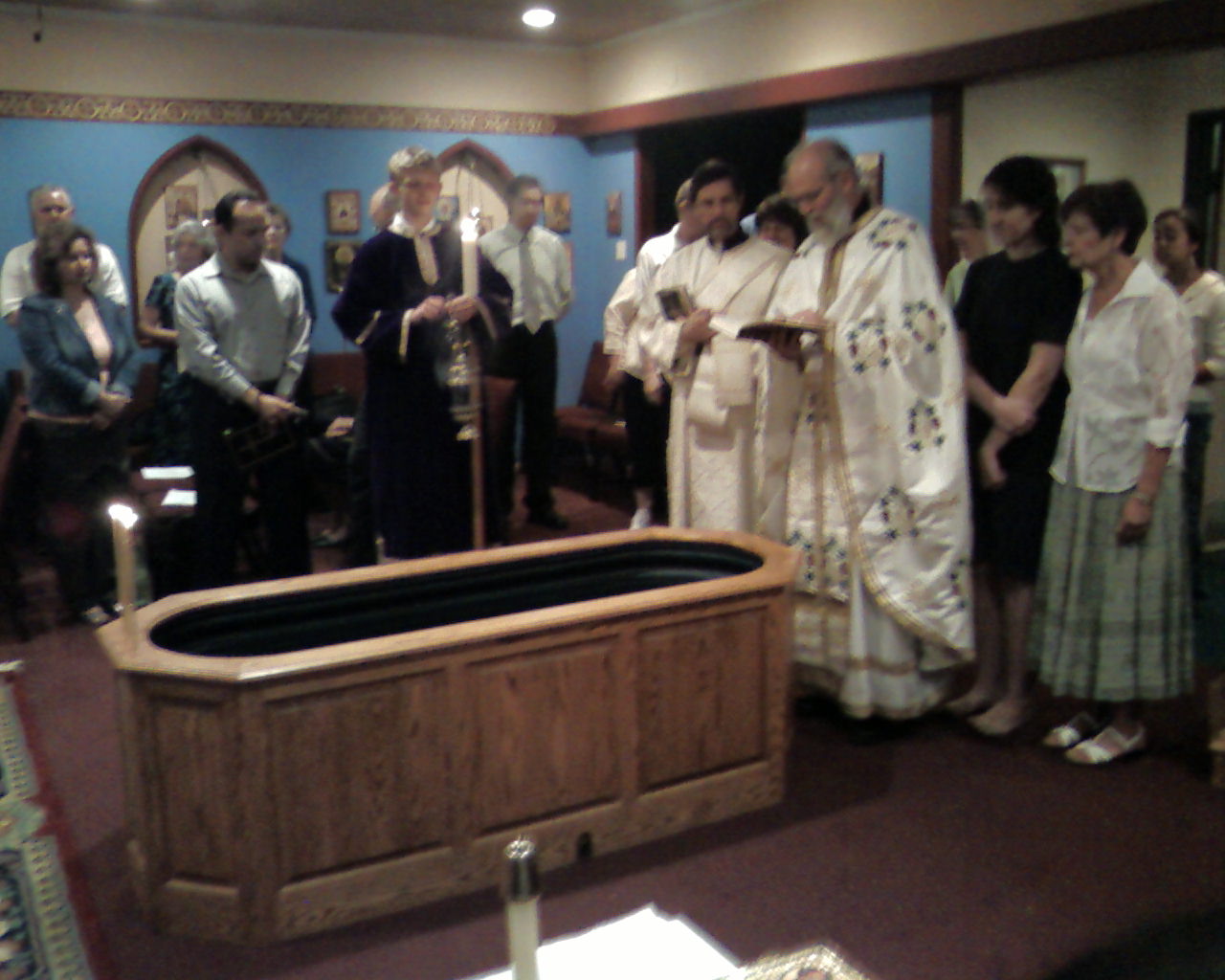
This morning’s service was the Vesperal Liturgy of the Harrowing of Hell. During this service, we watched one of our new friends receive Baptism and several more of our new friends receive Chrismation. I’ve posted a few pictures I took on my cell phone. I apologize for the poor quality.


It was at this service that everything we’ve been experiencing through Lent, and especially Holy Week, finally caught up with me. The services on Thursday night and through Friday were absolutely intense. I have nothing in my personal history as a Protestant to compare with the depth, richness and beauty of these past few days. We have read so much Scripture, sang so many hymns, said so many prayers, and bowed and crossed ourselves so many times that we have virtually lived in a continual atmosphere of worship, prayer and Scripture the past few days. In addition, there are the layers upon layers of symbols, details and meaning that everything holds in the Orthodox Church. Everything is done for a reason, often many reasons, that ties every gesture, word and act back into the Gospel and the life of God.

So this morning, as service began, I happened to be standing near the large cross that had been placed in the center of sanctuary. I stood looking at the cross, simply bathing in all that has come before and in preparation for what was to come. As I gazed at the cross, my eyes lowered to the small image at the foot of the cross. It is a small image of a skull and bones, symbolizing death. And like a massive wave, the magnitude of Jesus’ life, crucifixion and resurrection washed over me. He has defeated death through death! Death is vanquished. He didn’t just forgive my sins. He completely and absolutely destroyed death and its power!

During one of the previous services, the entire congregation participated in a procession with candles outside the Church. As we re-entered the sanctuary, everyone walked through the sanctuary doors under the icon of Christ’s burial. This symbolized both our participating in Christ’s death and the fact that as we go through that death with him, we then enter his life, which is in his Church.

So my friends’ Baptism, Chrismations and first Communion as new members of Christ’s Holy Church pulsed with such meaning this morning.

As the service was drawing to an end, our priest was gifting each new member with a cross that is to be worn at all times. As he put the chain around the neck of one of my friends and hugged him, I heard him whisper, “Welcome home.”

At those words, tears welled in my eyes and I felt such an ache in my heart. I have been searching, for what I now know as “home,” for as long as I can remember. I was searching for it as a young teenager before I had ever heard of Jesus. I was searching for it after accepting Jesus into my life over twenty years ago. I have searched for it as God has lead me on my journey into Calvary Chapel, the Baptist Church, Youth with a Mission, the OMS Holiness Church, the Vineyard and the Emerging Church. And each step has brought me a little bit closer.

I yearn to hear those words, “Welcome home,” whispered into my ear one day. I long to find the place where the yearnings of my heart to be like Jesus are truly and fully met. Debbie and I hope to find a non-consumerist church community, where all of us — men, women, and children — train to follow Jesus together into his world. Will that be the Orthodox Church? A huge part of me hopes so. And if the last four months are any indication, it looks like it will be so. I feel everything has been preparing me to embrace such a spiritually and theologically deep, rich and full-life form of Christianity. Perhaps I have found home.

 Subscribe through Feedburner

Great & Holy Friday

This morning we participated in the Service of Royal Hours. The following is a hymn we sang as we knelt before Jesus on the cross:


“Today he who hung the earth upon the waters is hung upon the tree.

Today he who hung the earth upon the waters is hung upon the tree.

Today he who hung the earth upon the waters is hung upon the tree.


“The King of the Angels is decked with a crown of thorns.

He who wraps the heavens with clouds is wrapped in the purple of mockery.

He who freed Adam in the Jordan is slapped on the face.

The Bridegroom of the Church is affixed to the cross with nails.

The son of the Virgin is pierced by a spear.


“We worship Thy passion, O Christ.

We worship Thy passion, O Christ.

We worship Thy passion, O Christ.

“Show us also Thy glorious resurrection!”


 Subscribe through Feedburner

Keeping Vigil Is Our Mission

On the first three evenings of Holy Week, we participate in the Bridegroom Matins. These services echo the parable of the ten virgins in Matthew 25:1-13. The celebrations of this past weekend — Lazarus Saturday and Palm Sunday — were foretastes of the joy that awaits us at Pascha. They were bright and joyful celebrations. But through Holy Week, we once again enter a somber time. The constant theme through this week flows right from Jesus’ mouth in Matthew 25:13, “Keep watch.” The Christ the Bridegroom is coming, so keep vigil.

Keeping a vigil can often be viewed as a passive activity. Yet, it is anything but passive. It is attentive repentance and watchfulness. It is actively preparing a place for Christ the Bridegroom in the internal bridal chamber of our hearts.

One of the things that has drawn me to Eastern Orthodoxy is their balanced understanding of “missional,” although they probably would never use that word. In my opinion, many of the discussions I’ve read regarding “missional” lean too far on what I would call “missional activity” rather than on what I would call “missional being.” As valid as most of this missional activity is, Jesus calls his followers to something much deeper than that. He calls them to keep vigil. 

In John 20:21, Jesus says, “As the Father has sent me, I am sending you.” Jesus fulfilled his part in the Father’s mission on earth. But the mission continues until Christ’s return. So Jesus passes the missional baton very carefully. We participate in our part of God’s mission just like Jesus participated in his — by being the embodied fullness, life and presence of God on earth. That means we must be formed into Christ’s likeness so that, like Christ, we too can be God’s fullness, life and presence on earth. In other words, missional activity must flow from missional being. We must be Christ’s likeness so that we may cooperate with Christ in God’s mission.

So mission is first and foremost formation into Christ’s likeness. While journeying into the formation into Christ’s likeness, the Orthodox Church emphasizes something even deeper than formation — repentance. Repentance is the very core of living in God’s kingdom. We see this in Jesus’ proclamation in Mark 1:14-15:

“After John was put in prison, Jesus went into Galilee, proclaiming the good news of God. ‘The time has come,” he said. “The kingdom of God is near. Repent and believe the good news!'”

These words are more than instruction about how to enter God’s kingdom. They reveal how one breathes and lives moment-by-moment in God’s kingdom. Repent and believe. Repent and believe. Repent and believe.

So to pull all the loose strings of this post together, keeping vigil — actively preparing our internal bridal chamber for Christ the Bridegroom through training into repentance and therefore being formed into Christ’s likeness — is mission. Keeping vigil is our mission. A life of continual “repent and believe” forms us into Christ’s likeness so we may truly be sent as he was sent. This is how we are saved and in turn become saving.

 Subscribe through Feedburner

And We’re Off!

Wow! What a great weekend. Holy Week has finally arrived for the Eastern Orthodox Church. Friday night was the Little Compline with the Canon of St Lazarus. Then on Saturday morning, we gathered for Lazarus Saturday. When Fr Patrick began this special Divine Liturgy with “Blessed is the Kingdom of Father and of the Son and of the Holy Spirit both now and ever and unto ages of ages,” I felt this powerful rush of excitement and anticipation. Lent has been escalating to this moment. And with Lazarus Saturday, Lent ends and Holy Week begins. A hymn that we sang during the service and throughout the weekend services brings it altogether so well:

“By raising Lazarus from the dead before Your passion,
You did confirm the universal Resurrection, O Christ God!
Like the children with the palms of victory,
We cry out to You, O Vanquisher of death;
Hosanna in the Highest!
Blessed is He that comes in the Name of the Lord!”

On Saturday night we returned to church for the Great Vespers for Palm Sunday. At the end of the service, we venerated a striking icon of Jesus calling Lazarus from the tomb. Then Fr Patrick anointed our foreheads, palms and the back of our hands with oil.

This morning was Palm Sunday. A special feature of today’s service was a procession with palm branches out of the church and down the sidewalk. What a sight! And such incredible joy! Also the Lenten fast was lifted slightly, allowing fish, wine and oil. (During Lent, Eastern Orthodox fast from meat, dairy, wine and oil.) Coffee hour was crowded and bustling. In addition to some normal Lenten food, those who prepared coffee hour also brought some delicious salmon and several bottles of wine. It tasted so good! The anticipation of the coming week was palpable. We sat around talking and laughing and our family was one of the last ones to leave. Our family is making great friends at St Peters.

Our plan was to go home afterwards and get chores done, but my parents called. Yesterday I told my mom about our family’s decision to explore Orthodoxy during 2008. I wasn’t sure how she and my dad were going to react. My mom called wanting to get together today to talk. Debbie and I shared with my parents about the fullness of Christ’s life that we’ve been experiencing in the church. Both were positive and my mom admitted to a deep yearning for something more in her relationship with Jesus. After our talk, we went shopping for the girls’ Pascha dresses.

Then we bolted down the 210 Freeway to meet Mark, Barb and Maribeth for an enjoyable dinner of good food, talking and laughing. God has blessed our family with such great friends. And right now, my life feels so deep and rich. I feel like I’m drinking deeply from a well of crisp water.

The rest of this week will be very, very busy. There are two services (morning & evening) every day until Holy and Great Friday. Debbie and the kids are hoping to make it to some of the morning services before the kids start school.

By next weekend, we’ll be going full steam ahead. Three services on Holy and Great Friday followed by an all-night vigil of reading Psalms at Jesus’ tomb, all accompanied by a strict fast. On Holy and Great Saturday morning, we’ll experience the Paschal Vesperal Liturgy of the Harrowing of Hell. (What a great name for a worship service!) During this service, we’ll witness some of our new friends receiving the sacraments of baptism and chrismation as they join the Orthodox Church. Then we go home, sleep, cook and return at 10:30 that night for a candlelight Rush Service followed by Paschal Matins and Divine Liturgy. Then around 2 am, we break our Lenten fast together with a grand feast! Then we go home and sleep some more and finally gather for an afternoon Agape Service where one of the Gospel accounts is read in as many languages as possible, followed by a party in the park.

I’ve been a Christian for over 20 years. But this year will prove to be one of the fullest, most meaningful, most joyous Easters we will have ever experienced. Glory to God!

Oh… and by the way, this is my 500th post since I started blogging in 2003. Yeaa!

 Subscribe through Feedburner

An Interesting Convergence

Today, I experienced an interesting moment of convergence. Last night we spent time in our home group discussing the nature of sin. We had talked about how the Western Christian concept of sin as breaking a Law and thereby punishable by death was an incorrect perspective. Rather, the biblical idea of sin is that it is our failure to be truly human as God intended — to live in communion with God and then to be his image to the rest of creation. Sin is our failure to do this and the resulting death we experience is within the very fabric of our being, thus breaking and corrupting everything we touch.

Last night’s conversation was fresh in my mind this afternoon as I listened to a recent podcast by Frederica Mathewes-Green while driving home from work on the 605 Freeway. The title of the podcast was Sin As Pollution.” In the podcast, Frederica was describing the effects of sin by reading part of a monologue by Garrison Keillor of Prairie Home Companion fame.

The monologue was in the form of a letter written by Jim, a man who was waiting on his front yard to be picked up by a woman from work with whom he was going to attend a conference and with whom he was tempted to begin an affair.

As Jim is waiting to be picked up by this woman, he waxes reflective about the repercussion of his potential affair. As he looks down the street at his neighbors’ homes, Jim realizes that his infidelity will pollute many lives. He states, “Although I thought my sins would be secret, they would be no more secret than an earthquake.” His reflections climax with this powerful and moving image, “When my wife and I scream in senseless anger, blocks away, a little girl we do not know, spills a bowl of gravy all over a white tablecloth.”

And as I listened to Frederica read this line, on the other side of the freeway, a white Ford Expedition streaked by being pursued by a train of police cars with lights flashing and sirens screaming. I saw sin’s pollution firsthand. There were hundreds of drivers this afternoon on the southbound 605. And the driver, trying to escape the police and probably the consequences of his sin, was polluting everyone around him in potentially harmful and dangerous ways. I hoped and prayed that this high-speed pursuit would end safely and peacefully; hoping and praying that the driver’s sins would not intersect and destroy someone else’s life on that freeway.

Next week, we observe Holy Week for the Eastern Orthodox Church. The last several weeks have been a communal journey to the cross that has been filled with stories, Scriptures, songs, fasting and prayers with a common theme — “Lord, have mercy.”

May the Lord have mercy on my sins, on our sins, on the world’s sins. May he trample death through death. May he bring the life of God that we so desperately need. And may he fully fashion us into the image of God, as embodied in his own life, so that we will be ultimately free from sin.

 Listen to Frederica’s podcast, “Sin As Pollution.”

 Subscribe through Feedburner

Fr Stephen & “Is Hell Real?”

Fr Stephen has a great post today about the “reality” of hell. Throughout much of my Evangelical life, I had simply embraced the assumption that heaven and hell were places. It wasn’t until I began my theological deconstruction and reconstruction several years ago that I began to realize that neither were places at all. Heaven is something much more. In fact, one of the many beautiful things that has drawn me to Orthodoxy is their understanding of heaven and hell. Here’s a quote from Fr Stephen’s post:

“But in Orthodox spiritual terms I would say that hell is a massive state of delusion, maybe the ultimate state of delusion. It is delusional in the sense that (in Orthodox understanding) the “fire” of hell is not a material fire, but itself nothing other than the fire of the Living God (Hebrews 12:29). For those who love God, His fire is light and life, purification and all good things. For those who hate God, His fire is torment, though it be love.”

The very fire of God — his light, love and purification — is heaven or hell. for those who love God, his light and love are heaven! But for those who hate God (and this is the amazing thing), his very love and light are hell!

Some thoughts from one of Fr Stephen’s subsequent comments from the same post are also worth noting:

“I don’t think of them [heaven and hell] in terms of places but in terms of our relationship with God. We use place metaphors for that’s what we know, but the reality of heaven certainly transcends anything we currently think of as place. I do not mean to describe them as merely figurative either.

“But neither can they be somehow compared as having a comparable existence. It might seem like something for a philosophy class, but it is also something for a theology class, at least as we know theology in the Orthodox Church.

“Literalism is the bane of Scriptural understanding. Not that there aren’t plenty of “literal” things described. But many times we have to push beyond the literal to arrive at the truth. At least this is the case in many of the Eastern Church fathers.”

Heaven is not a destination that I hope to get to when I die, nor is hell a destination I want to avoid. Rather, heaven is ultimately my participation in God, who is the fullness of being, life and reality. 

Take a few moments and read Fr Stephen’s post in entirety HERE:

 Subscribe through Feedburner


“You Can Never Worship God Too Much”

That’s what Chris, my eight year old son, said today. I was talking to the kids about our family’s experience of Eastern Orthodoxy during the last four months.

Wow! He’s so right. Exploring Eastern Orthodoxy has opened up our experience of corporate worship more than we could imagine. We’ve moved from an experience of corporate worship being 30 minutes of singing followed by a sermon to services (often a couple hours long) filled with incense, icons, candles, an altar, bowing, crossing ourselves, ancient prayers and hymns, vestments and the Eucharist. Worship is now such a full experience.

And it’s all about and for God! You really can’t worship God too much.

 Subscribe through Feedburner

The Saints are Truly Human

Now that the migration of my blog from TypePad to WordPress is complete, I’m beginning to think through the content for a new series that will be called something like “Evangelical to Emerging Church to Eastern Orthodoxy.” I’m hoping to share in this series how a typical Evangelical pastor like myself could leave the local church, write an article called “Detoxing from church” (notice the small “c”), become affiliated with the Emerging Church and, within about five years, find himself on the threshold of the Eastern Orthodox Church. In many ways, this series will be the sequel to “Detoxing from church” that I’ve been promising myself to write for the last couple of years called “Rehabbing to Church” (notice the capital “C”). I’m hoping to share how my search for a church that is missional, incarnational, communal, liturgical, sacramental and historical find its fullest, although not perfect, expression in Eastern Orthodoxy. I’m also hoping to share the issues that I’ve found difficult to embrace during this journey as well.

But in the meantime, I’d like to leave you with something our priest said tonight at Vespers. This past week, during the Great Confession of Repentance , we heard the amazing and moving story of Mary of Egypt. While Easter has come and gone for Western Christianity, Easter for Eastern Orthodoxy isn’t until April 27. So Fr Patrick encouraged us to look to the saints as we experience our frailty and even despair during the last couple of weeks of Lent. While sharing this, Fr Patrick said, “The saints are truly human. It is we who are subhuman.”

This is an absolutely encouraging reminder! Jesus is the model of true humanity. He shows us what Adam and Eve and all of their descendants were to become as the image of God. Jesus then conquered death through death, bringing about our salvation. As 2 Peter 1:3-4 says:

“His divine power has given us everything we need for life and godliness through our knowledge of him who called us by his own glory and goodness. Through these he has given us his very great and precious promises, so that through them you may participate in the divine nature and escape the corruption in the world caused by evil desires.”

This is our salvation. Jesus has made available participation in the divine nature (theosis ) for everyone. The saints are those who have followed Christ in theosis to the transformation of their being into the fullness and likeness of Christ as the true human being. And this great cloud of witnesses surrounds us as heaven and earth meet and encourage us forward into our own transformation into Christ’s fullness and likeness.

 Subscribe through Feedburner

Fr Stephen and “Salvation by Grace”

Fr Stephen has a wonderful post about the Orthodox perspective of salvation as transformation rather than a forensic salvation. One of the points he makes is that because salvation is transformation, it takes a lifetime and requires constancy. As Fr Stephen puts it, at its core, a life of transformation requires “just showing up.”It’s a great post and you can read it HERE .It’s this kind of stuff that attracted me to Orthodoxy in the first place.

 Subscribe through Feedburner

Good Introductory Resources to Orthodox Christianity

If anyone reading this blog is interested in reading some introductory essays to Eastern Orthodoxy, click HERE to go to a resource page of the Antiochian Orthodox Christian Archdiocese.

 Subscribe through Feedburner

Still Thinking about Scripture

Since posting on the Orthodox view of Scripture, I have found myself thinking a lot about the subject. Also, thanks to those who commented on that post. The comments have posed some questions for me that I’m hoping to resolve over time.To move forward in this process of resolution, I will be posting responses and thoughts to a book my friend, David, gave me to read. It’s called, The Mystery of Christ, by Fr. John Behr. Fr. John teaches courses in patristics, dogmatics and scriptural exegesis at St. Vladimir’s Orthodox Theological Seminary.I began reading the book casually, but I’ve decided to start over and use Fr. John’s book as the material for some blog posts over the next few weeks. His book challenges us to approach theology as the early disciples did — by viewing Scripture retrospectively with Christ’s passion as the primary hermeneutic. He writes in the preface:

“But it is a stubborn fact, or at least is presented this way in the Gospels of Matthew, Mark, and Luke, that the one born of Mary was not known by the disciples to be the Son of God until after the Passion, his crucifixion and resurrection… Thus, to speak of the ‘Incarnation,’ to say that the one born of the Virgin is the Son of God, is an interpretation made only in the light of the Passion.”

I have enjoyed and have been challenged by what I have read so far in Fr. John’s book, so I’m looking forward to blogging my responses and thoughts to it over time. If you would like to read a synopsis of the book, there is a three-part review at Oozerdoxie (a collection of Orthodox bloggers who also post at theooze.com ):PART ONEPART TWOPART THREE

 Subscribe through Feedburner

Orthodox View of Scripture

I was reading a new blog post by Fr. Stephen that is challenging the way I view Scripture. If you’re really interested, you can read the whole post HERE . But let me give you a quote:

The Scriptures, as used in the Orthodox Church, are decidedly the Church’s Scriptures, and cannot be rightly read apart from the liturgical and ascetic life of the Church.“Literalism is a false means of interpretation (hermenuetic) and is a vain attempt to democratize the Holy writings. If they can be read on a literal level, then everyone has equal access to them and everybody has equal authority to interpret them. Thus certain forms of Protestantism, caught up in the various modern theories of the Reformation, sought to do to the Scriptures what many sought to do with their governments. Kill the princes! Kill the priests! Everyone can be his own king, his own priest. Smash the images and any claim to authority. Of course these extreme forms always failed quickly, to be replaced by some version of moderation.“Thus the Scriptures are not purely democratic – some interpreters are more equal than others.”

Fr. Stephen’s post causes a “Yeah!… Hey, wait a minute!” reaction in me. One of the things I have struggled with as a Protestant is how anyone with a Bible can interpret it and make it say whatever they want it to say. I’ve lost count of how many small group discussions I have attended where I have inwardly cringed when someone said, “Well, what this means to me is…”And a similar dynamic occurs at the academic level, where attempts to discover the author’s original intent based on critical study can be incredibly diverse and even contradictory.The legacy of Sola Scriptura in western Protestantism is tragic. Anyone can believe Scripture says what they want it to say and then find someone to validate that belief. I mean, just watch any National Geographic or History Channel special around Easter or Christmas. All it takes are a few talking heads with letters behind their names to concoct some ridiculous theory to explain the biblical stories. Or skim the titles at any Christian books store and you’ll find Scripture being used to support basically any topic.So, I find myself agreeing with Fr. Stephen’s idea, “Thus the Scriptures are not purely democratic – some interpreters are more equal than others.”But I also find myself reacting to his ideas. As one who has spent my entire adult life learning to interpret and teach Scripture, the idea that “The Scriptures, as used in the Orthodox Church, are decidedly the Church’s Scriptures, and cannot be rightly read apart from the liturgical and ascetic life of the Church” is a very foreign, and quite frankly, frightening concept to me. Or, his statement later in his post, “The authority to speak about Christ is given to those whom He has chosen and ordained” really stirred up some reaction in me.Now I’ve learned that when I react strongly to something, the first questions I need to ask are “Why am I reacting so strongly to this? What is this exposing in me?” In this case, the answer is very obvious: Pride. I don’t like to be told what to believe. I like the fact that I have learned the skills to interpret Scripture and wrestle with Scripture to yield interpretations different than the popular versions of Christianity.Now it’s not all pride. Part of it is a response to having been taught false ideas by well-meaning Bible teachers in the past. Part of it is having been trained in seminary to approach theology with a critical and even a skeptical eye. But a good part of it is pride — my interpretations are the result of my hard work, my study and my skill.So I know I need to do several things: First, I know Fr. Stephen’s post rings true. Scripture must be read, studied and lived in the liturgical and ascetic life of the Church. So probably the most important action our family must take is finding a parish in which to immerse our lives and to begin experiencing Scripture.Second, I need to seek some counsel about whether it is possible to merge both a liturgical life in Scripture with a “critical” study of Scripture. Or to come to grips with the fact that they may be diametrically opposed to each other.Third, I need to bring my exposed pride before my Lord so that he may save me from it. I need to deal with the possibility that not everybody, including myself, has the equal authority to interpret Scripture and that I may need to yield to those whom God has ordained to teach me. This scares me more than I want to admit. And once again, I find myself praying, “Lord, have mercy.”

 Subscribe through Feedburner

Intro to Icons

 One of the things I want to understand better as we explore Orthodoxy are icons. Although I’ve read a little bit about icons, I know virtually nothing about them. And yet I sense that they will provide my family with a depth of spirituality that we’ve been lacking in our evangelical lives.I came across an article by Susan Cushman, via Father Stephen , that in my opinion, offers a wonderful introduction to icons and their spiritual beauty. The article is called, “Icons Will Save the World,” and not only contains some ideas worth exploring and thinking about, but also links to some books that seem promising.In her article, Susan Cushman quotes Henri Nouwen, who explains why he chose to meditate on icons rather than on the artistic masterpieces of Michelangelo or Rembrandt. He writes:

“I have chosen icons because they are created for the sole purpose of offering access, through the gates of the visible, to the mystery of the invisible. Icons are painted to lead us into the inner room of prayer and bring us close to the heart of God.” 

Personally, when I look at icons, I sense that they are doors, but doors that presently remain closed to me. But like doors that promise to open into rooms filled with light, warmth and unknown wonder, I look forward to the day when they will swing open and snatch my breath away with what lies behind them. And beyond that, to learn to see humans and the entire creation as icons of God.But some may ask, “Why are icons so important?” Simply put, icons are expressions of the Incarnation. The invisible and boundless God became visible and embodied. This is a powerful declaration. In Genesis, God spoke over his newly formed creation, “It is good.” Yet through Christ’s Incarnation, he declared even more loudly over a broken creation, “It is still good!” The Incarnation climaxed God’s mission that began in Genesis 1 and which Paul summarizes in Ephesians 1:9-10:

“With all wisdom and insight he has made known to us the mystery of his will, according to his good pleasure that he set forth in Christ, as a plan for the fullness of time, to gather up all things in him, things in heaven and things on earth.” 

Heaven and earth are still meant to be fused and merged together. Human beings are this reality as we become the temple of God, his presence on earth. But it doesn’t stop with human beings. All things on heaven and earth are to be reconciled together and gathered up in Christ. And icons are one way in which this occurs. Icons of Christ, his Mother and the Saints somehow merge heaven and earth together. And as we enter into communion with God through them, we can be envisioned and energized for a life pleasing and worthy of Christ. As Susan Cushman states in her article:

“The icons are visions of what we can become if we allow God to penetrate every aspect of our lives. Those who attain this God-likeness to the fullest extent recognized by the Church are saints. Their lives, their stories, lift us up to be all that we can be — as we are transformed by God’s grace and love.” 

I have much to learn in Orthodoxy. But I excitedly anticipate a liturgical life, a sacramental life, a iconographic life — and ultimately through them, an Incarnational life.And even though icons are presently a mystery to me, I resonate and long to experience the last sentence of Cushman’s article:

“No wonder the Church celebrates those wise bishops of the Seventh Ecumenical Council who proclaimed iconography to be an ordinance and tradition that is not something extra, something added to the life of the Church, but as Chryssavgis says, a necessary expression of the reality of both God and the world.” 

 Subscribe through Feedburner

Good Orthodox Resources

I am truly a beginner to Eastern Orthodoxy, which quite frankly is very humbling. While I conceptually grasp some of the doctrines, Orthodoxy is much more than just a theological shift. In Orthodoxy, if I understand it correctly, the Church’s theology, worship and life all go together. So I probably won’t really get an adequate feel for Orthodoxy until my family and I join a parish.But since that won’t happen for about another month at least, I continue to learn through reading and listening. So I wanted to share an Orthodox resource that I have found helpful. It’s the blog and podcast by Father Stephen. You can read his blog HERE and you can listen to his podcast HERE. Also, if you click THIS LINK, it will subscribe you to his podcast via iTunes.Also, click HERE to hear a great conversation with Dr. Eve Tibbs from Fuller Seminary about the differences between the Christian East and West.Enjoy!

 Subscribe through Feedburner

Life Change #2

I’d like to share another change our family is experiencing. Debbie and I haven’t shared it with too many people, partly because we are in the very beginning stages and partly because of the potential misunderstanding our new journey may create. But it’s an important part of our lives right now and will become increasingly significant after we move into 2008.


Debbie and I are exploring the reality of our family joining Eastern Orthodoxy. Our journey together has brought us through Protestant evangelicalism longing for something deeper, richer and more significant.


But I’m jumping ahead of myself.


Several years ago, as a professional pastor, I experienced severe burnout. I emerged from that experience questioning both my practices as a pastor and a Christian. I was doing everything I had counseled others to do in order to be strong and mature Christians — church attendance, small group attendance, tithing, participation in ministry, evangelism, prayer, practicing spiritual gifts, regular Bible study, daily quiet times, worship, etc. And yet, while doing all of these activities, inwardly I was angry, stressed, jealous, competitive, greedy, lustful, afraid, insecure, and manipulative. Even though I loved God and truly desired to follow him, everything I was practicing was having virtually no effect upon my inward life.


My burnout became the catalyst for my journey into spiritual formation. I soon discovered the practices of spiritual disciplines and community that were beginning to reshape and renew my inward life.


But this journey quickly led me to realize that even deeper than my false practices lay my false theology and worldview from which those practices were nurtured and strengthened. And this theology and worldview was deeply ingrained within the entire structure of popular Protestant evangelicalism. It’s popular music, books, teaching, radio programs, and even local church infrastructures perpetuated theology, practices and ultimately a life that claimed to be biblical, but was far removed from anything Jesus and his early followers envisioned.


In my search for a theology that would sustain a life of spiritual formation, found myself drawn to theologians and church leaders such as N.T. Wright, Alexander Schmemman, Bishop Kallistos Ware, Father Thomas Hopko and others. Soon I found myself mentally embracing a fuller theology and faith that was significantly different from my Protestant roots. It seems that every facet of my theology underwent tectonic shifts. And all of this while pastoring a Protestant church.


The last four and half years away from professional ministry, while difficult in regards to understanding my calling as a pastor, have been wonderfully liberating in my personal exploration in theology and practice. The emerging church has provided an extended conversation that fueled my theological shifts. I love the faith-community in which God has placed my family. I love the new avenues of influence God has opened through my blog, writing and work at Asian Access. I have loved walking with two Fuller Theological Seminary students as they worked on their field education projects.


Yet, in all of this, there has been something missing. And it was especially noticeable when our family attended a local church on Sunday mornings. Debbie and I decided a couple of years ago to attend a local Vineyard Church that was pastored by my friend. This would allow our kids to participate in a youth program and allow Debbie and me to join in larger corporate worship, both missing within our small home church.


I discovered that the more I was away from professional pastoring, the more difficult it was to attend a local church. Don’t misunderstand me. My friend is an excellent pastor. He is perhaps one of the healthiest pastors I have ever met. I wish he had been in my professional life earlier on as a mentor. I probably would have avoided a lot of pitfalls.


Despite his excellent pastoring, I would leave Sunday morning worship meetings miserable and depressed. It is very difficult to explain what I was experiencing. At first, I thought Sunday mornings simply reminded me of everything I had lost when I left my last pastorate. But it was something else.


The worship, sermons, and fellowship at the local church were superb at one level. But everything was… how do I put it?… unreal. I kept seeing a structure with programs and budgets and people all perpetuating something that wasn’t real. It wasn’t real to Jesus’ vision. It wasn’t real to the Bible. It wasn’t real to the early church and to those who lived, labored and died for the doctrines and practices we now take for granted. It wasn’t real to any authentic spirituality. And it wasn’t real to life. It was like entering some weird fantasyland reality that didn’t make sense anymore.


Again, please don’t misunderstand me. It wasn’t a problem with my friend’s church. In fact, of all of the evangelical churches I have visited lately, his was the most comfortable and healthiest.


As I met with my pastor-friend for coffee over the last year or so, he would tell me repeatedly that because of who I have become theologically, it would be very difficult for me to find a church that I would fit. The truth of his statement hit me one day as I was emailing Mark. I suddenly realized that I embrace and believe more core Eastern Orthodox theology than I do Protestant evangelical theology. And although I disagree with some Eastern Orthodox theology, they are more peripheral areas. On the other hand, I disagree with most core Protestant theology. (I’ll need to unpack that in a future post.)


I was leaving Sunday worship meetings depressed because I was so out of sync with everything there — the music, the teaching, the subculture, the worldview — that it was a constant reminder of how much I don’t fit anymore.


Lately, I’ve been listening to a lot of Eastern Orthodox podcasts from Ancient Faith Radio. As I listen to their discussions of faith, practice, theology and sacramental worldview, I’m discovering that I’ve believed this stuff a looooooong time already. In fact, I told Mark that I think theologically, I’ve been Orthodox for quite a while and it’s just taking time for the rest of me to catch up.


So our family is beginning a slow and cautious journey into Eastern Orthodoxy. We have visited a friend’s church for Vespers several times. It is so foreign and strange. After spending my entire adult life both academically and professionally pursuing ministry in a Protestant context, it is weird being a “beginner” all over again. But there is such promise in Eastern Orthodoxy for both me and my family. The thought of being part of a faith-community whose entire reason for being is to become like Jesus and to live and practice toward that goal together within a rich and deeply historical system excites me.


But I’m very anxious as well. In many ways, I feel there is no where to go from here if Orthodoxy isn’t for us. I cannot go back into evangelicalism. And because Roman Catholicism is inherently a western worldview like Protestantism, moving there seems to be only a lateral move.


So as our family explores Eastern Orthodoxy, I will be posting our experiences and reflections.

 Subscribe through Feedburner