Holy Pentecost

Tomorrow is Holy Pentecost for the Orthodox Church. Not surprisingly, Orthodoxy understands Pentecost much differently than Pentecostals and Charismatics. In my past life as a Charismatic Christian, I associated Pentecost and the subsequent Spirit-filled life with zeal and exuberance that often bordered on emotionalism. Not so with Orthodoxy. If I understand it correctly, the Spirit-filled life is one of powerful and profound silence.

Tonight at Liturgy, Fr Patrick explained the Spirit-filled life with the analogy of the Sacramento River. At its headwaters, the Sacramento River is small, shallow and noisy as it bubbles from the ground. As it moves, it gathers water and grows wider and deeper. And as it does so, it grows quieter. When it’s finally at its most powerful and deepest point in its journey, it is silent. So it is with the Spirit-filled life. Pentecost was an explosion of energy and exuberance as the promised Holy Spirit descended upon Jesus’ followers. But as the Church matured, that initial experienced transformed into an ever-deepening and ever-quieting life as God’s power rooted out sins and passions that divide us and forged divine unity.

Here’s part of a hymn that we sung tonight at Vespers and will sing again tomorrow morning:

“When He came down and confused the tongues,

The Most High divided the nations;

but when He distributed the tongues of fire,

He called all people to unity.

Therefore, with one voice we glorify the most-Holy Spirit.”

Kontakion of Pentecost

 Subscribe through Feedburner

Shawn Ragan & “Prelest”

I am thoroughly enjoying Shawn’s blog. He is a professional Protestant pastor who is willing to walk away from his job and ministry in order to follow Jesus into the Orthodox Church. His posts are very authentic, well-written, and inspiring.

One of his latest posts, called “Prelest,” discusses an issue I’ve faced personally as well. Spiritual disciplines, such as prayer, fasting and almsgiving, are core practices in Orthodoxy. Because of this, it is easy for us who are naturally self-disciplined to take on the mantle of spiritual disciplines with a bit more ease. Add to that my distorted perfectionism, and I can fall prey to the idea that “more is better.” So if praying for 10 minutes every morning is good, then I’m going to shoot for 20 or 30 or 60 minutes. And if I succeed at this, I fall into a second and more devious trap of judgmentalism toward those who can’t or won’t practice spiritual disciplines with any kind of consistency.

Well, all of that is a spiritual deception called Prelest or spiritual pride. And it is demonic. As Shawn explains in his post, if my spiritual discipline is leading toward spiritual pride, demons will actually empower my spiritual discipline. The idea of demons actually empowering my spiritual disciplines so that they further blind and deceive me is absolutely terrifying to me. Simply engaging in spiritual disciplines is not enough for formation. They can actually hurt me if done incorrectly.

Bottom-line, I must remain humble before the Lord in both my knowledge and practice. Jesus alone is my salvation. And I’m reminded over and over that I need the wisdom and nurture of his Church to help me in my journey towards him.

 Subscribe through Feedburner


Fr Stephen & “Is Relationship with God What We Want?”

Things have been pretty busy as we draw to the end of another school year. So I haven’t had much time or energy to blog. But I’m still here.

Since I don’t have much to say, I wanted to point to someone who does. This week, I listened to a podcast that really spoke volumes to me. It’s by Fr Stephen Freeman and is entitled “Is Relationship with God What We Want?” It’s about fifteen minutes long and you can listen to it HERE or subscribe to his podcast at the iTunes store.

Fr Stephen does a fine job examining the word “koinonia” as it’s used in the New Testament. The word doesn’t really mean “fellowship.” Rather, it means “participation” and “communion.” The Church is not a fellowship — an association of like-minded people. Rather, it’s to be participation in one another’s lives, communion with each other.

Anyway, I’m not doing his podcast justice. Listen to it and allow God to speak. 

 Subscribe through Feedburner

Shawn Ragan & “Expressing Yourself”

I wanted to point to a wonderful post by Shawn Ragan and his experience with venerating the icons. You can read his entire post HERE:

This issue evoked mixed emotions in me as our family began exploring Eastern Orthodoxy. I didn’t consider this expression of honor to Christ, his Mother and the family of Saints as idolatry. In fact, I saw this form of reverence as worshipping Christ through the life of a particular Saint, thus expanding my worship of Christ. As Shawn affirms in his post, the lives of the Saints point to Christ, they don’t replace him.

My issue was that I’m a very private person. I had no problem with venerating the icons, but I was uncomfortable with such an intimate expression in front of a roomful of people. I struggled with a similar discomfort as a charismatic when I first began raising my hands during the worship.

But like Shawn’s children, my children embraced it very naturally. And it made me long to venerate the icons even more. So as we prepared to enter Holy Week, I made the decision to die to my personal discomfort and to do what my heart was craving to do. And while I felt nervous and awkward my first time, no one gawked or stared.

And so began a new dimension of worshipping Christ for me that I absolutely love. I love the icons. I love walking through the sanctuary when everyone has left, praying and venerating the icons of Saints who lived and died for Jesus in ways I cannot fathom. I look forward to learning about the lives of many of them and to be encouraged to live more faithfully for Christ.

These Saints are the people Jesus referred to when he said, “For whoever does the will of my Father in heaven is my brother and sister and mother.” These are members of Jesus’ family. They are the ones who have become truly human in him. And every worship service is like a family reunion as we worship Christ together.

(The icon at the top of this post is the Theotokos of Vladimir.)

 Subscribe through Feedburner

Journeying Home (4) — Where’s That in the Bible?


As we began attending St Peter’s, a local Antiochian Orthodox parish, we were immediately confronted with how foreign Eastern Orthodoxy is to western Evangelicalism. In many ways, we discovered profound beauty and holiness that are absolutely missing in most Evangelical churches. Eastern Orthodoxy is incredibly multi-sensory. In Orthodox worship, one smells the incense, sees the icons, candles and vestments, tastes the bread, and chants the prayers and hymns. In addition, one also venerates the cross, icons, and Gospel Book, crosses oneself, makes prostrations, and greets others with a holy kiss, all the time standing through most of the service. When you complete an Orthodox worship service, you not only feel like you’ve prayed and worshipped deeply, but you also feel like you’ve visited an art museum, seminary and a gym. Every part of your being is impacted by awe-inspiring beauty, divine holiness, theological profundity and historical depth. (Debbie and I joked after our journey through Lent and Holy Week that we need to start working out so we’re in shape for next year’s Pascha season.)

But along with the beauty and holiness, we also came face-to-face with concepts and stories that continue to evoke one question, “Where is that in the Bible?” Expressed in that question is a significant clash between a Protestant worldview and an Orthodox worldview.One of the values deeply ingrained in me as a Protestant was sola scriptura, literally “by scripture alone.” This doctrine teaches that the Scriptures are the singular authority in all matters of faith and practice. In this view, the Bible is self-interpreting and the final authority of Christian doctrine. At a practical level for most Protestants, sola scriptura equates to a deep personal belief in Scripture’s final authority. And conversely, a rejection of sola scriptura equates to a similar rejection of Scripture’s authority.

Viewing Eastern Orthodoxy through the lens of sola scriptura can cause many Protestants to conclude that Orthodoxy does not value the Bible. This is an unfortunate and a completely incorrect conclusion.

Orthodoxy values Scripture deeply. For example, when practiced fully, during the course of Matins (morning services) and Vespers (evening services) the entire Psalter is recited each week and twice a week during Lent. The Old Testament is read at Vespers. The Gospel climaxes Matins on Sunday mornings. At the Liturgy, a special Epistle and Gospel reading are assigned for each day of the year, so that the entire New Testament (except Revelation) is read at the Eucharist. It has also been calculated that the Liturgy contains 98 quotations from the Old Testament and 114 from the New. Scripture saturates every Orthodox service because Orthodoxy view Scripture as the verbal icon of Christ. All of Scripture, both Old and New Testaments, are first and foremost about Christ. So the Gospel Book has a place of honor on the altar and it is carried in procession at the Liturgy. All of this is to say that Orthodoxy practices a deep respect for Scripture.

While Protestantism attempts to view Scripture by itself, Orthodoxy values, reads, interprets and practices Scripture as part of its larger Holy Tradition. For the Orthodox Church, Holy Tradition is simply the ongoing life of God’s people. It’s the living continuity with Christ, the Apostles and the Church of ancient times. It’s the life of Christ within his Body passed on through the ages.

Unfortunately, the idea of tradition often carries a negative connotation for many western Evangelicals. I used to view tradition as blind allegiance to an old custom or practice that now carried little relevance, meaning or life. But I’m now learning and experiencing the vibrant life of Christ that is Holy Tradition. And within this Holy Tradition, at the most prominent place, are the Scriptures. For Orthodoxy, Scripture and Holy Tradition are not two separate sources of authority. Scripture was written and passed down as part of its Holy Tradition. 

So what forms Holy Tradition? Holy Tradition is composed of Holy Scripture, the Nicene-Constantinopolitan Creed, the decrees of the Ecumenical Councils, the lives of the Saints, the Divine Liturgy, the Holy Icons, the Church Hierarchy, and the Church architecture. But Orthodoxy also recognizes that not everything received from the past is of equal value. Holy Scripture, the Creed and the doctrinal declarations of the Ecumenical Councils hold a prominent place in Holy Tradition. These are considered absolute and unchanging. The other elements of Tradition do not carry the same authority.

In addition, Orthodoxy recognizes that not everything from the past is necessarily true. At this point, Orthodoxy distinguishes between Tradition and tradition. Many traditions are simply wise and pious opinions, not universal statements of truth. As Timothy Ware declares in his book, The Orthodox Church (much of which this post draws), “It is absolutely essential to question the past.” The Church, as Christ’s Body, must exercise discernment.

In my opinion, the perceived conflict that most Protestants have with sola scriptura versus Holy Tradition is actually a conflict between the private individual’s right versus accountability to the Church.

As with all values, sola scriptura did not emerge in a vacuum. Rather, it was one of the ways the Reformers attempted to correct some of the abusive practices and authority within the Roman Catholic Church (abuses not found in the Eastern Orthodox Church). The doctrine of sola scriptura removes the absolute right of interpreting Scripture from the Church and places it in the hands of the private individual. Consequently, the attempt to correct one abuse eventually led to another — the priority of the private individual exercised in every aspect of the spiritual life. In this light, a person’s interpretation of Scripture is correct simply because he or she believes it’s correct. So at a practical level, sola scriptura implies that the private interpreter is the actual authority in all matters of faith and practice. While Scripture is the source from which the individual constructs his or her private interpretation, it is the individual who makes the final determination of what he or she believes. The individual is his or her own final authority.

So the real issue that many Protestants have with Orthdoxy’s Holy Tradition is not whether Scripture and Holy Tradition are contradicting authorities. Rather, the issue is whether the individual or the Church is the final authority in regards to matters of faith and practice. 

As I have journeyed toward Orthodoxy, I have had to come to terms with this issue. Over and over I have to answer penetrating questions. Will I cling to my own privately constructed theology or consent to the collective wisdom of the Church’s Holy Tradition? Was my interpretation of Scripture that I had forged together from miscellaneous influences and my own limited intelligence superior to the interpretation of the truly Holy, Apostolic, and Catholic Church? Who could I trust to lead me in the way of salvation and toward the likeness of Christ — myself or the Church that has faithfully preserved the Gospel and life of Christ for 2000 years far better than any other Christian expression?

Over the last several months, I have felt like Jacob wrestling with the angel of the Lord. I now realize that my attempts to wrestle on behalf of my private theology, private piety, and private spirituality was more an act of defiant pride than anything else. And as I have learned to humbly recognize the Church’s authority, I have found her to be like a loving Mother, nurturing me with her fullness, wisdom and holiness in ways I never would have experienced on my own.

And I have discovered that humbly yielding to the Church does not mean blindly and unthinkingly accepting everything. The Church trains us into the mind and life of Christ, so there is plenty of room for critical discernment and personal responsibility for what I believe and practice. But now I do this within an ecclesiology that naturally supports proper belief and practice. And as I do this, I experience Christ’s life.

To be continued…

 Subscribe through Feedburner


Fr Patrick & “What is the Divine Liturgy”

Fr Patrick has a wonderful post on the Divine Liturgy. There are a couple of good lines that stand out for me.

The first one is the quote by Elder Zacharias of Essex:

“The Divine Liturgy is the highest form of prayer in which a sacred exchange takes place. Mankind offers to God ‘his temporal and limited life (in exchange) for the eternal and infinite life of God.’”

Couple this quote by one of Fr Patrick’s:

“Not all prayer is of the same depth—or height.”

This is so true. I’ve been a praying Christian for over 20 years. And no matter how much I pray, my prayers are always a reflection of my own spiritual maturity or lack thereof. In other words, my personal prayers cannot be any larger than who I am. In my earlier years of immaturity, I used to think that written prayers were a sign of spiritual deadness and only spontaneous prayers carried the essential “passion” to be effective.

Now that I’ve grown up a bit, I’ve incorporated Daily Hours and written prayers into my prayer life over the last several years. I cannot explain the added depth and height of praying prayers that have been written and prayed by men and women of greater spiritual maturity and wisdom.

And now participating in the Divine Liturgy every week at St Peter’s adds an even greater dimension. I’m truly entering into the highest prayer of the Church. By praying their prayers, I’m not only being trained in how to pray, but I’m praying in unity with the rest of the Church. I’m participating in actually being part of Christ’s Body, crying out in one voice prayers inspired by the Spirit.

The final line that leaps from Fr Patrick’s post is:

“The Liturgy is better experienced than understood.”

There are events in human life in which experience far surpasses any kind of rational understanding. And one of those moments is the Divine Liturgy. While some knowledge of the Divine Liturgy is helpful in order to participate in it more fully, I have found it much more beneficial to allow the movements of prayer, worship, theology, and beauty to wash over me like waves at the beach.

For those who are interested, Fr Patrick will be posting more on the basics of Divine Liturgy in the near future. These posts will be under the category “Orthodox Christian liturgics.”

You can read Fr Patrick’s entire post HERE.

Priestly Blogging

As I mentioned in an earlier post, Fr Patrick, our priest, has begun blogging. Cathy found this Bizarro cartoon in this morning’s paper that reminded us of him. This one’s for you Fr Patrick. Keep up the blogging!


 Subscribe through Feedburner


Oh, I Forgot to Mention…

  …Michael caught a duck.

I was going through the photos on my cell phone and came across these photos. Here’s the back story:

Every Saturday, we have brunch with Debbie’s parents and her youngest brother. Just down the street from one of the restaurants we frequent is a mortuary with a small gated fountain/pond with ducks. The kids walked to the mortuary while we finished brunch. As we were leaving the restaurant to pick them up, we received a call on the cell phone. “Mom! Michael caught a duck! Can we keep it?” One of the ducks somehow got on the other side of the fence and Michael was able to catch it.

I love what his t-shirt says, “This is what cool looks like.” Yup. It certainly is.

We didn’t keep the duck. We released it back into “the wild” of the mortuary.

 Subscribe through Feedburner

Fr Patrick, Fr Stephen, & Personal Salvation

Last night during our inquirers’ class, Fr Patrick spoke about faith’s role in salvation. (Once again, it was a great teaching, especially as he talked about Orthodoxy’s ability to synchronize properly the essential subjective and objective dimensions of faith.) At one point Fr Patrick began speaking about the Protestant emphasis on “accepting Jesus as your personal Savior.” 

In our modern world, “personal” translates into “private.” Scripturally, a private existence is no existence at all. It is self-delusion and self-destruction. There is no such thing as a private salvation or a private savior. Both are oxymorons. True life as God intended, and therefore true salvation into that life, is relational. It is communal. That’s what the Greek word koinonia means — communion, participation.

So Fr Patrick offered a better question that has been echoing in my mind since last night, “Have you accepted Jesus as our common Savior?” As the Body of Christ, we hold Jesus in common as our Savior. Together we are his Body. Together, we commune with him. Together, we participate in him. Together we unite ourselves to him and to each other. Thus, together, we are being saved in him.

So with this resonating in me, I was thrilled to read Fr Stephen’s latest post entitled, “The Orthodox Church and Personal Salvation.” In the post he shares some thoughts regarding a Franklin Graham article and then includes a short article that he wrote on personal salvation. The entire article is definitely worth reading. But his included earlier article is awesome and supports what we discussed during last night’s class. Here’s the majority of the article:

“Thus there is always something of a hesitancy when someone asks (in newspeak), “Have you accepted Jesus Christ as your personal savior?” If only we would, it would be truly significant. But in our modern street-wise theology, Christ as personal savior becomes synonymous with Christ as private savior, and as such is no savior at all. For no one and nothing can save the false existence we have created in the privacy of our modern existence. We were not created for such an existence.

“In the story of Genesis – the first appearance of the phrase, “It is not good,” is applied to man – in an existence that is private. “It is not good for man to be alone.” We do not exist in the goodness which God has created for us when we exist alone. The most remote hermit of the Christian desert does not live alone, but lives radically for others and to God. Of all men he is the least alone. No one would take on the radical ascesis of the desert for themselves alone: it is an act of radical love.

“And thus the personal God: Father, Son and Holy Spirit, determined that salvation for humanity could only take place as we lived fully and truly into the existence for which we were and are created: the Church. In the Church we do not exist as mere individuals but as members of the Body of Christ. My life is the life of Christ. What happens to me is essential to what happens to all the members of the Body and what happens to the members of the Body is essential for what happens to me. Their life is my life.

“Thus when we approach the cup of Christ’s Body and Blood, we never approach it for our private good but as members of the Body. We are thus enjoined to be in love and charity with our neighbor and to forgive the sins of all – otherwise the cup is not for our salvation but our destruction.”

And then comes the climactic moment of the article:

“The salvation into which we are Baptized is a new life – no longer defined by the mere existence of myself as an individual – but rather by the radical freedom of love within the Body of Christ. To accept Christ as our “personal” savior, thus can be translated into its traditional Orthodox form: “Do you unite yourself to Christ?” And this question is more fully expounded when we understand that the Christ to whom we unite ourself is a many-membered body.”

For me, Fr Stephen’s article drives home two facts: First, Jesus is our common Savior with and through whom we commune together. And second, the Orthodox Church has faithfully preserved and practiced this truth through the ages by its Holy Tradition.

Read “The Orthodox Church and Personal Salvation”

 Subscribe through Feedburner

Father Patrick is Blogging!

Our priest, Father Patrick, has started a blog. He posted his first post today. I’m very excited about what he will write. Every homily he has delivered has been “out of the park.” I am amazed at his ability to make simple some very deep spiritual and theological concepts. The other day, I listened to him explain the Trinity in five minutes in a simple, yet non-simplistic way, that maintained the essential theological nuances. I thought it was absolutely brilliant.

So stop by his blog and encourage him to write.

(The picture is of Fr Patrick preparing to baptize our friend, Christina.)

 Subscribe through Feedburner

Journeying Home (3) — Why Eastern Orthodoxy?

As the last five years have passed, Debbie and I concluded that our family needed something more than our home church. While we love our home group and have no desire to end the friendships, fellowship and discussions, we needed some sort of time-tested faith-community that would train us to into the incarnational life we observe in the Bible. However, I simply don’t have the time, energy or intelligence to create something new only to discover in several years, especially at the cost of our children’s spirituality, that it didn’t work.

So while we currently remain committed to our home church, we knew we also needed to seek another Christian tradition for our family’s life and growth in Christ. The spectrum of choices seemed simple — Protestantism, Emerging Church, Anglicanism, Roman Catholicism, or Eastern Orthodoxy. However, the only viable option for us was Eastern Orthodoxy. Why?

In a nutshell, the primary attraction I had to Eastern Orthodoxy was its soteriology. For most of my Christian life as a western Evangelical, I lived and operated under the judicial view of salvation that is common to western Christianity. In addition, I had fully embraced the reduced popular version that one hears in many witnessing opportunities. It goes something like this:

“God loves you and has created you for a wonderful purpose. However, humanity rebelled against God and therefore all people are born and live under the guilt of sin, compounded by their own disobedience. We are all guilty of breaking God’s Law and because the wages of sin is death, every human being is condemned to die. But because God loves you so much, he sent his son to die on your behalf. On the cross, Jesus took upon himself the wrath and judgment reserved for you. So if you accept Jesus’ gift simply by believing it in faith, you are forgiven of your of guilt and God now views you with Jesus’ righteousness.”

Or to reduce it further into how most western evangelicals think, salvation means we’re forgiven of all of our sins and as a result, we will go to heaven when we die. This viewpoint focuses primarily on the individual and treats salvation as an event and a commodity regardless of the actual state of one’s life.

After my episode of severe burnout several years ago and during my subsequent theological reconstruction, I abandoned the judicial metaphor as the primary understanding of sin and salvation. I realized that while God was lavish with his love and forgiveness, I really hadn’t been saved from much of anything. As a successful pastor who loved Jesus, I was virtually as broken and screwed up as a human being as I was when I first began following Christ. It was this very fact that forced me to realize that the biblical view of salvation was more organic, relational, and synergistic than legal.

Salvation is the process of restoration to what humans were created to be. Rather than sin being the breaking of God’s Law, the root of sin is the movement from being to non-being. Sin is the distortion of our humanity, of who we are supposed to be as God’s image on earth. This is the glory of which we all fall short. Rather than being truly human, sin makes us subhuman. So the problem of sin is much deadlier and sinister than mere guilt or disobedience. It is the warping, distortion and brokenness of who we are as human beings. It is the full corruption of my mind, heart, body, soul and relationships. In this light, I don’t just need to be forgiven. I need to be healed. I don’t just need assurance of admittance into heaven in the future. I need assurance that who I am in the present is being transformed out of my desperate and destructive subhuman existence and into the image and likeness of God as I was divinely intended to live.

So salvation isn’t primarily about guilt and forgiveness. It’s about brokenness and healing. It’s about delusion and illumination. It’s about distortion and transformation. It’s about death and life in the here-and-now. As a follower of Jesus, I truly cannot say, “I am saved.” I can only say, “I am being saved.”

Christ’s crucifixion has conquered evil, destroyed death, reconciled creation, redeemed the human nature, and released God’s forgiveness. In other words, Jesus has made God’s salvation completely available to all people. But as St Paul exhorts the Philippians, “work out your salvation with fear and trembling; for it is God who is at work in you, enabling you both to will and to work for his good pleasure.” Salvation is something that is worked out progressively with God.

So if salvation is a lifelong journey of healing transformation in God, then how am I actually being saved? I am being saved by participating in the life of God by communing with Jesus Christ within the life of his people. So not only is salvation an ongoing relationship with God by communing with and following Christ, but salvation is also an ongoing relationship with God’s people. There is no such thing as a private salvation. One can only experience “being saved” within a community of Christ’s followers.

It is very easy to read this and wonder, “Isn’t this works-righteousness?” or “Aren’t you now trying to earn salvation?” And the simple answer is “Not at all.” None of this is possible without God’s grace completely penetrating and affecting all of this. But while salvation is opposed to earning, it requires strenuous effort in synergy with God’s grace. Salvation must be worked out in cooperation with God. It is like going to physical therapy to recover from an accident or surgery. Healing requires effort on my part, not as an attempt to earn anything, but as the cooperative process with my doctors that moves me from my brokenness to my healing.

Or to switch metaphors, the process of salvation is like marriage. I am legally married. But that thought rarely enters my mind. Rather, the last 19 years of marriage have been learning to live in a cooperative relationship with Debbie so that she and I progressively become one. Again, it’s not about earning anything. It’s a relationship of becoming something other than what I was when I began, knowing that what I am becoming is far better than what I was.

What are we becoming? Our salvation is that we’re becoming God’s humanity as he intended. We’re not only being restored into the image of God but growing into the likeness of God. We are growing into the fullness and likeness of Jesus, who was true humanity as we were all intended to become. So we are becoming by grace what Christ is by nature — the very fullness of God in our humanity. And as we become this, the entire Creation is being sanctified. In other words, we are becoming the agents of God’s sanctification and renewal of creation. And this then moves the discussion to mission (but that will have to wait for another post).

So all of this discourse on salvation is simply to say that Eastern Orthodoxy is the only Christian tradition that has this beautiful soteriology built into its tradition, theology, ecclesiology and daily practice and life. We encounter it and live it in every formal service as a church and informal gathering as friends. It is woven into the very fabric of the Orthodox way of life.

While Mark and I have taught this soteriology and our families have tried to live in it all the way back to our time at the Vineyard, through our association with the Emerging Church, and within our experience as a home church, it has only been during the last five months in an Orthodox parish that we have found the natural environment in which this salvation can be fully lived and experienced.

As Mark mentioned in his post, we finally feel at home.

 Subscribe through Feedburner

Journeying Home (2) — From Emerging Church to Eastern Orthodoxy

So we left the evangelical church. Several of us began meeting at Mark and Barbara’s home. Mark and I, disillusioned by the consumerist model of church, desired to create a new kind of community. We wanted this community to be organic, not requiring a building or staff. We wanted this community to avoid becoming meeting-centric. Our hope was that our times together would supplement each member’s personal apprenticeship to Jesus. We didn’t want our members to rely on any structure, program, system or staff in their relationship with Christ. We wanted to purge ourselves from the contemporary Christian ethos of viewing the church as the organization that provides for my spiritual needs. It was out of this vision that I wrote the article “Detoxing from church.” In hindsight, I wished I had entitled it “Detoxing from Consumer church,” since I was actually critiquing the consumerist model of the evangelical church.

We also began acquainting ourselves with the fledgling Emerging Church. Through blogs and relational networks, we discovered others who were leaving the consumerist evangelical church with the hope of developing alternative forms of Christian community. We were encouraged by people with similar stories, who were paving the ecclesiological path into the future. 

Our group developed three simple values — the inward journey, the outward journey and the corporate journey. We hoped to become a community that focused on being formational, missional, and communal. We wanted to be apprentices, becoming like Jesus from the inside-out. We wanted to become ambassadors, living like Jesus in the world. And we wanted to become apprentices and ambassadors by how we lived and worshipped together. One of the statements we adopted was “To embody, demonstrate and announce the fullness of Christ.” Simply put, we wanted to be incarnational. We hoped to learn how to be Jesus’ actual body, the continuing incarnation on earth. Just as Jesus embodied Yahweh, we desired to be sent as Jesus was sent (John 20:21). In fact, we embraced an Orthodox saying, “Becoming by grace what Christ is by nature.”

So our group met, lived, and loved together. We read books together, studied Scripture together, and ate together. At this time, our home church is five years old. I am forever grateful for the experience. After fourteen years of professional ministry, I relearned how to have substantial friendships completely free from any pastoral role. I was also free to engage in theological exploration and discovery that I could not have done on staff at my previous church. And most importantly, our group has shown my family love in very rich and meaningful ways. 

Yet, during these past five years, I have learned several lessons that ultimately turned my gaze toward Eastern Orthodoxy.

I quickly learned that while spiritual formation requires personal responsibility and effort, it is a communal endeavor. During our home church’s first couple of years, even though I knew spiritual formation requires community, I think I overemphasized the individual aspect. To our members, I continued to liken spiritual formation to individual athletic training — one needs to train as an individual in order to be like Jesus and live his kind of life just as one needs to train in order to be a great basketball player. 

However, I learned that just as very few people are capable of mastering a sport simply by training on their own, very few people are capable of mastering God’s life by training on their own. Spiritual formation is a team sport. The “one another” exhortations in the New Testament alone make that clear. Spiritual formation must be learned, practiced and lived at the corporate level. The community’s experience of formation is not supplemental, but foundational to each member’s formation.

This became especially evident as Debbie and I discussed our children’s formation. We obviously wouldn’t expect our kids to train into spiritual formation on their own. They needed guidance from us as parents, which we gladly accepted. But we also realized that they needed some sort of structure to help them experience formation within a community. They needed to worship, pray, study and fellowship in a community. We also felt that they needed formational moments like youth camp and service projects. So after a couple of years as a home church, Debbie and I decided that our family would also attend an evangelical church in order to provide community and structure for our kids. Unfortunately, it got to the point that once a week, we were driving our two younger kids to one church for their children’s program and our two older kids to a church in a different city for their youth program. That got old quick.

In our home church, we knew we needed some sort of structure during our community gatherings to help us be formational, missional and communal. Gathering only to eat, study and talk was meaningful, but also lacked something essential. Specifically, we needed worship and prayer. But I didn’t want us to fall back into singing contemporary worship songs that contained shallow, mishmash theology. Nor did I want us to digress into prayer meetings that were filled with extemporaneous and usually forced and shallow prayers. Communal worship and prayer needed to be deeper in order to be formational.

At first, this was difficult to admit. Because the consumerist structure that we had left was so destructive, I clung vehemently to the concept of a community with very limited structure. And we floundered. We needed structure to steer us as a community into formational worship and prayer. But I dreaded the idea of creating a system upon which we would develop an unhealthy dependence as we had done in the consumer model. Yet, we couldn’t continue without structure. We decided we needed some form of liturgy to guide us.

Since none of us came from any liturgical tradition, we began exploring liturgical components from a variety of Christian traditions. We used the Divine Hours. We used Lectio Divina. We used the Common Book of Prayers. We incorporated Eastern Orthodox prayers. We lit candles. We read from the Revised Common Lectionary. We even created our own prayers. 

And we discovered two things. First, creating liturgy requires a lot of energy and time, something we didn’t have.  Also, this kind of endeavor creates a liturgy that is discontinuous and jumbled. While sometimes meaningful at a personal level, our efforts failed to create a regular structure that supported a formational life. And, quite frankly, I’m simply not smart enough to create a cohesive liturgy every single week. Others in the Emerging Church were developing liturgy, but the results either seemed relevant only to the life of that local community or were pieced together from various sources like we had experienced. We needed something cohesive that was larger than our local context and had a time-proven record of supporting spiritual formation. 

Our liturgical exploration also made us aware to the need for sacraments. We knew Jesus’ Incarnation redeems all of creation and the entire world is filled with his presence. We realized that formation occurs by living one’s whole life with Jesus’ presence in the world. But learning to experience his presence in the world requires special moments of his presence as a community. One cannot experience the entire world as a sacrament without actual sacraments. One cannot view the entire world as holy and filled with Christ’s presence without having special moments that are holy and filled with Christ’s presence. The logical conclusion of Christ’s Incarnation is a sacramental life. But as Protestants, our only regular sacrament was communion. But was it only symbolic or something more? Unable to agree, we left it at “to each his or her own.”

Bottom-line, over the last five years, I have learned that an incarnational life — being formational, missional, and communal — must be supported within a community that has effectively practiced time-proven and life-giving liturgy and sacraments. My family and I need this kind of community, but where would we find it? Our simple non-Protestant choices were Roman Catholicism, Anglicanism, or Eastern Orthodoxy. While certain aspects of Roman Catholicism and Anglicanism were attractive, their historical roots as well as contemporary issues dissuaded me from leading my family in either of those directions. Also, I had become very attracted to Eastern Orthodox theology over the last several years and had become convinced that they had preserved the biblical Gospel better than other traditions. I was surprised upon reflection that I agreed more with Orthodox theology than I did with Protestant theology. 

So through David’s encouragement, Debbie and I decided in late 2007 to give our family twelve months to explore Eastern Orthodoxy in a parish close to our home.

To be continued…

 Subscribe through Feedburner


Icon of St. Nectarios

Debbie took three of our kids to Matins this morning at St. Peter’s. When they returned home, my oldest son gifted me with a small icon of St. Nectarios that he bought for me. St. Nectarios was a very humble and pious man who, among other things, loved God’s Word, prayer, and graciously endured false slander. He is such a beautiful example of a Christ-filled life, one that I hope I may emulate.

I’m hoping to address the issue of saints and icons in a future post, but I want to say now that one of the ways I feel the Orthodox Church offers the fullness of the Gospel is through the commemoration of the saints. God is alive and truly wonderful through his saints.

Below is a synopsis of his life from AbbaMoses.com:

“Saint Nectarius was born in Selyvria of Thrace on October 11, 1846. After putting himself through school in Constantinople with much hard labour, he became a monk on Chios in 1876, receiving the monastic name of Lazarus; because of his virtue, a year later he was ordained deacon, receiving the new name of Nectarius. Under the patronage of Patriarch Sophronius of Alexandria, Nectarius went to Athens to study in 1882; completing his theological studies in 1885, he went to Alexandria, where Patriarch Sophronius ordained him priest on March 23, 1886 in the Cathedral of Saint Sabbas, and in August of the same year, in the Church of Saint Nicholas in Cairo, made him Archimandrite. Archimandrite Nectarius showed much zeal both for preaching the word of God, and for the beauty of God’s house. He greatly beautified the Church of Saint Nicholas in Cairo, and years later, when Nectarius was in Athens, Saint Nicholas appeared to him in a dream, embracing him and telling him he was going to exalt him very high.

“On January 15, 1889, in the same Church of Saint Nicholas, Nectarius was consecrated Metropolitan of Pentapolis in eastern Libya, which was under the jurisdiction of Alexandria. Although Nectarius’ swift ascent through the degrees of ecclesiastical office did not affect his modesty and childlike innocence, it aroused the envy of lesser men, who convinced the elderly Sophronius that Nectarius had it in his heart to become Patriarch. Since the people loved Nectarius, the Patriarch was troubled by the slanders. On May 3, 1890, Sophronius relieved Metropolitan Nectarius of his duties; in July of the same year, he commanded Nectarius to leave Egypt.

“Without seeking to avenge or even to defend himself, the innocent Metropolitan left for Athens, where he found that accusations of immorality had arrived before him. Because his good name had been soiled, he was unable to find a position worthy of a bishop, and in February of 1891 accepted the position of provincial preacher in Euboia; then, in 1894, he was appointed dean of the Rizarios Ecclesiastical School in Athens. Through his eloquent sermons, his unwearying labours to educate fitting men for the priesthood, his generous almsdeeds despite his own poverty, and the holiness, meekness, and fatherly love that were manifest in him, he became a shining light and a spiritual guide to many. At the request of certain pious women, in 1904 he began the building of his convent of the Holy Trinity on the island of Aegina while yet dean of the Rizarios School; finding later that his presence there was needed, he took up his residence on Aegina in 1908, where he spent the last years of his life, devoting himself to the direction of his convent and to very intense prayer; he was sometimes seen lifted above the ground while rapt in prayer. He became the protector of all Aegina, through his prayers delivering the island from drought, healing the sick, and casting out demons. Here also he endured wicked slanders with singular patience, forgiving his false accusers and not seeking to avenge himself. Although he had already worked wonders in life, an innumerable multitude of miracles have been wrought after his repose in 1920 through his holy relics, which for many years remained incorrupt. There is hardly a malady that has not been cured through his prayers; but Saint Nectarius is especially renowned for his healings of cancer for sufferers in all parts of the world.”


 Subscribe through Feedburner

Journeying Home (1) — From Evangelical to Emerging Church

As I mentioned in an earlier post, I’ve always been searching, even when I didn’t have words to express what I was looking for. Meeting Jesus and becoming his apprentice answered the deepest parts of my questing heart. And following God’s calling into professional ministry for over fourteen years provided wonderful opportunities to fulfill that search.

Yet through it all, I have always felt God calling me to journey deeper and to explore his kingdom. So here I am, standing on the threshold of the Eastern Orthodox Church. Ironically, all of my adult education and professional experience have brought me to this place — a place where all of my adult education and professional experience are virtually obsolete and irrelevant. And while that prospect has its own issues to deal with, I have a substantial peace about the next steps. Simply put, I believe God has journeyed with me and shaped me so that I could be right here.

When I first committed to following Jesus, I told him I would go wherever he led me. And if that means following him into a place where everything I’ve learned and worked for must be laid aside, then it is a very simple price to pay in order to journey with him further into his life and likeness.

So how did I get here? 

As an associate pastor in a small Vineyard church, I had fully embraced the business model of running a church. Inspired by men like John Maxwell, Rick Warren and Bill Hybels, I strained to create an efficient and effective Christian organization. I spent most of my waking hours trying to design and implement systems for assimilating, training, mobilizing, and reaching people, especially leaders. And on a personal level, I was doing everything I counseled others to do in order to grow as Christians — Sunday worship attendance, small group attendance, tithing, evangelism, daily quiet time, teaching Sunday school, reading the Bible in a year, serving in ministries, praying for people, practicing spiritual gifts and more. 

And yet, something was terribly wrong. I was always stressed, frustrated, and angry. I was consuming caffeine non-stop and taking Tylenol like candy for my constant headaches. The worst thing was how I had learned to create a happy “ministry” exterior to cover up this internal mess. I could be smiling and joking with someone that I was fuming over and he would never know it.

And then I crashed. I had a burnout crisis that is still very vivid in my memory after all of these years. The despair and self-loathing I felt at that moment still haunts me.

I crawled away from that moment completely broken. I could do only one thing — cling to Jesus. I spent most mornings in a local coffee shop just resting in Jesus’ presence. I listened to worship music, prayed, read Scripture and journaled. But these were no longer activities I did to grow as a Christian. They became communion with Jesus. I quickly became aware that I had spent years amassing Bible knowledge, developing organizational skills, and engaging in Christian activities with very little, if any, inward transformation into Christ’s likeness.

I learned painfully that the system one uses is designed to produce the results one experiences. In other words, my broken inner life was the direct result of how I lived my life as a Christian and a pastor. It was because of how I lived my life, not despite it, that I was in such a mess. My theology and my practices were broken. And simply trying to “do better” or “try harder” would ultimately create the same results.

So my focus changed to following Jesus into his likeness and allowing his ministry to be the natural outflow of his character and life within me. I would still do my job as a pastor, but everything began changing. My theology began changing as I realized that virtually every aspect — christology, bibliology, soteriology, eschatology, missiology, cosmology — was distorted and therefore contributed to my ill health. This in turn changed my teaching and preaching. And it changed how I worked as a pastor. I could still do my job, but how I did it and why I did it had changed. Over time I began to sense health.

And over time I began to sense something else.

I was becoming a square peg trying to fit into a round hole. I was no longer fitting in the church I helped build and pastor. The lasting changes I was experiencing on a personal level and trying to realize on a corporate level would require a hugely different church paradigm in order to see them reproduced within the congregation’s life. In the end, I probably created more disruption than was necessary.

Through a series of circumstances, God orchestrated my departure for the sake of my health as well as the church’s. Mark, who was also on staff with me at the Vineyard, left as well. We, and a few families close to us, received the leadership’s blessing to go and try to develop something new, a missional community.

To be continued…

 Subscribe through Feedburner

David Feliciano and “Orthodoxy Is For Everyone”

My friend, David, who has been very instrumental in my family’s progress into Orthodoxy, has a post worth reading called, “Orthodoxy Is For Everyone.”

I was with him during the time he initially began exploring Orthodoxy and I had the privilege of attending his and Nicole’s Chrismation service. At the time, I believed I was following God’s calling as an evangelical pastor, so I wasn’t really offended by David’s conversion. I believed that he had his calling and I had mine. Sure he may have believed that he was entering into the fullest expression of the Church and Faith. But I had the surety of my calling. What I didn’t realize then, but do realize now, is that I needed to take a few more turns in my own journey with Jesus to prepare me to enter Orthodoxy. Somehow, Jesus used my obedience to my sense of calling to prepare for where I am today.

And while I haven’t been received into the Orthodox Church yet, I want to echo David’s words:

“My own experiences and beliefs about this living and ancient faith/tradition is that it IS for everybody. It is only foreign in the sense that it is radically Christian and holy, and I believe that it truly is the fullness of the gospel (i.e., the fullness of Jesus’ message and tradition).”

Oh, and Thank You, David, for embodying this radical Christianity and helping us to enter this wonderful Faith.

 Subscribe through Feedburner

Another Thought About Interpretation…

After my last post on Fr Stephen’s post, “An Orthodox Hermeneutic,” I had another thought regarding my pride and biblical interpretation. When I examine Orthodox interpretation of Scripture, not only must I hold my personal biblical interpretations in light of 2000 years of Living Tradition, but I must also hold it in light of Orthodoxy’s 2000-year ability to maintain the true Gospel.

As an evangelical Protestant and then in the last several years of association with the Emerging Church, we talked non-stop about recovering and redefining the Gospel. For various reasons offered by really smart people, it is clear that the Gospel in western Christianity has become overly-simplified, distorted or completely replaced with something else.

This isn’t true of Orthodoxy. I’ve noticed it in my reading of Orthodox theology and have now experienced it firsthand, especially during Lent and Holy Week. And these services, with their liturgy and prayers, are centuries old. They have been faithfully and unwaveringly helping Jesus’ followers enter and live in the Gospel for hundreds and hundreds of years. As much as I enjoy my theological musing and study, I cannot make that claim about my biblical interpretations. So when my doctrines rub up against Orthodox doctrines, I must learn to comply humbly.

 Subscribe through Feedburner

Fr Stephen Freeman & “An Orthodox Hermeneutic”

Christ is risen!

Fr Stephen has written a post worth reading called, “An Orthodox Hermeneutic.” In my short and limited experience with Orthodoxy, I have to admit that a lot of what he says makes sense. Personally, I no longer adhere to Sola Scriptura since it strips Scriptures out of the very context that created them and gives them meaning — the Church and its Living Tradition. In addition both modern biblical scholarship and the teaching from the pulpit are examples of what happens when Sola Scriptura runs its course — every person has an interpretation of Scripture.

Yet, at a deep level, I also struggle with some of what Fr Stephen says. I have my own pet biblical interpretations and some of them are not embraced by the Orthodox Church. In those moments, I have to ask myself, “Can I honestly hold up the interpretative conclusions that I have reached from my limited study before 2000 years of the Church’s Living Tradition and believe that I’m right and they’re wrong?” You see, it boils down to pride rather that correct interpretation. Here’s a bit from Fr Stephen’s post:

“Thus it is that the Church itself is the proper hermeneutic of Scripture – having been written by Christ, ministered by the apostles, not with ink, “but with the Spirit of the living God; not in tables of stone, but in fleshy tables of the heart.” Thus, to a certain extent, to say that the Scriptures are the Church’s book is a tautology. Either the Church is that epistle, written in the fleshy tables of the heart, or it is not the Church at all. It is partly for this reason that Orthodoxy sees the interpretation of Scripture as something that does not take place apart from the Church nor without the Church, but in the midst of the Church, which is herself the very interpretation, constantly echoing the Word of God in her services, sacraments, and all of her very life.

“It is, of course, the case that there are things to be found within the Church that are not “of” the Church, but are things to be purged, to be removed, to be met with repentance. Indeed the life of the Orthodox Church is only rightly lived as a life of constant repentance. “A broken and contrite heart, O God, Thou wilt not despise” (Psalm 50 (51):17.”


Subscribe through Feedburner

Bright Week

As a newbie to Eastern Orthodoxy, I’m trying to learn stuff as fast as I can. Well, this week is Bright Week. For Orthodox, Bright Week begins a time of celebration that lasts until Pentecost. And during this period, because of the reality of Jesus’ resurrection, Orthodox do things a little different. Below is a list of things that are done during Bright Week. I first heard this list on the Orthodixie pocast. Mark was able to find these items through the This Side of Glory blog.

  • During Bright Week, our prayers in church and at home are sung and not read as we sing all week the feast of the risen Christ: Christ is risen!
  • During Bright Week, we do not read from the psalter at home or in church for the prophecies have been fulfilled: Christ is risen!
  • During the entire Paschal season there is no prostrating or kneeling permitted in church or at home for we stand with the resurrected Christ: Christ is risen! [Ha! I did remember that one. Hooray!]
  • During the Paschal season we begin all of our prayers at home and in church by singing the troparion of Pascha: “Christ is risen from the dead, trampling down death by death, and upon those in the tombs bestowing life!”
  • During the Paschal season and extending to Pentecost, we do not pray “O Heavenly King, the Comforter, the Spirit of Truth…” for the Comforter comes on Pentecost. Christ is risen

Christ is Risen! Truly he is risen!

 Subscribe through Feedburner

So, What About Your Kids?

As I’ve mentioned before, our entire family is exploring Eastern Orthodoxy together through 2008. So you may be interested in how my children are processing their experiences.

First, St. Peters has several families with children. Our kids began making friends fairly quickly. As much as their spiritual development is a priority for Debbie and me, we knew it had to happen in the context of good friendships. I believe most, if not all, of the kids have grown up Orthodox in that church since it converted en masse from being a Four Square church to Orthodoxy about twelve years ago. So we’ve been thrilled that our kids have been embraced by the youth. It was a blast watching our kids playing and hanging out together with new friends at the Pascha Party at the park on Sunday.

Also, if you’re not familiar with Orthodoxy, all of the children join the adults for all of the services. That’s because Orthodox children, even young babies, are part of the parish and receive the Eucharist every Sunday. If there is a Sunday school program at an Orthodox Church, it is supplementary and usually held after Divine Liturgy on Sunday morning. In fact, all of the children participate in the full life of the Church. (It was very moving to watch over 20 children bowing before and venerating the cross simultaneously during many of the Holy Week services.)

Debbie and I were concerned about how our kids would fit in as we joined St. Peters. While our kids have made friends fairly easily at past Protestant churches, they had attended their own “age-appropriate” programs during the adult worship service. So, how would our kids deal with the lengthy Orthodox services? How would they process things that were different from the Protestant experiences like venerating the icons, chanting, crossing themselves, kissing the priest’s hand and other differences? Would these differences hinder them from making friends with the Orthodox children?

Well, after four months at St. Peters, it seems like we had nothing to be concerned about. As I mentioned above, our kids began making friends very quickly. And each, in his or her own time, has taken to Orthodox practice and theology (at their level of understanding) like a duck to water. Practices and points of theology that have been serious issues of internal wrestling for Debbie and me were virtually nothing for the kids.

For example, our older kids immediately understood the logic and theology behind venerating the icons. They understand that Jesus conquered death and so those who have passed on are still alive and desire to intercede for the salvation of God’s people on earth. My kids love the story of the saints. And it thrills me that they find the lives of those who have lived for Christ hundreds of years ago as interesting and relevant to their own salvation and relationship with Christ.

Also, all four of my kids loved Holy Week and Pascha. We took them out of school on Friday so that they could experience everything during their first Pascha. It seemed like we virtually lived at the Church for three days, a lot of that time spent standing in services. And all four of them kept telling us how great the experience was.

After we got some sleep following the Pascha service, I asked my kids to write down a few things that they like and dislike about Orthodoxy. Here’s what they said:

Christopher (8 yrs old) said he likes the Orthodox Church because, “They share stuff. They are very nice. They tell the truth. They are very holy. We give respect (he’s speaking of the various acts of veneration to the icons, cross, Gospel and priest). And it’s fun to hang out with them.” The only thing he didn’t like was the fact that it’s hard to understand the chanting.

Danielle (10 yrs old) said she likes the Orthodox Church “Because the people are nice and the priest is sometimes funny in his sermon. I also like the chanting and incense.” Her only dislike, “The only bad thing is sometimes the service goes too late.”

Catherine (13 yrs old) said she like the Orthodox Church for these reasons, “I love how they study the saints and not just read them out of the Bible. I also love how they reenact Palm Sunday and the hanging and taking down of Christ [from the cross]. And I like how they all fast the same thing.” Her only dislike was “I don’t like how long we have to stand. But if we keep going there [to St Peters], it will become easier.”

Michael (16 yrs old) said “I like the Orthodox Church because the people are all nice. I enjoy Fr. Patrick and how he is able to be funny while preaching. I also enjoy the fact that there is more respect. Today, most Christian churches have loud ‘rock bands’ playing worship songs while at the Orthodox Church, they do chanting that is calmer and more respectful.”

Michael is very much like me. He observes and processes things quietly and internally. On Sunday after all the Pascha events, he said, “Dad, this weekend was amazing.” That simple statement spoke volumes.

All four of my kids are eager to become Orthodox. However, Debbie and I want to wait at least another couple of months before we seriously consider the idea of our family becoming catechumens. This probably will be one of the most important decisions of our family’s life, so we don’t want to make an emotional decision. It will be the first time that our family will choose a church home together and not joining one because it was dad’s next pastoral job.

 Subscribe through Feedburner

A Pascha Surprise

We arrived home last night after the Agape Service and Pascha Party to discover a nice surprise. Catherine had captured a few caterpillars a couple of weeks ago. Two of them had emerged from the cocoons over the Pascha weekend, so we released them back into the wild. It was a nice symbolic way to end our Pascha experience.

 Subscribe through Feedburner

Post-Pascha Reflections

I awoke this morning and sat on the couch for a few moments, attempting to recollect my thoughts and feelings of the past week. Do you know that exhausted, almost numb feeling you have the day after a momentous event like a wedding, or birth, or funeral? You know, those events when your life is virtually consumed for days, if not weeks; where every waking moment and your entire schedule is completely altered in preparation for that event. And then you wake up the morning after the event and realize in the midst of your quiet fatigue that your life, as you knew it, has been changed forever.

That’s how I feel right now.

In over twenty years as a Christian, I have never been so completely immersed in Jesus’ journey to the cross and empty tomb. And I have tried. In the past, I’ve fasted for Lent. I’ve attended Palm Sunday, Good Friday and Easter Services. I’ve used resources to help me understand the culture and theology around these historical events as well as reflect upon and pray through this pivotal moment in creation’s history. And many times I’ve had some wonderful and personally meaningful Easters. 

But nothing I have done over two decades can even compare to what our family experienced this week. In fact, until this week, I would never have known that such an experience was possible. Sitting here on this side of my first Pascha, I feel like we actually journeyed with Jesus from Bethany where he raised Lazarus from the dead. I feel like we walked through the gates of Jerusalem with him to the cries of “Hosanna.” I feel like we stumbled back out of the city walls to the horror of the cross and then to the despair of the sealed tomb. I feel like we were with the first women as they discovered the terrifying and miraculous truth that he had risen. Even as I write this, tears are welling up again. What has previously been words on a page or scenes in a movie has become very real.

I’m not sure if I can fully express it in words, but my entire being feels like the events of Jesus’ crucifixion, burial and resurrection actually happened this week and I was a part of it. I was there at the cross hearing the nails being pounded. I was there at his sealed tomb grieving the loss of my friend. I was there in Hades witnessing the ultimate vanquishing of death. I was there at the empty tomb awestruck at the impossible reality that he was alive. And all of this resonating with the truth that Jesus has conquered death by death.

And I was there not by some Hollywood-like realistic re-creation of historical events or by somehow reading and thinking my way into what those events may have been like. I was there through the power of the Holy Spirit as God’s Church, invoking its two thousand years of Living Tradition, created a fully immersive environment of worship, prayer, Scripture, liturgy, symbol, theology, wisdom and community that made all of this Real to me and made me Real for it. I experienced powerfully how the Church’s Living Tradition is truly the life of Christ.

And now I sit. My heart is full. My mind is reeling. My body is exhausted. My eyes burn from both fatigue and tears. And my spirit is joyful at the prospect of living in and with a community whose very identity and life resounds with the cry, “Christ is risen! Truly He is risen!”

 Subscribe through Feedburner

Holy Pascha

It’s about 4 am. We got home from our first Pascha service about 3:30 am. It was absolutely stunning! The candles, the songs, the priest banging on the church door with the cross, the choir, the flowers. Amazing!

We sang this great song over and over throughout the service as we held our candles above our heads:

“Christ is risen from the dead, trampling down death by death,

And upon those in the tomb, bestowing life!”

Now we’re exhausted and will try to sleep for several hours and re-energize before the Agape Service at 2 pm and the Pascha party at 4 pm.

Below are a few pictures I snapped with my cell phone during the Pascha service.


And now I’m off to bed.

 Subscribe through Feedburner

Great & Holy Saturday

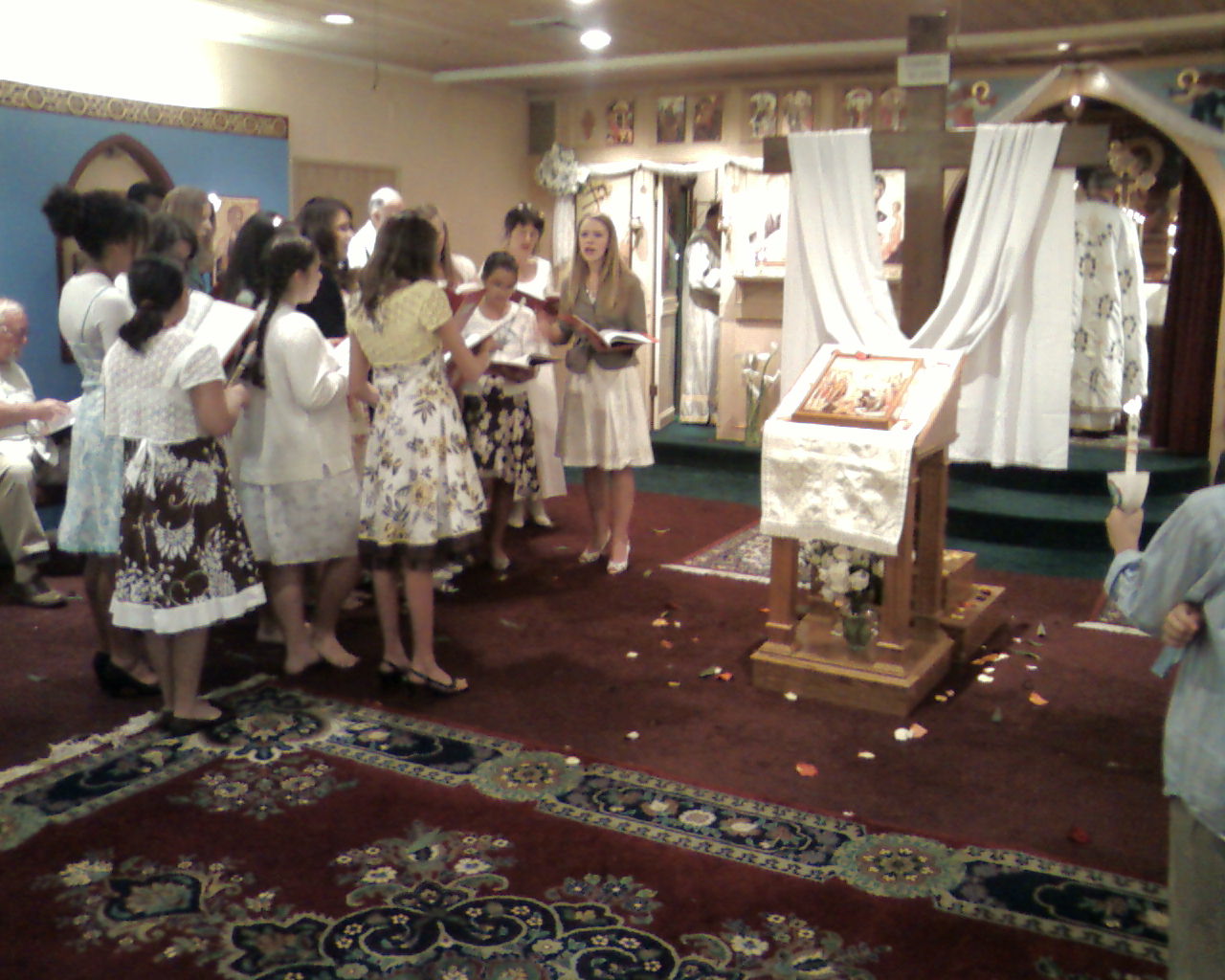
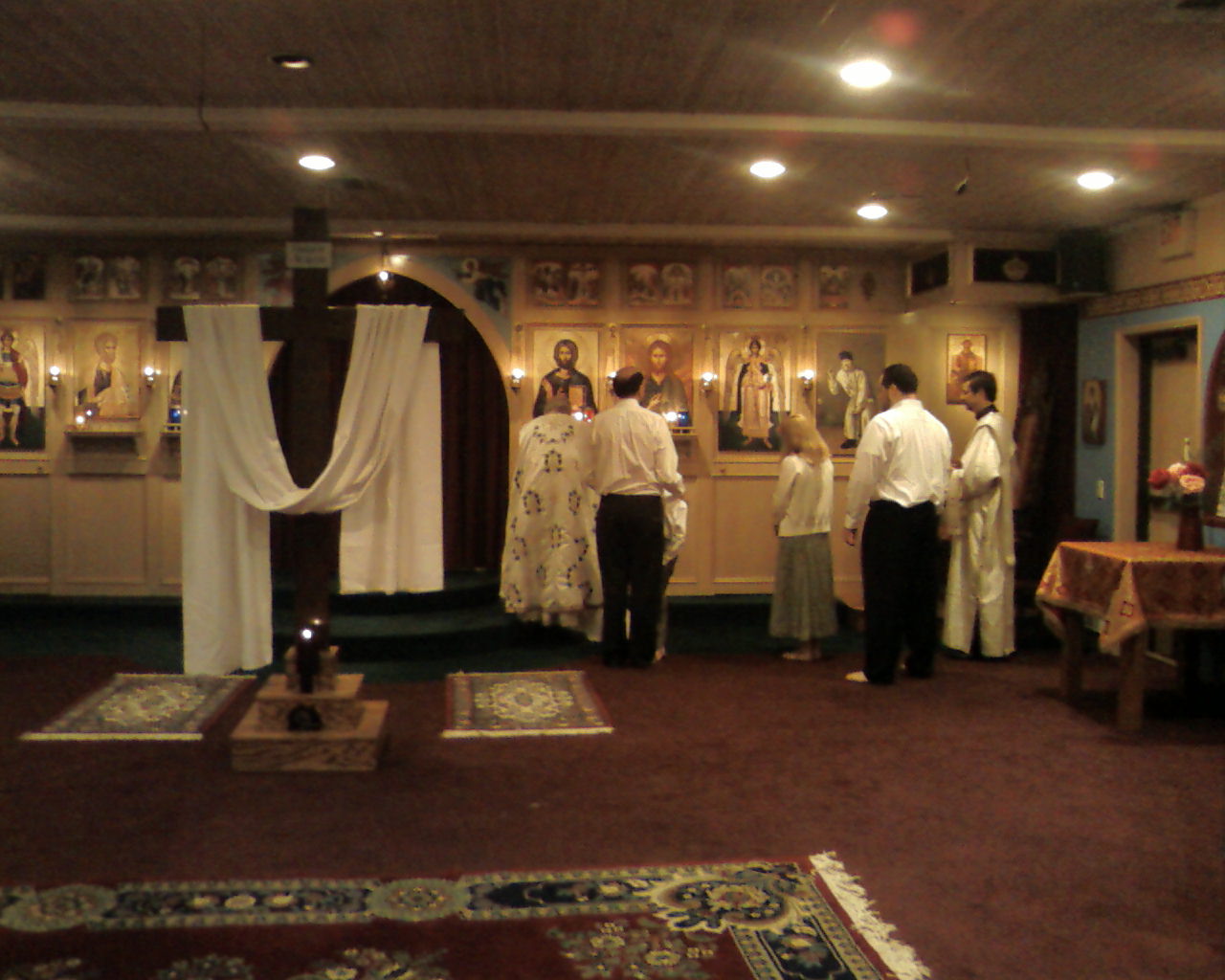
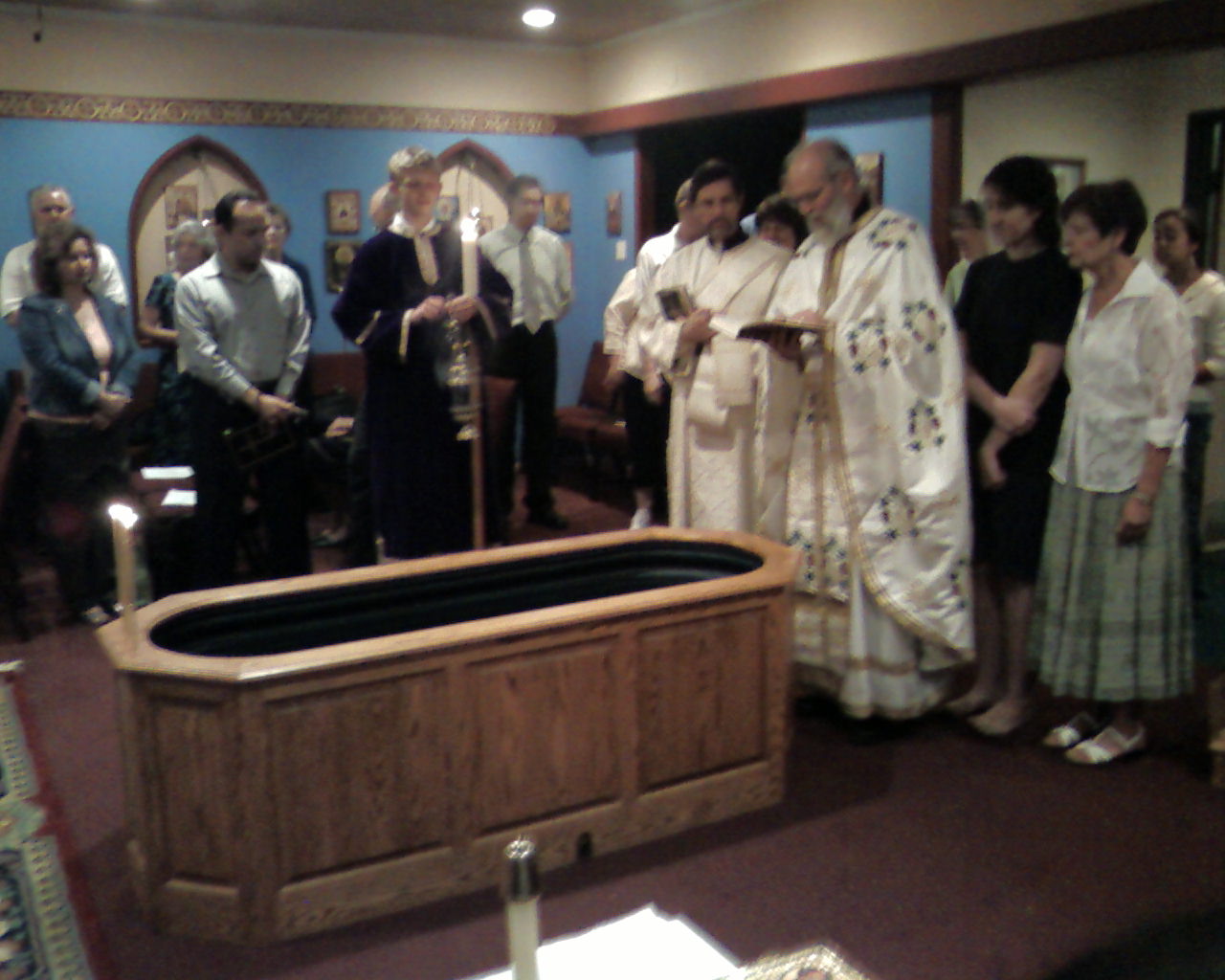
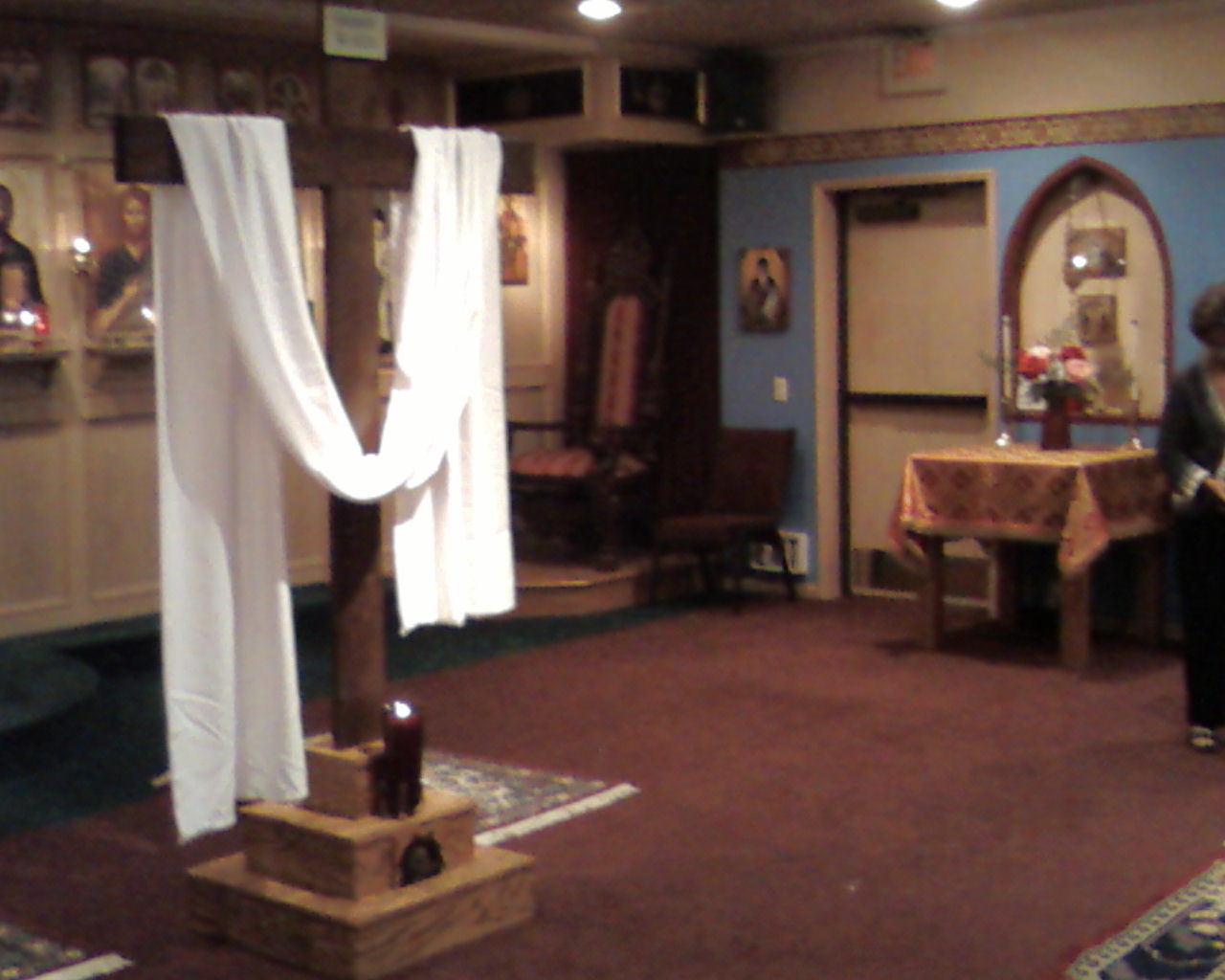
This morning’s service was the Vesperal Liturgy of the Harrowing of Hell. During this service, we watched one of our new friends receive Baptism and several more of our new friends receive Chrismation. I’ve posted a few pictures I took on my cell phone. I apologize for the poor quality.


It was at this service that everything we’ve been experiencing through Lent, and especially Holy Week, finally caught up with me. The services on Thursday night and through Friday were absolutely intense. I have nothing in my personal history as a Protestant to compare with the depth, richness and beauty of these past few days. We have read so much Scripture, sang so many hymns, said so many prayers, and bowed and crossed ourselves so many times that we have virtually lived in a continual atmosphere of worship, prayer and Scripture the past few days. In addition, there are the layers upon layers of symbols, details and meaning that everything holds in the Orthodox Church. Everything is done for a reason, often many reasons, that ties every gesture, word and act back into the Gospel and the life of God.

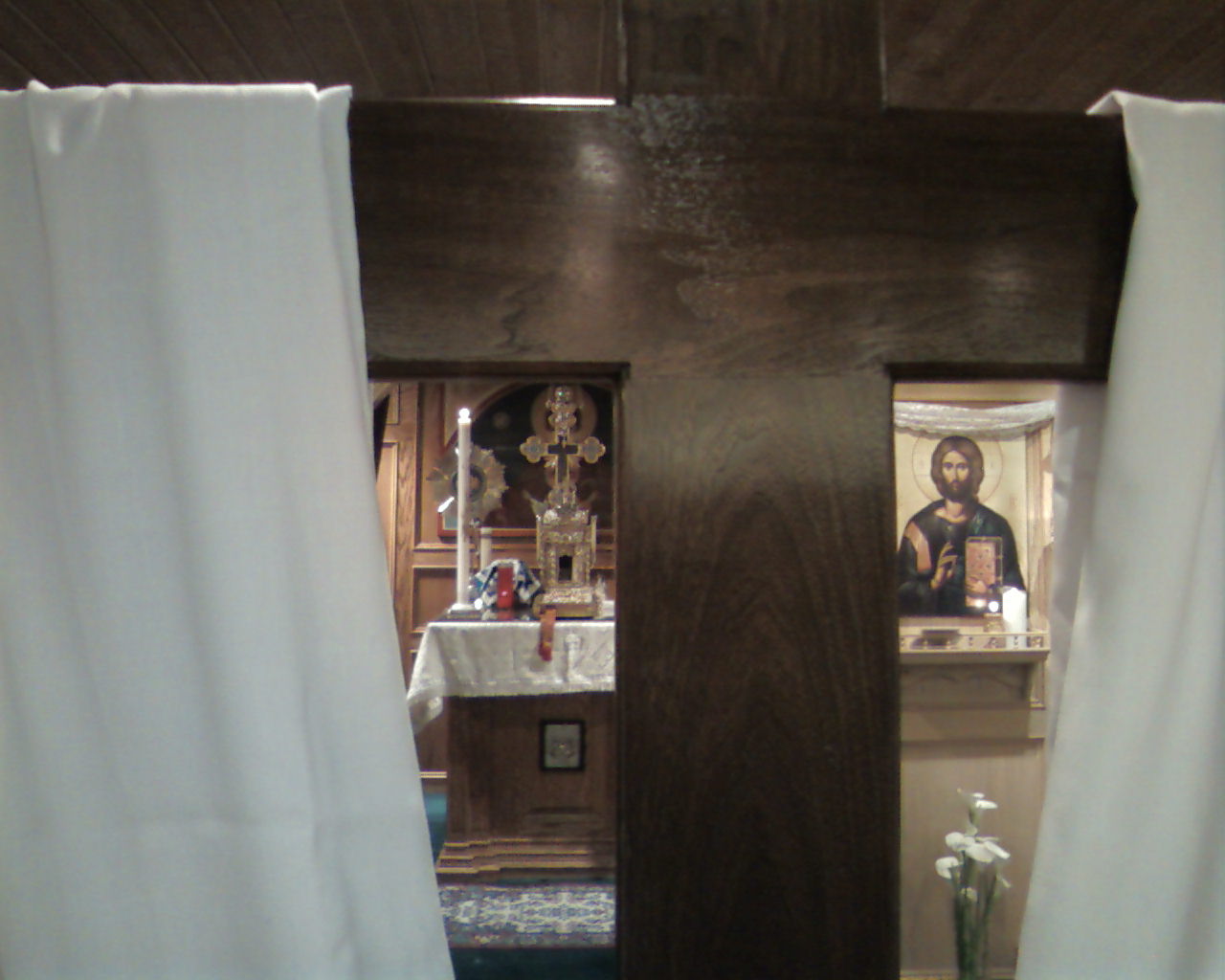
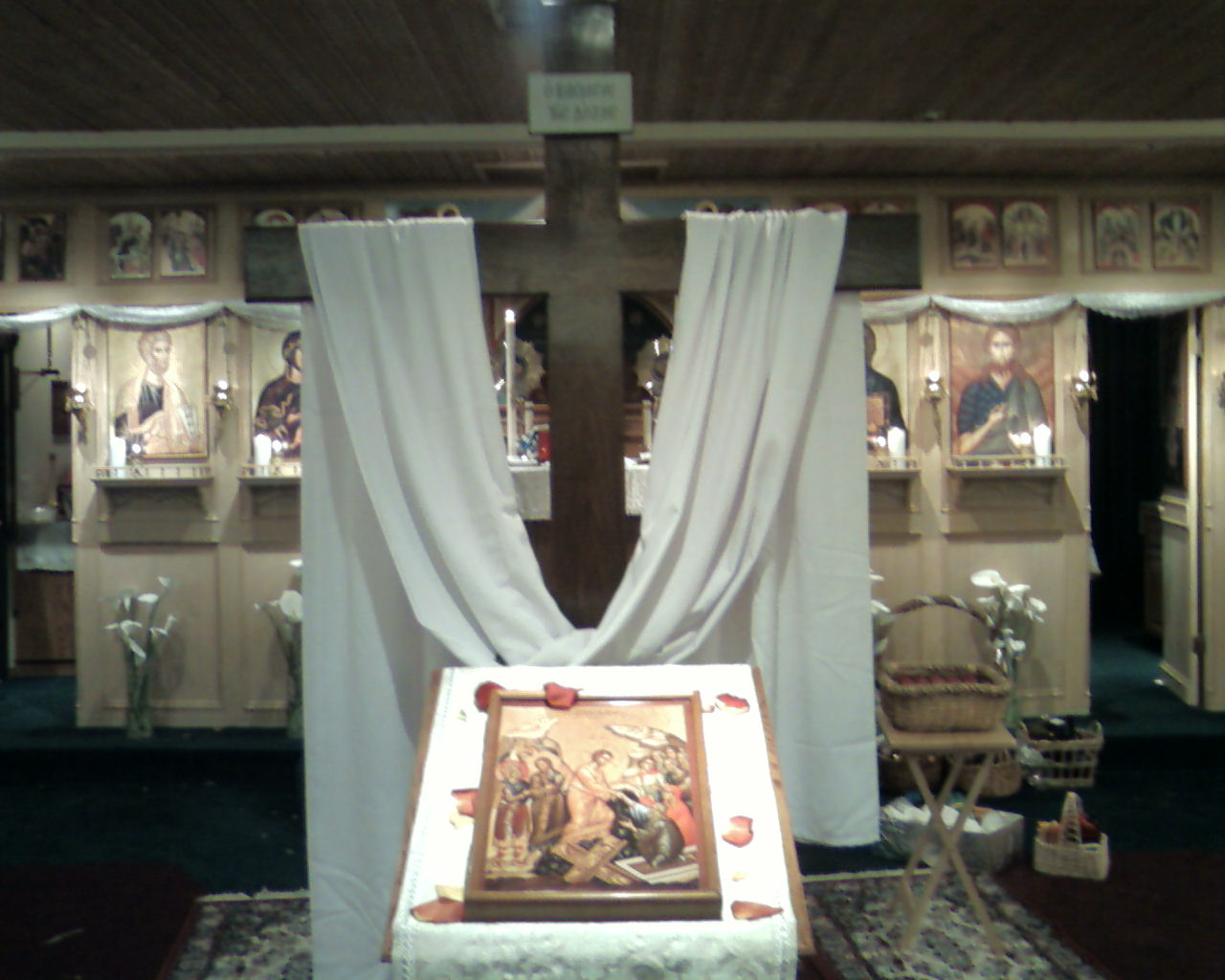
So this morning, as service began, I happened to be standing near the large cross that had been placed in the center of sanctuary. I stood looking at the cross, simply bathing in all that has come before and in preparation for what was to come. As I gazed at the cross, my eyes lowered to the small image at the foot of the cross. It is a small image of a skull and bones, symbolizing death. And like a massive wave, the magnitude of Jesus’ life, crucifixion and resurrection washed over me. He has defeated death through death! Death is vanquished. He didn’t just forgive my sins. He completely and absolutely destroyed death and its power!

During one of the previous services, the entire congregation participated in a procession with candles outside the Church. As we re-entered the sanctuary, everyone walked through the sanctuary doors under the icon of Christ’s burial. This symbolized both our participating in Christ’s death and the fact that as we go through that death with him, we then enter his life, which is in his Church.

So my friends’ Baptism, Chrismations and first Communion as new members of Christ’s Holy Church pulsed with such meaning this morning.

As the service was drawing to an end, our priest was gifting each new member with a cross that is to be worn at all times. As he put the chain around the neck of one of my friends and hugged him, I heard him whisper, “Welcome home.”

At those words, tears welled in my eyes and I felt such an ache in my heart. I have been searching, for what I now know as “home,” for as long as I can remember. I was searching for it as a young teenager before I had ever heard of Jesus. I was searching for it after accepting Jesus into my life over twenty years ago. I have searched for it as God has lead me on my journey into Calvary Chapel, the Baptist Church, Youth with a Mission, the OMS Holiness Church, the Vineyard and the Emerging Church. And each step has brought me a little bit closer.

I yearn to hear those words, “Welcome home,” whispered into my ear one day. I long to find the place where the yearnings of my heart to be like Jesus are truly and fully met. Debbie and I hope to find a non-consumerist church community, where all of us — men, women, and children — train to follow Jesus together into his world. Will that be the Orthodox Church? A huge part of me hopes so. And if the last four months are any indication, it looks like it will be so. I feel everything has been preparing me to embrace such a spiritually and theologically deep, rich and full-life form of Christianity. Perhaps I have found home.

 Subscribe through Feedburner

Great & Holy Friday

This morning we participated in the Service of Royal Hours. The following is a hymn we sang as we knelt before Jesus on the cross:


“Today he who hung the earth upon the waters is hung upon the tree.

Today he who hung the earth upon the waters is hung upon the tree.

Today he who hung the earth upon the waters is hung upon the tree.


“The King of the Angels is decked with a crown of thorns.

He who wraps the heavens with clouds is wrapped in the purple of mockery.

He who freed Adam in the Jordan is slapped on the face.

The Bridegroom of the Church is affixed to the cross with nails.

The son of the Virgin is pierced by a spear.


“We worship Thy passion, O Christ.

We worship Thy passion, O Christ.

We worship Thy passion, O Christ.

“Show us also Thy glorious resurrection!”


 Subscribe through Feedburner

Keeping Vigil Is Our Mission

On the first three evenings of Holy Week, we participate in the Bridegroom Matins. These services echo the parable of the ten virgins in Matthew 25:1-13. The celebrations of this past weekend — Lazarus Saturday and Palm Sunday — were foretastes of the joy that awaits us at Pascha. They were bright and joyful celebrations. But through Holy Week, we once again enter a somber time. The constant theme through this week flows right from Jesus’ mouth in Matthew 25:13, “Keep watch.” The Christ the Bridegroom is coming, so keep vigil.

Keeping a vigil can often be viewed as a passive activity. Yet, it is anything but passive. It is attentive repentance and watchfulness. It is actively preparing a place for Christ the Bridegroom in the internal bridal chamber of our hearts.

One of the things that has drawn me to Eastern Orthodoxy is their balanced understanding of “missional,” although they probably would never use that word. In my opinion, many of the discussions I’ve read regarding “missional” lean too far on what I would call “missional activity” rather than on what I would call “missional being.” As valid as most of this missional activity is, Jesus calls his followers to something much deeper than that. He calls them to keep vigil. 

In John 20:21, Jesus says, “As the Father has sent me, I am sending you.” Jesus fulfilled his part in the Father’s mission on earth. But the mission continues until Christ’s return. So Jesus passes the missional baton very carefully. We participate in our part of God’s mission just like Jesus participated in his — by being the embodied fullness, life and presence of God on earth. That means we must be formed into Christ’s likeness so that, like Christ, we too can be God’s fullness, life and presence on earth. In other words, missional activity must flow from missional being. We must be Christ’s likeness so that we may cooperate with Christ in God’s mission.

So mission is first and foremost formation into Christ’s likeness. While journeying into the formation into Christ’s likeness, the Orthodox Church emphasizes something even deeper than formation — repentance. Repentance is the very core of living in God’s kingdom. We see this in Jesus’ proclamation in Mark 1:14-15:

“After John was put in prison, Jesus went into Galilee, proclaiming the good news of God. ‘The time has come,” he said. “The kingdom of God is near. Repent and believe the good news!'”

These words are more than instruction about how to enter God’s kingdom. They reveal how one breathes and lives moment-by-moment in God’s kingdom. Repent and believe. Repent and believe. Repent and believe.

So to pull all the loose strings of this post together, keeping vigil — actively preparing our internal bridal chamber for Christ the Bridegroom through training into repentance and therefore being formed into Christ’s likeness — is mission. Keeping vigil is our mission. A life of continual “repent and believe” forms us into Christ’s likeness so we may truly be sent as he was sent. This is how we are saved and in turn become saving.

 Subscribe through Feedburner

And We’re Off!

Wow! What a great weekend. Holy Week has finally arrived for the Eastern Orthodox Church. Friday night was the Little Compline with the Canon of St Lazarus. Then on Saturday morning, we gathered for Lazarus Saturday. When Fr Patrick began this special Divine Liturgy with “Blessed is the Kingdom of Father and of the Son and of the Holy Spirit both now and ever and unto ages of ages,” I felt this powerful rush of excitement and anticipation. Lent has been escalating to this moment. And with Lazarus Saturday, Lent ends and Holy Week begins. A hymn that we sang during the service and throughout the weekend services brings it altogether so well:

“By raising Lazarus from the dead before Your passion,
You did confirm the universal Resurrection, O Christ God!
Like the children with the palms of victory,
We cry out to You, O Vanquisher of death;
Hosanna in the Highest!
Blessed is He that comes in the Name of the Lord!”

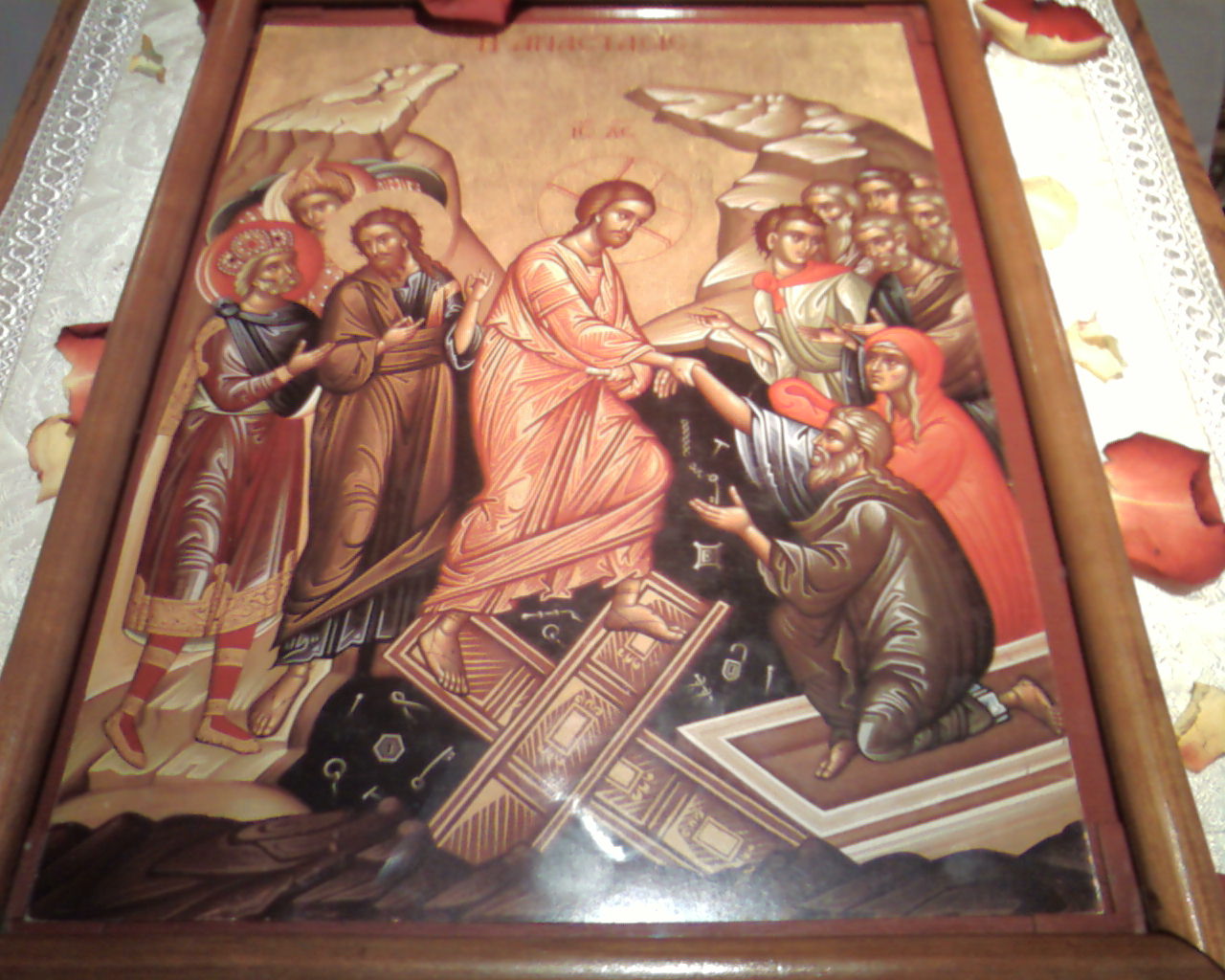
On Saturday night we returned to church for the Great Vespers for Palm Sunday. At the end of the service, we venerated a striking icon of Jesus calling Lazarus from the tomb. Then Fr Patrick anointed our foreheads, palms and the back of our hands with oil.

This morning was Palm Sunday. A special feature of today’s service was a procession with palm branches out of the church and down the sidewalk. What a sight! And such incredible joy! Also the Lenten fast was lifted slightly, allowing fish, wine and oil. (During Lent, Eastern Orthodox fast from meat, dairy, wine and oil.) Coffee hour was crowded and bustling. In addition to some normal Lenten food, those who prepared coffee hour also brought some delicious salmon and several bottles of wine. It tasted so good! The anticipation of the coming week was palpable. We sat around talking and laughing and our family was one of the last ones to leave. Our family is making great friends at St Peters.

Our plan was to go home afterwards and get chores done, but my parents called. Yesterday I told my mom about our family’s decision to explore Orthodoxy during 2008. I wasn’t sure how she and my dad were going to react. My mom called wanting to get together today to talk. Debbie and I shared with my parents about the fullness of Christ’s life that we’ve been experiencing in the church. Both were positive and my mom admitted to a deep yearning for something more in her relationship with Jesus. After our talk, we went shopping for the girls’ Pascha dresses.

Then we bolted down the 210 Freeway to meet Mark, Barb and Maribeth for an enjoyable dinner of good food, talking and laughing. God has blessed our family with such great friends. And right now, my life feels so deep and rich. I feel like I’m drinking deeply from a well of crisp water.

The rest of this week will be very, very busy. There are two services (morning & evening) every day until Holy and Great Friday. Debbie and the kids are hoping to make it to some of the morning services before the kids start school.

By next weekend, we’ll be going full steam ahead. Three services on Holy and Great Friday followed by an all-night vigil of reading Psalms at Jesus’ tomb, all accompanied by a strict fast. On Holy and Great Saturday morning, we’ll experience the Paschal Vesperal Liturgy of the Harrowing of Hell. (What a great name for a worship service!) During this service, we’ll witness some of our new friends receiving the sacraments of baptism and chrismation as they join the Orthodox Church. Then we go home, sleep, cook and return at 10:30 that night for a candlelight Rush Service followed by Paschal Matins and Divine Liturgy. Then around 2 am, we break our Lenten fast together with a grand feast! Then we go home and sleep some more and finally gather for an afternoon Agape Service where one of the Gospel accounts is read in as many languages as possible, followed by a party in the park.

I’ve been a Christian for over 20 years. But this year will prove to be one of the fullest, most meaningful, most joyous Easters we will have ever experienced. Glory to God!

Oh… and by the way, this is my 500th post since I started blogging in 2003. Yeaa!

 Subscribe through Feedburner

An Interesting Convergence

Today, I experienced an interesting moment of convergence. Last night we spent time in our home group discussing the nature of sin. We had talked about how the Western Christian concept of sin as breaking a Law and thereby punishable by death was an incorrect perspective. Rather, the biblical idea of sin is that it is our failure to be truly human as God intended — to live in communion with God and then to be his image to the rest of creation. Sin is our failure to do this and the resulting death we experience is within the very fabric of our being, thus breaking and corrupting everything we touch.

Last night’s conversation was fresh in my mind this afternoon as I listened to a recent podcast by Frederica Mathewes-Green while driving home from work on the 605 Freeway. The title of the podcast was Sin As Pollution.” In the podcast, Frederica was describing the effects of sin by reading part of a monologue by Garrison Keillor of Prairie Home Companion fame.

The monologue was in the form of a letter written by Jim, a man who was waiting on his front yard to be picked up by a woman from work with whom he was going to attend a conference and with whom he was tempted to begin an affair.

As Jim is waiting to be picked up by this woman, he waxes reflective about the repercussion of his potential affair. As he looks down the street at his neighbors’ homes, Jim realizes that his infidelity will pollute many lives. He states, “Although I thought my sins would be secret, they would be no more secret than an earthquake.” His reflections climax with this powerful and moving image, “When my wife and I scream in senseless anger, blocks away, a little girl we do not know, spills a bowl of gravy all over a white tablecloth.”

And as I listened to Frederica read this line, on the other side of the freeway, a white Ford Expedition streaked by being pursued by a train of police cars with lights flashing and sirens screaming. I saw sin’s pollution firsthand. There were hundreds of drivers this afternoon on the southbound 605. And the driver, trying to escape the police and probably the consequences of his sin, was polluting everyone around him in potentially harmful and dangerous ways. I hoped and prayed that this high-speed pursuit would end safely and peacefully; hoping and praying that the driver’s sins would not intersect and destroy someone else’s life on that freeway.

Next week, we observe Holy Week for the Eastern Orthodox Church. The last several weeks have been a communal journey to the cross that has been filled with stories, Scriptures, songs, fasting and prayers with a common theme — “Lord, have mercy.”

May the Lord have mercy on my sins, on our sins, on the world’s sins. May he trample death through death. May he bring the life of God that we so desperately need. And may he fully fashion us into the image of God, as embodied in his own life, so that we will be ultimately free from sin.

 Listen to Frederica’s podcast, “Sin As Pollution.”

 Subscribe through Feedburner

Fr Stephen & “Is Hell Real?”

Fr Stephen has a great post today about the “reality” of hell. Throughout much of my Evangelical life, I had simply embraced the assumption that heaven and hell were places. It wasn’t until I began my theological deconstruction and reconstruction several years ago that I began to realize that neither were places at all. Heaven is something much more. In fact, one of the many beautiful things that has drawn me to Orthodoxy is their understanding of heaven and hell. Here’s a quote from Fr Stephen’s post:

“But in Orthodox spiritual terms I would say that hell is a massive state of delusion, maybe the ultimate state of delusion. It is delusional in the sense that (in Orthodox understanding) the “fire” of hell is not a material fire, but itself nothing other than the fire of the Living God (Hebrews 12:29). For those who love God, His fire is light and life, purification and all good things. For those who hate God, His fire is torment, though it be love.”

The very fire of God — his light, love and purification — is heaven or hell. for those who love God, his light and love are heaven! But for those who hate God (and this is the amazing thing), his very love and light are hell!

Some thoughts from one of Fr Stephen’s subsequent comments from the same post are also worth noting:

“I don’t think of them [heaven and hell] in terms of places but in terms of our relationship with God. We use place metaphors for that’s what we know, but the reality of heaven certainly transcends anything we currently think of as place. I do not mean to describe them as merely figurative either.

“But neither can they be somehow compared as having a comparable existence. It might seem like something for a philosophy class, but it is also something for a theology class, at least as we know theology in the Orthodox Church.

“Literalism is the bane of Scriptural understanding. Not that there aren’t plenty of “literal” things described. But many times we have to push beyond the literal to arrive at the truth. At least this is the case in many of the Eastern Church fathers.”

Heaven is not a destination that I hope to get to when I die, nor is hell a destination I want to avoid. Rather, heaven is ultimately my participation in God, who is the fullness of being, life and reality. 

Take a few moments and read Fr Stephen’s post in entirety HERE:

 Subscribe through Feedburner


“You Can Never Worship God Too Much”

That’s what Chris, my eight year old son, said today. I was talking to the kids about our family’s experience of Eastern Orthodoxy during the last four months.

Wow! He’s so right. Exploring Eastern Orthodoxy has opened up our experience of corporate worship more than we could imagine. We’ve moved from an experience of corporate worship being 30 minutes of singing followed by a sermon to services (often a couple hours long) filled with incense, icons, candles, an altar, bowing, crossing ourselves, ancient prayers and hymns, vestments and the Eucharist. Worship is now such a full experience.

And it’s all about and for God! You really can’t worship God too much.

 Subscribe through Feedburner

The Saints are Truly Human

Now that the migration of my blog from TypePad to WordPress is complete, I’m beginning to think through the content for a new series that will be called something like “Evangelical to Emerging Church to Eastern Orthodoxy.” I’m hoping to share in this series how a typical Evangelical pastor like myself could leave the local church, write an article called “Detoxing from church” (notice the small “c”), become affiliated with the Emerging Church and, within about five years, find himself on the threshold of the Eastern Orthodox Church. In many ways, this series will be the sequel to “Detoxing from church” that I’ve been promising myself to write for the last couple of years called “Rehabbing to Church” (notice the capital “C”). I’m hoping to share how my search for a church that is missional, incarnational, communal, liturgical, sacramental and historical find its fullest, although not perfect, expression in Eastern Orthodoxy. I’m also hoping to share the issues that I’ve found difficult to embrace during this journey as well.

But in the meantime, I’d like to leave you with something our priest said tonight at Vespers. This past week, during the Great Confession of Repentance , we heard the amazing and moving story of Mary of Egypt. While Easter has come and gone for Western Christianity, Easter for Eastern Orthodoxy isn’t until April 27. So Fr Patrick encouraged us to look to the saints as we experience our frailty and even despair during the last couple of weeks of Lent. While sharing this, Fr Patrick said, “The saints are truly human. It is we who are subhuman.”

This is an absolutely encouraging reminder! Jesus is the model of true humanity. He shows us what Adam and Eve and all of their descendants were to become as the image of God. Jesus then conquered death through death, bringing about our salvation. As 2 Peter 1:3-4 says:

“His divine power has given us everything we need for life and godliness through our knowledge of him who called us by his own glory and goodness. Through these he has given us his very great and precious promises, so that through them you may participate in the divine nature and escape the corruption in the world caused by evil desires.”

This is our salvation. Jesus has made available participation in the divine nature (theosis ) for everyone. The saints are those who have followed Christ in theosis to the transformation of their being into the fullness and likeness of Christ as the true human being. And this great cloud of witnesses surrounds us as heaven and earth meet and encourage us forward into our own transformation into Christ’s fullness and likeness.

 Subscribe through Feedburner

A Nice Day Off

Debbie and the kids have been off the last week for spring break. So I decided to take today off and take the family on a day trip. We went to Crystal Cove State Park and had a wonderful day. The weather was beautiful and the entire day was very relaxing and nice. Aaaahhhh…

You can check out some of the photos we took by clicking on the Flikr widget in the sidebar.

 Subscribe through Feedburner

Welcome!!

Welcome.jpg

I want to welcome you to my new blog. I’ve imported it from my old Typepad blog called, “First Take the Blog out of Your Own Eye.” I hope you enjoy your visit here.

 Subscribe through Feedburner

Fr Stephen and “Salvation by Grace”

Fr Stephen has a wonderful post about the Orthodox perspective of salvation as transformation rather than a forensic salvation. One of the points he makes is that because salvation is transformation, it takes a lifetime and requires constancy. As Fr Stephen puts it, at its core, a life of transformation requires “just showing up.”It’s a great post and you can read it HERE .It’s this kind of stuff that attracted me to Orthodoxy in the first place.

 Subscribe through Feedburner

The Fullness of the Church

I want to broach a subject that I know is fraught with controversy. And I know it’s a subject that I am very inadequate to discuss. However, a comment in a recent post got me thinking about an area of Eastern Orthodoxy that was initially a major hang-up for me. It’s the idea that the Orthodox Church is the true Church. Anyone exploring Orthodoxy will bump up against this concept very quickly.

At this point, I don’t have much to offer to any theological debate about this topic other than my limited experience thus far in the Orthodox Church.

I had voiced my discomfort with Orthodoxy’s ecclesiological claims several months ago to an Orthodox friend while we were discussing my interest in exploring Orthodoxy. He advised me to view Orthodoxy’s ecclesiological claim as being the “fullness of the Church” rather than being “true Church,” a phrase that I kept hearing as “the only and only real Church.”

As I have been exploring Eastern Orthodoxy the last couple of months, I’ve discovered something. So far in my experience, Eastern Orthodoxy lacks nothing good, beautiful and true that I had known previously in my experience as a Protestant Charismatic Evangelical Christian and pastor. In fact, I believe Eastern Orthodoxy possesses a fuller version of all that I had previously experienced, plus abundantly more goodness, beauty and truth.

In other words, not only do I find a parallel commitment to biblical study and praxis, mission, sound theology, life in the Spirit, community and worship, but all of that is enhanced with deep historical connectedness, real communion of the saints, art, music, liturgy, prayers, icons, ascetic practices, spiritual direction, spiritual formation, sacramental life, and much more.

And the few aspects of Protestant Charismatic Evangelicalism that I miss are either stylistic preferences, areas of personal comfort or peripheral issues.

This makes the alternative of my past experience pale in comparison. For example, as a member of the Vineyard denomination, my church history only goes back about 30 years. As a Protestant, it goes back about 500 years. Even with my best intentions to be a missional community, I couldn’t dismiss the fact that when our house church gathered, we were completely disconnected historically. We were a small group that had splintered off of a larger splinter, which had come from a larger splinter, which came from a larger splinter. But in Orthodoxy, I am deeply connected to the wisdom, teaching, example and communion of the entire Church all the way back to its beginning.

Another example is my experience in worship. As a member of the Vineyard, corporate worship was practically experienced as 30 minutes of singing followed by a 45-60 minute sermon. Even our attempts at constructing a more liturgical worship in our house church ended up being disjointed and disconnected from anything historical. In Orthodoxy, I engage in full-sensory, liturgical worship that has been practiced for twenty centuries and rooted in the full life of the Church.

Is the Orthodox Church the “true” Church? All I can say is at this point in our journey east, the Orthodox Church certainly seems to be the fullest expression of the Church.

If you’re interested in exploring this a bit more, Father Stephen has a good podcast about this subject. You can listen to the podcast HERE.

 Subscribe through Feedburner

Good Introductory Resources to Orthodox Christianity

If anyone reading this blog is interested in reading some introductory essays to Eastern Orthodoxy, click HERE to go to a resource page of the Antiochian Orthodox Christian Archdiocese.

 Subscribe through Feedburner

A Much-Needed Update

I can’t believe it has been over a month since I posted something here. Things have been going well on all fronts for our family. And one of the reasons why I haven’t made the time to post anything is that I’ve been spending all of my spare time enjoying my family. I can’t think of anything else I’d rather do than spend time with Debbie and the kids. So for those who are interested, this post is an attempt to bring you up to speed.

Our family had a wonderful Christmas vacation. Prior to the break, Debbie was working double hours at her job and I was working my new full-time job at the school district and putting in part-time hours at Asian Access. It was nice to have ten full days off to spend with the family.

January started off being much more manageable. Debbie is now working her normal hours and I only have the school district job. But the wedding season is quickly approaching and I’ll be spending several Saturdays beginning in March filming weddings. But I don’t feel as burned out as I did last year and I’m approaching this season with a much better attitude.

 A couple of weeks ago, our family got to spend time with Debbie’s childhood friend, Deanna, and her husband Alan. Deanna and Alan were in California for a conference and we got to spend an afternoon with them. We went out to Newport beach and explored the tidal pools.

 Michael is doing pretty well as a sophmore in high school. He started a science fiction class this term and is enjoying it. For good or bad, he seems to have inherited my geek gene. But unlike me, he makes being a geek look good.

 Cathy is in 8th grade. She’s in a dancing group at school. They had their first competition a couple of weeks ago and her group finished 1st place in their division! I can’t believe she’s going to be in high school next year.

Danielle is in 5th grade. Her school just held a talent show last night. It was such a blast watching her and her friends having a great time dancing. I can’t believe she’s going to be in middle school next year.

 Chris is in 3rd grade. Last week, he was invited to his first birthday party without his siblings. And the day before, he decided to stay after school without his siblings to help in the book faire. Being the fourth child, Chris is very social and does just about everything with his brother and sisters. So these two moments seem to be marking a shift in his growth. Next year, he will be in his elementary school without his sister.

Debbie is doing well in her job. She does so well with children and is a caring and mature presence in otherwise very immature and broken families. I’m glad God has provided her this job to be Jesus’ presence to these babies and their teenage moms.

And I’m absolutely loving my new job as a computer tech for the school district. I enjoy the people I work with and I enjoy the challenge and satisfaction that the job brings. The other day I was setting up computers in a computer lab at one of the elementary schools. While I was there, one of the teachers brought her class for a walk-through. It was so cool hearing these kids “ooh” and “aah” and see their looks of anticipation, knowing they would get to work on these computers next week. Knowing that I help provide support for the teachers and their students in their educational environment is a wonderful thing.

Our family has been attending Saint Peter the Apostle Antiochian Orthodox Church . Our “journey east” so far has been a mixture of wonder and challenge. I absolutely love the worship. The entire experience engages all of one’s senses. I love the icons, the incense, the altar, the vestments, the music, the prayers, everything. I didn’t realize how much I was longing for a deeper and richer kind of Christianity, especially for something that was non-American. This is basically the way the Church worshipped the first several centuries of its existence, a historical connectedness that is very important to me.

But I must also say that the foreignness of Eastern Orthodoxy has eclipsed much of our experience thus far. Every time we visit, it feels like we’ve moved to a different country and culture. There is so much we don’t understand and, quite frankly, can’t understand from a western Christian perspective. I’m glad we’ve decided to take at least one year to explore Orthodoxy. It would be too easy to make a premature decision in the midst of our immediate confusion and discomfort.

We also like Fr Patrick and the people at St Peter’s. Although it is a small parish, there are several families with children our age and a few “newbies” that are just a few months ahead of us. Debbie and I have also begun attending their weekly parish study. Our goal at this early stage in our exploration is to try and view things from their eastern perspective and forgo judging everything from our western perspective. And when I’m absolutely honest with myself, any points of disagreement or challenge that I have found with Orthodoxy really flow from my own issues. Bottom-line, I don’t want to die to myself.

While our Orthodox experience is strange for us right now, I agree with something Deb has said — Eastern Orthodoxy seems to be the only form of Christianity that will help us raise our kids spiritually the way we’ve been wanting to raise them. That’s because Eastern Orthodoxy is not a Christian faith based on ideas of God or emotions of inspiration as we’ve been accustomed to in the west. Nor is it merely a set of doctrines or beliefs. Rather, Eastern Orthodoxy is a full-life, community-based experience of communion with Christ through worship, sacraments and spiritual disciplines that holds spiritual formation (or what Orthodox call theosis) at its heart. And as part of that experience, Eastern Orthodox theology of the Incarnation, the Trinity, the Atonement, the Gospel, salvation, the sacramental life, Tradition and many other core doctrines are absolutely spot on. So onward and upward we go.

 Subscribe through Feedburner

Still Thinking about Scripture

Since posting on the Orthodox view of Scripture, I have found myself thinking a lot about the subject. Also, thanks to those who commented on that post. The comments have posed some questions for me that I’m hoping to resolve over time.To move forward in this process of resolution, I will be posting responses and thoughts to a book my friend, David, gave me to read. It’s called, The Mystery of Christ, by Fr. John Behr. Fr. John teaches courses in patristics, dogmatics and scriptural exegesis at St. Vladimir’s Orthodox Theological Seminary.I began reading the book casually, but I’ve decided to start over and use Fr. John’s book as the material for some blog posts over the next few weeks. His book challenges us to approach theology as the early disciples did — by viewing Scripture retrospectively with Christ’s passion as the primary hermeneutic. He writes in the preface:

“But it is a stubborn fact, or at least is presented this way in the Gospels of Matthew, Mark, and Luke, that the one born of Mary was not known by the disciples to be the Son of God until after the Passion, his crucifixion and resurrection… Thus, to speak of the ‘Incarnation,’ to say that the one born of the Virgin is the Son of God, is an interpretation made only in the light of the Passion.”

I have enjoyed and have been challenged by what I have read so far in Fr. John’s book, so I’m looking forward to blogging my responses and thoughts to it over time. If you would like to read a synopsis of the book, there is a three-part review at Oozerdoxie (a collection of Orthodox bloggers who also post at theooze.com ):PART ONEPART TWOPART THREE

 Subscribe through Feedburner

Orthodox View of Scripture

I was reading a new blog post by Fr. Stephen that is challenging the way I view Scripture. If you’re really interested, you can read the whole post HERE . But let me give you a quote:

The Scriptures, as used in the Orthodox Church, are decidedly the Church’s Scriptures, and cannot be rightly read apart from the liturgical and ascetic life of the Church.“Literalism is a false means of interpretation (hermenuetic) and is a vain attempt to democratize the Holy writings. If they can be read on a literal level, then everyone has equal access to them and everybody has equal authority to interpret them. Thus certain forms of Protestantism, caught up in the various modern theories of the Reformation, sought to do to the Scriptures what many sought to do with their governments. Kill the princes! Kill the priests! Everyone can be his own king, his own priest. Smash the images and any claim to authority. Of course these extreme forms always failed quickly, to be replaced by some version of moderation.“Thus the Scriptures are not purely democratic – some interpreters are more equal than others.”

Fr. Stephen’s post causes a “Yeah!… Hey, wait a minute!” reaction in me. One of the things I have struggled with as a Protestant is how anyone with a Bible can interpret it and make it say whatever they want it to say. I’ve lost count of how many small group discussions I have attended where I have inwardly cringed when someone said, “Well, what this means to me is…”And a similar dynamic occurs at the academic level, where attempts to discover the author’s original intent based on critical study can be incredibly diverse and even contradictory.The legacy of Sola Scriptura in western Protestantism is tragic. Anyone can believe Scripture says what they want it to say and then find someone to validate that belief. I mean, just watch any National Geographic or History Channel special around Easter or Christmas. All it takes are a few talking heads with letters behind their names to concoct some ridiculous theory to explain the biblical stories. Or skim the titles at any Christian books store and you’ll find Scripture being used to support basically any topic.So, I find myself agreeing with Fr. Stephen’s idea, “Thus the Scriptures are not purely democratic – some interpreters are more equal than others.”But I also find myself reacting to his ideas. As one who has spent my entire adult life learning to interpret and teach Scripture, the idea that “The Scriptures, as used in the Orthodox Church, are decidedly the Church’s Scriptures, and cannot be rightly read apart from the liturgical and ascetic life of the Church” is a very foreign, and quite frankly, frightening concept to me. Or, his statement later in his post, “The authority to speak about Christ is given to those whom He has chosen and ordained” really stirred up some reaction in me.Now I’ve learned that when I react strongly to something, the first questions I need to ask are “Why am I reacting so strongly to this? What is this exposing in me?” In this case, the answer is very obvious: Pride. I don’t like to be told what to believe. I like the fact that I have learned the skills to interpret Scripture and wrestle with Scripture to yield interpretations different than the popular versions of Christianity.Now it’s not all pride. Part of it is a response to having been taught false ideas by well-meaning Bible teachers in the past. Part of it is having been trained in seminary to approach theology with a critical and even a skeptical eye. But a good part of it is pride — my interpretations are the result of my hard work, my study and my skill.So I know I need to do several things: First, I know Fr. Stephen’s post rings true. Scripture must be read, studied and lived in the liturgical and ascetic life of the Church. So probably the most important action our family must take is finding a parish in which to immerse our lives and to begin experiencing Scripture.Second, I need to seek some counsel about whether it is possible to merge both a liturgical life in Scripture with a “critical” study of Scripture. Or to come to grips with the fact that they may be diametrically opposed to each other.Third, I need to bring my exposed pride before my Lord so that he may save me from it. I need to deal with the possibility that not everybody, including myself, has the equal authority to interpret Scripture and that I may need to yield to those whom God has ordained to teach me. This scares me more than I want to admit. And once again, I find myself praying, “Lord, have mercy.”

 Subscribe through Feedburner

Intro to Icons

 One of the things I want to understand better as we explore Orthodoxy are icons. Although I’ve read a little bit about icons, I know virtually nothing about them. And yet I sense that they will provide my family with a depth of spirituality that we’ve been lacking in our evangelical lives.I came across an article by Susan Cushman, via Father Stephen , that in my opinion, offers a wonderful introduction to icons and their spiritual beauty. The article is called, “Icons Will Save the World,” and not only contains some ideas worth exploring and thinking about, but also links to some books that seem promising.In her article, Susan Cushman quotes Henri Nouwen, who explains why he chose to meditate on icons rather than on the artistic masterpieces of Michelangelo or Rembrandt. He writes:

“I have chosen icons because they are created for the sole purpose of offering access, through the gates of the visible, to the mystery of the invisible. Icons are painted to lead us into the inner room of prayer and bring us close to the heart of God.” 

Personally, when I look at icons, I sense that they are doors, but doors that presently remain closed to me. But like doors that promise to open into rooms filled with light, warmth and unknown wonder, I look forward to the day when they will swing open and snatch my breath away with what lies behind them. And beyond that, to learn to see humans and the entire creation as icons of God.But some may ask, “Why are icons so important?” Simply put, icons are expressions of the Incarnation. The invisible and boundless God became visible and embodied. This is a powerful declaration. In Genesis, God spoke over his newly formed creation, “It is good.” Yet through Christ’s Incarnation, he declared even more loudly over a broken creation, “It is still good!” The Incarnation climaxed God’s mission that began in Genesis 1 and which Paul summarizes in Ephesians 1:9-10:

“With all wisdom and insight he has made known to us the mystery of his will, according to his good pleasure that he set forth in Christ, as a plan for the fullness of time, to gather up all things in him, things in heaven and things on earth.” 

Heaven and earth are still meant to be fused and merged together. Human beings are this reality as we become the temple of God, his presence on earth. But it doesn’t stop with human beings. All things on heaven and earth are to be reconciled together and gathered up in Christ. And icons are one way in which this occurs. Icons of Christ, his Mother and the Saints somehow merge heaven and earth together. And as we enter into communion with God through them, we can be envisioned and energized for a life pleasing and worthy of Christ. As Susan Cushman states in her article:

“The icons are visions of what we can become if we allow God to penetrate every aspect of our lives. Those who attain this God-likeness to the fullest extent recognized by the Church are saints. Their lives, their stories, lift us up to be all that we can be — as we are transformed by God’s grace and love.” 

I have much to learn in Orthodoxy. But I excitedly anticipate a liturgical life, a sacramental life, a iconographic life — and ultimately through them, an Incarnational life.And even though icons are presently a mystery to me, I resonate and long to experience the last sentence of Cushman’s article:

“No wonder the Church celebrates those wise bishops of the Seventh Ecumenical Council who proclaimed iconography to be an ordinance and tradition that is not something extra, something added to the life of the Church, but as Chryssavgis says, a necessary expression of the reality of both God and the world.” 

 Subscribe through Feedburner

Good Orthodox Resources

I am truly a beginner to Eastern Orthodoxy, which quite frankly is very humbling. While I conceptually grasp some of the doctrines, Orthodoxy is much more than just a theological shift. In Orthodoxy, if I understand it correctly, the Church’s theology, worship and life all go together. So I probably won’t really get an adequate feel for Orthodoxy until my family and I join a parish.But since that won’t happen for about another month at least, I continue to learn through reading and listening. So I wanted to share an Orthodox resource that I have found helpful. It’s the blog and podcast by Father Stephen. You can read his blog HERE and you can listen to his podcast HERE. Also, if you click THIS LINK, it will subscribe you to his podcast via iTunes.Also, click HERE to hear a great conversation with Dr. Eve Tibbs from Fuller Seminary about the differences between the Christian East and West.Enjoy!

 Subscribe through Feedburner

Our Gingerbread House

Last night at group, we changed things up a bit for Christmas. Barbara bought a Gingerbread house kit for our kids to assemble. It was a fun time, especially since I see my kids so little right now as I work two jobs. It was a nice experience in gourmet architecture

Thanks, Barb, for the house. Thanks, Mark, for taking the photos. And thanks, Kerri, for encouraging the kids’ creativity through the process.


 Subscribe through Feedburner

My Courageous Wife


 My friend, Steve, made a comment in my last post about how courageous Debbie is. I want to say how grateful I am for my wife. Being married to me, she has been on one wild ride. I know each pastoral/spiritual move we have made has been challenging. I also know the changes in my theology have been challenging. And now our decision to explore Eastern Orthodoxy will probably pose even more and greater challenges. But through it all, Debbie has expressed her love, respect and trust as we attempt to find what is truly best for our family. I am such a blessed man to have her for my wife. She’s my best friend and her strength constantly astounds me.


There’s a chorus from a Sister Hazel song that expresses my feelings:
“I wanna tell everybody everybodythat you’re so much more than they’ve ever even seen beforeAnd I wanna tell everybody everybodyIf they touched your hand then they’d never want to let you go.”
I love you, Deb!

 Subscribe through Feedburner

Life Change #2

I’d like to share another change our family is experiencing. Debbie and I haven’t shared it with too many people, partly because we are in the very beginning stages and partly because of the potential misunderstanding our new journey may create. But it’s an important part of our lives right now and will become increasingly significant after we move into 2008.


Debbie and I are exploring the reality of our family joining Eastern Orthodoxy. Our journey together has brought us through Protestant evangelicalism longing for something deeper, richer and more significant.


But I’m jumping ahead of myself.


Several years ago, as a professional pastor, I experienced severe burnout. I emerged from that experience questioning both my practices as a pastor and a Christian. I was doing everything I had counseled others to do in order to be strong and mature Christians — church attendance, small group attendance, tithing, participation in ministry, evangelism, prayer, practicing spiritual gifts, regular Bible study, daily quiet times, worship, etc. And yet, while doing all of these activities, inwardly I was angry, stressed, jealous, competitive, greedy, lustful, afraid, insecure, and manipulative. Even though I loved God and truly desired to follow him, everything I was practicing was having virtually no effect upon my inward life.


My burnout became the catalyst for my journey into spiritual formation. I soon discovered the practices of spiritual disciplines and community that were beginning to reshape and renew my inward life.


But this journey quickly led me to realize that even deeper than my false practices lay my false theology and worldview from which those practices were nurtured and strengthened. And this theology and worldview was deeply ingrained within the entire structure of popular Protestant evangelicalism. It’s popular music, books, teaching, radio programs, and even local church infrastructures perpetuated theology, practices and ultimately a life that claimed to be biblical, but was far removed from anything Jesus and his early followers envisioned.


In my search for a theology that would sustain a life of spiritual formation, found myself drawn to theologians and church leaders such as N.T. Wright, Alexander Schmemman, Bishop Kallistos Ware, Father Thomas Hopko and others. Soon I found myself mentally embracing a fuller theology and faith that was significantly different from my Protestant roots. It seems that every facet of my theology underwent tectonic shifts. And all of this while pastoring a Protestant church.


The last four and half years away from professional ministry, while difficult in regards to understanding my calling as a pastor, have been wonderfully liberating in my personal exploration in theology and practice. The emerging church has provided an extended conversation that fueled my theological shifts. I love the faith-community in which God has placed my family. I love the new avenues of influence God has opened through my blog, writing and work at Asian Access. I have loved walking with two Fuller Theological Seminary students as they worked on their field education projects.


Yet, in all of this, there has been something missing. And it was especially noticeable when our family attended a local church on Sunday mornings. Debbie and I decided a couple of years ago to attend a local Vineyard Church that was pastored by my friend. This would allow our kids to participate in a youth program and allow Debbie and me to join in larger corporate worship, both missing within our small home church.


I discovered that the more I was away from professional pastoring, the more difficult it was to attend a local church. Don’t misunderstand me. My friend is an excellent pastor. He is perhaps one of the healthiest pastors I have ever met. I wish he had been in my professional life earlier on as a mentor. I probably would have avoided a lot of pitfalls.


Despite his excellent pastoring, I would leave Sunday morning worship meetings miserable and depressed. It is very difficult to explain what I was experiencing. At first, I thought Sunday mornings simply reminded me of everything I had lost when I left my last pastorate. But it was something else.


The worship, sermons, and fellowship at the local church were superb at one level. But everything was… how do I put it?… unreal. I kept seeing a structure with programs and budgets and people all perpetuating something that wasn’t real. It wasn’t real to Jesus’ vision. It wasn’t real to the Bible. It wasn’t real to the early church and to those who lived, labored and died for the doctrines and practices we now take for granted. It wasn’t real to any authentic spirituality. And it wasn’t real to life. It was like entering some weird fantasyland reality that didn’t make sense anymore.


Again, please don’t misunderstand me. It wasn’t a problem with my friend’s church. In fact, of all of the evangelical churches I have visited lately, his was the most comfortable and healthiest.


As I met with my pastor-friend for coffee over the last year or so, he would tell me repeatedly that because of who I have become theologically, it would be very difficult for me to find a church that I would fit. The truth of his statement hit me one day as I was emailing Mark. I suddenly realized that I embrace and believe more core Eastern Orthodox theology than I do Protestant evangelical theology. And although I disagree with some Eastern Orthodox theology, they are more peripheral areas. On the other hand, I disagree with most core Protestant theology. (I’ll need to unpack that in a future post.)


I was leaving Sunday worship meetings depressed because I was so out of sync with everything there — the music, the teaching, the subculture, the worldview — that it was a constant reminder of how much I don’t fit anymore.


Lately, I’ve been listening to a lot of Eastern Orthodox podcasts from Ancient Faith Radio. As I listen to their discussions of faith, practice, theology and sacramental worldview, I’m discovering that I’ve believed this stuff a looooooong time already. In fact, I told Mark that I think theologically, I’ve been Orthodox for quite a while and it’s just taking time for the rest of me to catch up.


So our family is beginning a slow and cautious journey into Eastern Orthodoxy. We have visited a friend’s church for Vespers several times. It is so foreign and strange. After spending my entire adult life both academically and professionally pursuing ministry in a Protestant context, it is weird being a “beginner” all over again. But there is such promise in Eastern Orthodoxy for both me and my family. The thought of being part of a faith-community whose entire reason for being is to become like Jesus and to live and practice toward that goal together within a rich and deeply historical system excites me.


But I’m very anxious as well. In many ways, I feel there is no where to go from here if Orthodoxy isn’t for us. I cannot go back into evangelicalism. And because Roman Catholicism is inherently a western worldview like Protestantism, moving there seems to be only a lateral move.


So as our family explores Eastern Orthodoxy, I will be posting our experiences and reflections.

 Subscribe through Feedburner

Life Change #1

This is probably the longest I’ve let my blog go silent. But life has been crazy. And as I mentioned in a previous post, our family has been experiencing some significant changes.


So let me try and share what’s been happening. As mentioned before, one huge change has been in my career. After leaving professional ministry over four years ago, Debbie and I have been praying that God would reveal his will to us. For the first few years after leaving, I really wrestled with my perceived calling into ministry. Those years were filled with a sense of failure, doubt and quite a bit of depression. Fortunately, through a friend, God placed me in a wonderful work environment at Asian Access. I discovered a Christian organization where, believe it or not, everyone actually acted like Christians. The last three and a half years there were so essential to the healing I needed.


During that time, I applied for the senior pastor role at a couple of churches. And although I was the primary candidate at both, God spoke and told me very clearly that the timing wasn’t right. It seemed more and more evident that I would not be re-entering professional ministry anytime soon. Fortunately, Asian Access allowed me to stretch beyond my job description to contribute in a variety of pastoral ways. They allowed me to write, teach, lead worship, and screen applicants. Also during that time, I was able to contribute a chapter to two books, The Relevant Church and Out of the Ooze . And I had the incredible privilege of supervising two students from Fuller Theological Seminary in their field education projects.


Over the last year, I’ve become increasingly comfortable with the idea of not re-entering professional ministry. I know I’ve been called to pastor. But that doesn’t necessarily mean to do it as a career.


About two months ago, an opportunity arose to begin working as a computer technician for a local school district. Because of the circumstances that brought this opportunity to us, Debbie and I knew almost immediately that this was from God. So at the beginning of November, I began working for the school district as a consultant, waiting for them to post the job as a permanent position. In mid-November, they posted the job. Last Friday, I interviewed for the position and was later offered the position.


This kind of brings my professional career almost full-circle. Many people don’t know this, but I graduated from high school with an intended career path in computer science. In fact, I attended U.C. Irvine for one year with the goal of graduating with a degree in Information and Computer Science. After that year, God got a serious hold of my life and I spent the last 22 years of my adult life preparing for and enjoying professional ministry.
 

But I really sense that that part of my life is over, at least for now. I have absolutely no desire to go back into professional ministry. In fact, a month ago, I did something I couldn’t do for the last four years. I sold virtually all of my pastoral books! All of my commentaries, church growth books, ministry books, sermon books and even Emerging church books. I only kept a couple of commentaries, a few books on spiritual formation, all of my N.T. Wright books, and all of my Eastern Orthodoxy books. I sold about sixteen huge boxes of books!


The decision to sell my books was a huge one. Those books were the last connection to my identity as a professional pastor, the last emotional string to my heart. And you know what? It feels really good. Pastoring is completely about relationships now, not about mission statements, programming, or all the other stuff that has become associated with the modern church. And, I feel finally delivered from the crazy evangelical sub-culture that you find in most churches — the music, the language, the mixed up worldview, the distorted theology. (I know this may be somewhat difficult to hear for some who read this and I apologize. I’m not trying to offend. But being away from that sub-culture for a few years has made me realize how out of sync it is.)


So now I’m a computer technician, kind of like the Geek Squad for a school district. I work on a team with some great people in a district office with great people. Our team supports over 10 schools. We also support both the Windows (98, ME, 2000 & XP) and Macintosh (OS 8, 9 and X) platforms. Working there the last month has been very cool and I look forward to a long-term work relationship with the district.


Hopefully next time, I will talk about some spiritual changes our family is beginning to experience. (Although anyone who has read my last several posts will probably guess what those changes are.)

 Subscribe through Feedburner

Working Out My Salvation

In Philippians 2:12-13, Paul exhorts the Philippian Christians to keep on working out their salvation with fear in trembling. By doing so, they will joyfully discover that through their efforts, God is working in them for his good purpose.

Then in Philippians 2:15, Paul promises that a very specific and practical application of working out their salvation will result in them becoming “blameless and pure, children of God without fault in a crooked and depraved generation, in which you shine like stars in the universe.”

Wow! What spiritual activity can transform a human being into such a person? Hours of prayer? Intense fasting? Reading massive quantities of Scripture? Surely it must be something that only the elite percentile of Christians can actually do?

Well… the answer is in verse 14:

“Do everything without complaining and arguing.”

That’s it? Learn to be content and agreeable and I’ll become a faultless and pure child of God? Yup.

But remember that Paul is speaking more of just holding one’s tongue (although that’s probably a good start). He’s talking about becoming a person in which complaining and arguing are like a foreign language because we have become so fluent in God’s faithfulness and love.

In other words, why complain about the driver in front of me, or about my finances, or about my spouse, or about my work situation, or about… well about anything when God’s sovereignty covers all? Simply, I complain because I’m not getting my way.

Also, why argue with my kids, my spouse, my boss, my friends, or with… well with anyone when God’s sovereignty covers all? Simply, I argue because I’m not getting my way.

Do you notice a common theme? Complaining and arguing flow from an inflated self-will. When my position as the center of the universe is threatened because others don’t do things my way, believe what I believe, take my advice, or live as I would live, then I am compelled to complain and argue with them. I mean, come on, you would think people would have learned my will for their lives with all the WWJD paraphernalia around (What would Jason do?).

Now having said all of that, here’s an Eastern Orthodox prayer that I’m beginning to use daily to help me become a person that isn’t inclined to complain and argue by becoming a person re-envisioned with God’s full sovereignty and caring love.

“O Lord, grant me to greet the coming day in peace, help me in all things to rely upon Your holy will. In every hour of the day reveal Your will to me. Bless my dealings with all who surround me. Teach me to treat all that comes to me throughout the day with peace of soul and with firm conviction that Your will governs all. In all my deeds and words, guide my thoughts and feelings. In unforeseen events, let me not forget that all are sent by You. Teach me to act firmly and wisely, without embittering or embarrassing others. Give me strength to bear the fatigue of the coming day with all that it shall bring. Direct my will, teach me to pray. And, You Yourself, pray in me. Amen.”

St. Philaret of Moscow

 Subscribe through Feedburner

Worthy of Enjoying

A phrase in this morning’s prayer caught my attention:“And we will be made worthy of enjoying Your unapproachable light.”In 1John 1:5, the Apostle tells us that “God is light; in him there is no darkness at all.” However, I’ve never thought about the idea of actually “enjoying” God’s light, of joyfully anticipating dwelling eternally in his brilliance and glory. Yet, it’s in God’s light that we truly see and live in reality. Psalm 36:9 states, “In your light we see light.”Yet, the prayer also links another concept with enjoy God’s light. We need to be made worthy of enjoying God’s light. My first reaction was “Huh?” Why do I need to be made worthy of enjoying his brilliance? The fact is, I’m not worthy. My sins, selfishness, evil desires, and delusions prevent me from enjoying his light.My modern context gets in the way of understanding why this is so important. In pre-modern biblical times, light only came from fire. The two were inseparable. So the brighter the light, the hotter the fire. I imagine that when the biblical writers spoke of God’s light, it was intimately linked to the idea of God being an all-consuming fire. In other words, in order to enjoy the brilliance of his light, I also need to be made worthy to enjoy the “heat” of his holiness and glory.God’s fire needs to burn me as a living sacrifice. It needs to burn away everything that stands against his will and dreams. When it’s all slowly burned away by his presence, I’m being made worthy of enjoying his unapproachable light that comes with his fire.

 Subscribe through Feedburner

I’m Beat

I really enjoyed my first day today. The people are real nice, the work is challenging and I can’t wait to learn everything I can.However, I’m tired. I got to Asian Access by 5:15 this morning. Then started work at my new job at 8 am. Then I went back to Asian Access from 6 to 8. Now I’m going to eat dinner, watch Heroes, and drop into bed.And thank you to all of you who are praying for our family during this transition.

Getting Started

Well, I’m sitting in a Panera Bread and ready to start my new job down the street. I’ve been looking forward to this all weekend.

Over the Top!

I love my Macbook Pro, but not this much! For only (cough) $5,999, you can buy a 24k gold-plated 15″ Macbook Pro. And for an additional $3,000, you can have the beloved Apple logo encrusted with diamonds. Unfortunately it doesn’t seem to come in a 17″ model so forget it.

Leaving Asian Access

  I’m in a season of significant changes right now. My hope is to journal about some of them as I process through them.One of the largest changes is that today is my last day as a full-time employee of Asian Access. (The photos were taken during my “good-bye” party yesterday.)A little over 3 1/2 years ago, I applied for the Staff Accountant position at Asian Access. I had been unemployed for nine months, having decided to leave my career of professional ministry. At the time, I was getting desperate. Nine months of unemployment had completely dissolved our savings and was beginning to amass a sizable debt. God had been incredibly present and faithful during that time. But things were tough.My friend Jeff, who works at Asian Access, had told me about a Staff Account position that was open. I was reluctant to apply for a couple of reasons. First, I had just come through a very difficult and painful season at the last church I served at. I was very cynical of Christian organizations and didn’t want to step into another unhealthy situation. And second, after working in full-time professional ministry for 14 years, I wanted to try working in the “secular marketplace.” So I put off applying for a while. Fortunately, Jeff was persistent and circumstances got more difficult, so I applied. And surprisingly, they hired me — an ex-pastor with no professional finance experience or education.God knew what he was doing.Asian Access is the healthiest organization I have ever experienced. It is a Christian organization that really embodies Christ. My co-workers are awesome. Everyone cares for one another. The entire time I’ve worked there, no one has been grumpy, cross, harsh, or just plain jerky. Sure there have been times of stress, but everyone embodies such a Christlike presence.And I needed it more than I knew.I didn’t realize at the time how wounded and hurt I was. I needed a job in which all that was expected of me was my eight hours of work and no more. I could go home and be with my family, friends and life without carrying my job with me.I needed to be part of a healthy Christian organization. There has been so much joy, love, prayer and laughter at Asian Access. As a mission agency, we have staff spread out all over the U.S. and Asia. It is amazing that with such diversity, everyone genuinely likes each other and looks forward to being with each other. It’s the closest I’ve ever seen an organization actually live like a healthy family.I needed new co-workers and friends who would affirm God’s work in me. Over the years, my friends at Asian Access have both affirmed and created opportunities for me to share my pastoral experience and my theological exploration. Even though I worked in the finance department, they made room for me to screen applicants, teach, lead worship and influence through conversations, writing and blogging.I needed Asian Access and my friends whom I worked with daily. Through them God has brought about such deep healing in me. I feel so healthy again. I feel ready to move to the next phase of my journey.A couple of months ago, my friend Jeff took his family and followed Jesus to Japan to be Asian Access missionaries. While we were excited about his new calling, it was a deep blow to all of us in the office. Things haven’t been the same. I remember walking into his empty office the day after he left and being flooded and overwhelmed with immense loss. It was then that I began to perceive that deep changes were coming.Little did I know that the next change would be me.Today is my last day as a full-time employee of Asian Access. On Monday I start a new job, one which potentially could be the new career path that Debbie and I have been praying about since leaving full-time ministry. As you can imagine, I am very excited.But the excitement is mingled with sadness and some fear. I am leaving my friends, people who took a chance on me, trusted me, affirmed me, and loved me and my family back to health. I am leaving the safety of a healthy organization filled with authentic caring Christlike people. But I also know that their prayers and care are with me.Asian Access still needed someone to help do my job while they discern how God will fill my position. I offered to keep working part-time in the evenings and weekends through the end of the year. Our family could use the extra income and Asian Access could use the extra help. So they agreed.But while I’ll still be fulfilling my normal job responsibilities, I will be doing so after-hours and alone. I will no longer be part of the daily conversations, the laughter, the coffee breaks, the prayer times. And right now the prospect of that creates an ache in me that I didn’t anticipate.As I look toward my future, I am very excited. I am looking forward to my new job and my new friends. And I know God is already “over there” waiting for me as much as he is “right here.”There is so much potential in what awaits me. “Excited” can’t even communicate what I’m feeling. My new job is only one of several significant changes taking place. And in all of it, I feel free and liberated and more capable of following Jesus into new territory than I have felt in years. (And that hints at some of the other changes that are taking place in my life as well. But for that, you’ll have to wait.) 😉